Blog
Wild Niche is live in Vermont!
Big news, my friends! After a lifetime of mediocre-to-lousy experiences as an employee I am now the boss of me in a professional capacity! As some of you know this isn’t actually my first time starting my own business, but I intend for it to be the last (non-profits are another story). The first version of Wild Niche was a one-man-ecological-restoration army in western Washington state. That was a great couple of years that afforded me some very satisfying relationships with pieces of land and the people that held them. But, being in my late forties at the time my body was not happy about the cutting, digging and hauling in the summer sun and winter rain. This was after five (actually pretty good) years of feeling too old for this sh*t doing ecological restoration for Seattle contractor, Applied Ecology. I’m glad to have been in the trenches fighting the good fight for Mother Earth all those years, and my service will not stop until my life does. But the Spirit of the Forest has promoted me to the rank of General. What I mean to say is that I will now be directing my considerable knowledge and talents towards consulting, design, and ecological-science communication. If you aren’t new to this newsletter/blog then you are already familiar with my work in that last category. I very much intend on continuing this effort (and getting back to a more regular schedule), but today it’s my new consulting and design service that I am here to promote. Through Wild Niche I will practice ecological forestry and native-plant-focused landscape design for landowners who wish to do effective conservation work on their properties. Whether you want butterflies and native bees in your yard or nesting wood warblers and other migratory birds in your woods it’s the plant life that will bring them there. That plant life is awesome and beautiful in it’s own right, and also often in need of conservation. For these reason I intend for my signature service to be floristic surveys. You can’t take care of what you have if you don’t know what (who) you have. If you want to be the best possible steward of your piece of Earth let me introduce you to the plants that live there.
I’m keeping this post short, but would love it if you also took a peek at my new consulting page here: https://gerald-lisi.squarespace.com/new-page-1?p There will be more there soon, but I think it’s a good start. Thanks to my Chief Marketing Officer, Martha Marin, for the awesome logo. And thank YOU for your time and attention. I would love to read any and all thoughts you have about Wild Niche, in the comments below if you’re reading on my website or in an email reply if you’re reading this in your inbox. If you’re not reading this in your inbox please subscribe by entering your email address at the bottom of this page: https://www.geraldlisi.net/ Please be sure to confirm your subscription by replying to the confirmation email my website sends you. Thanks so much!
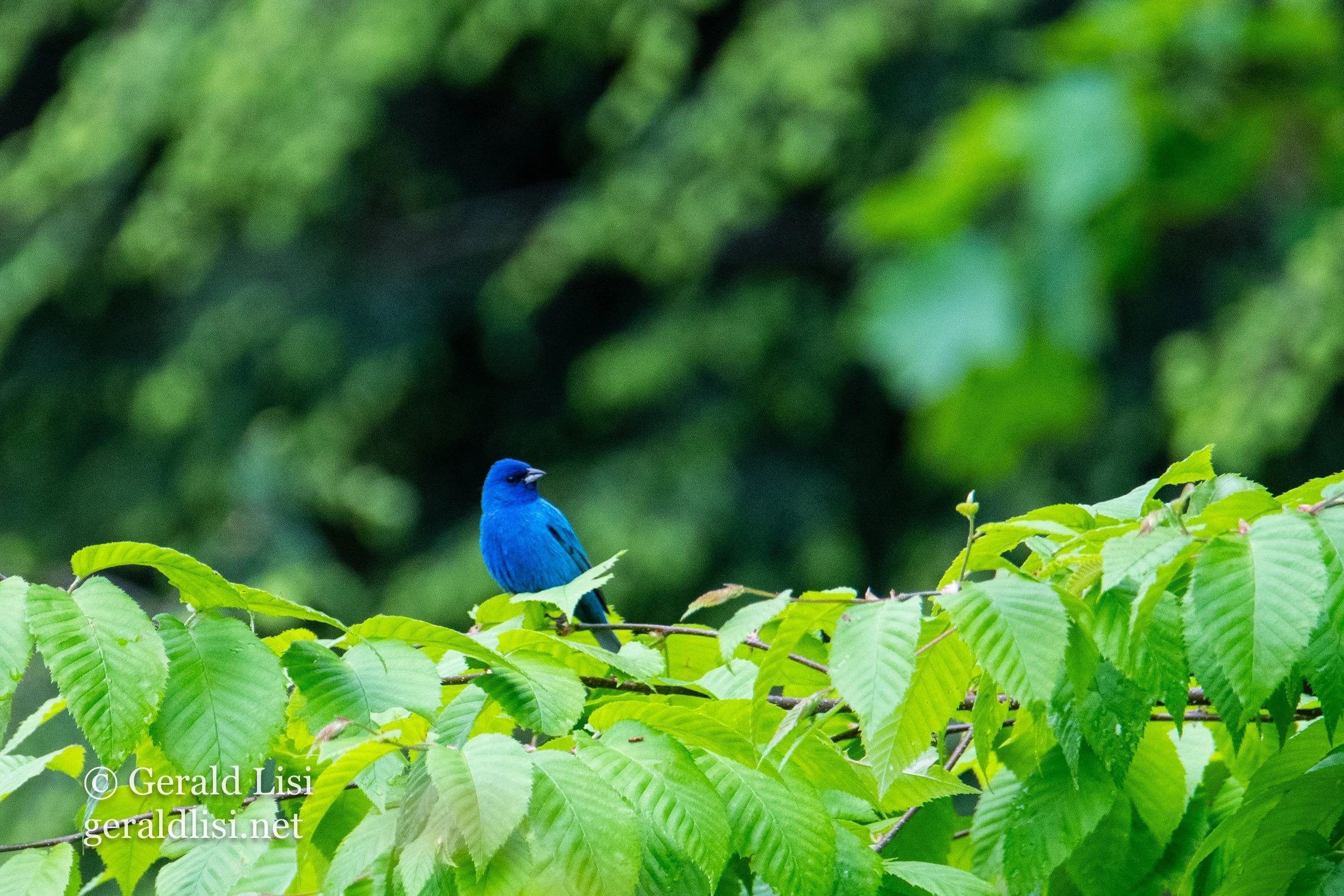
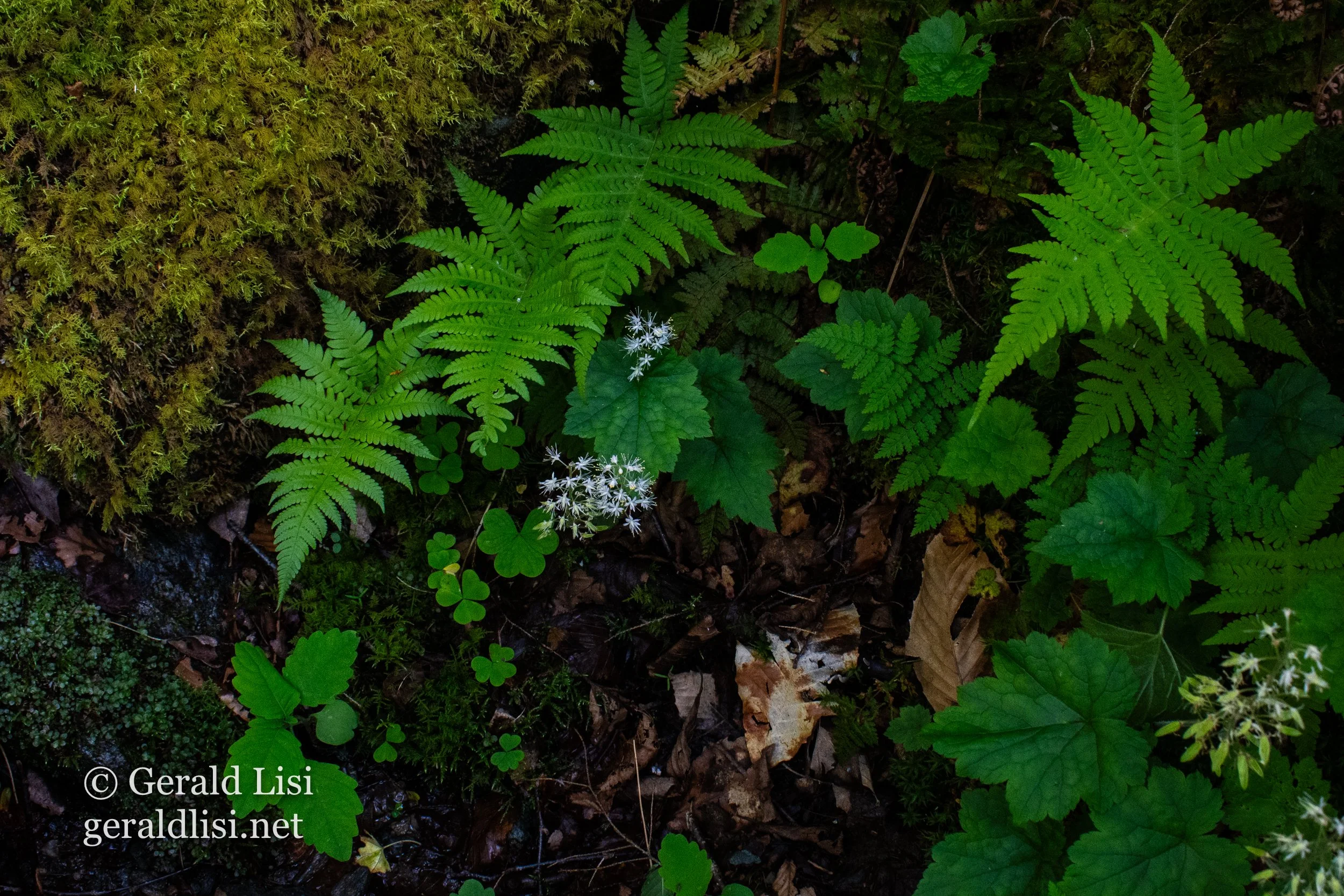
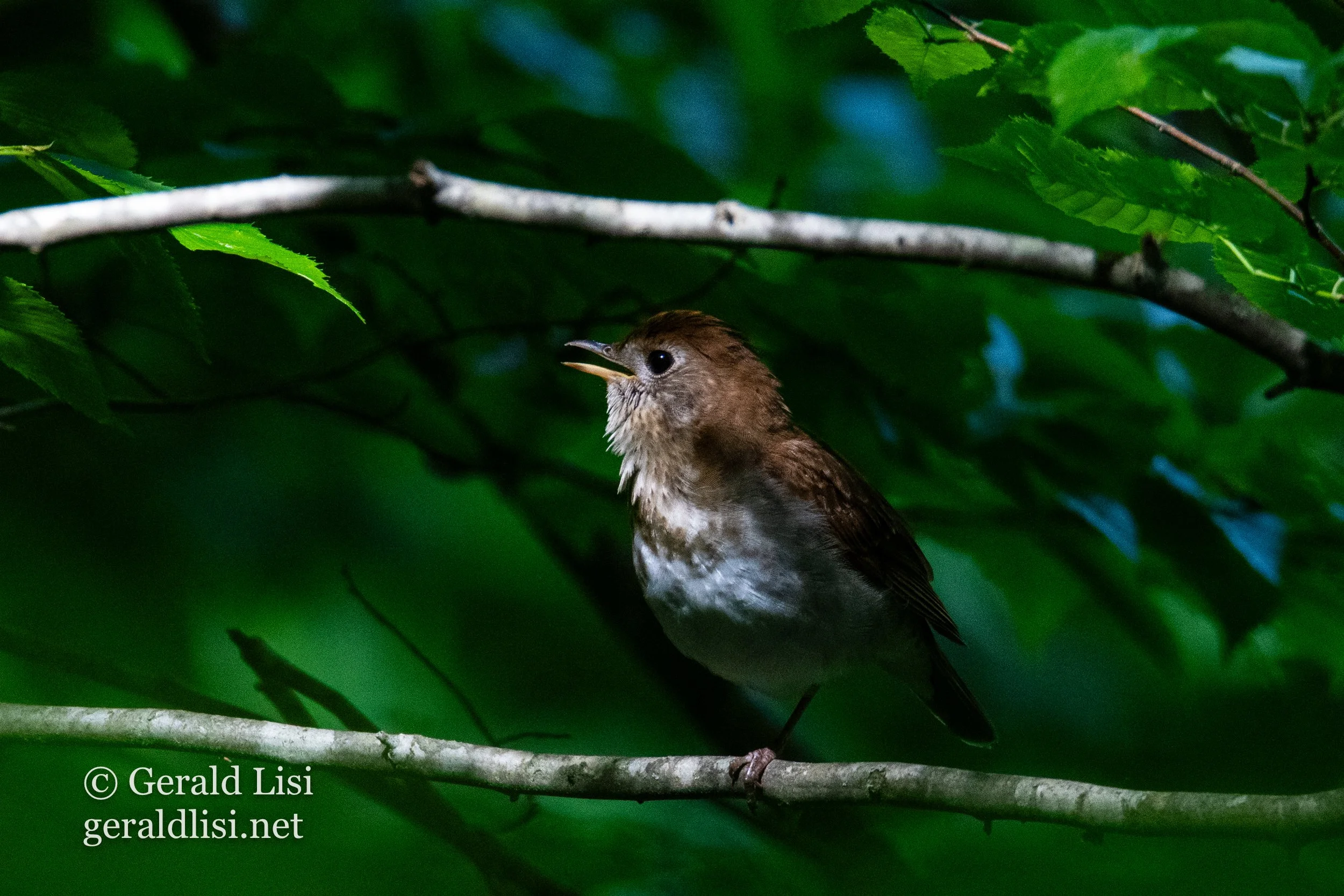
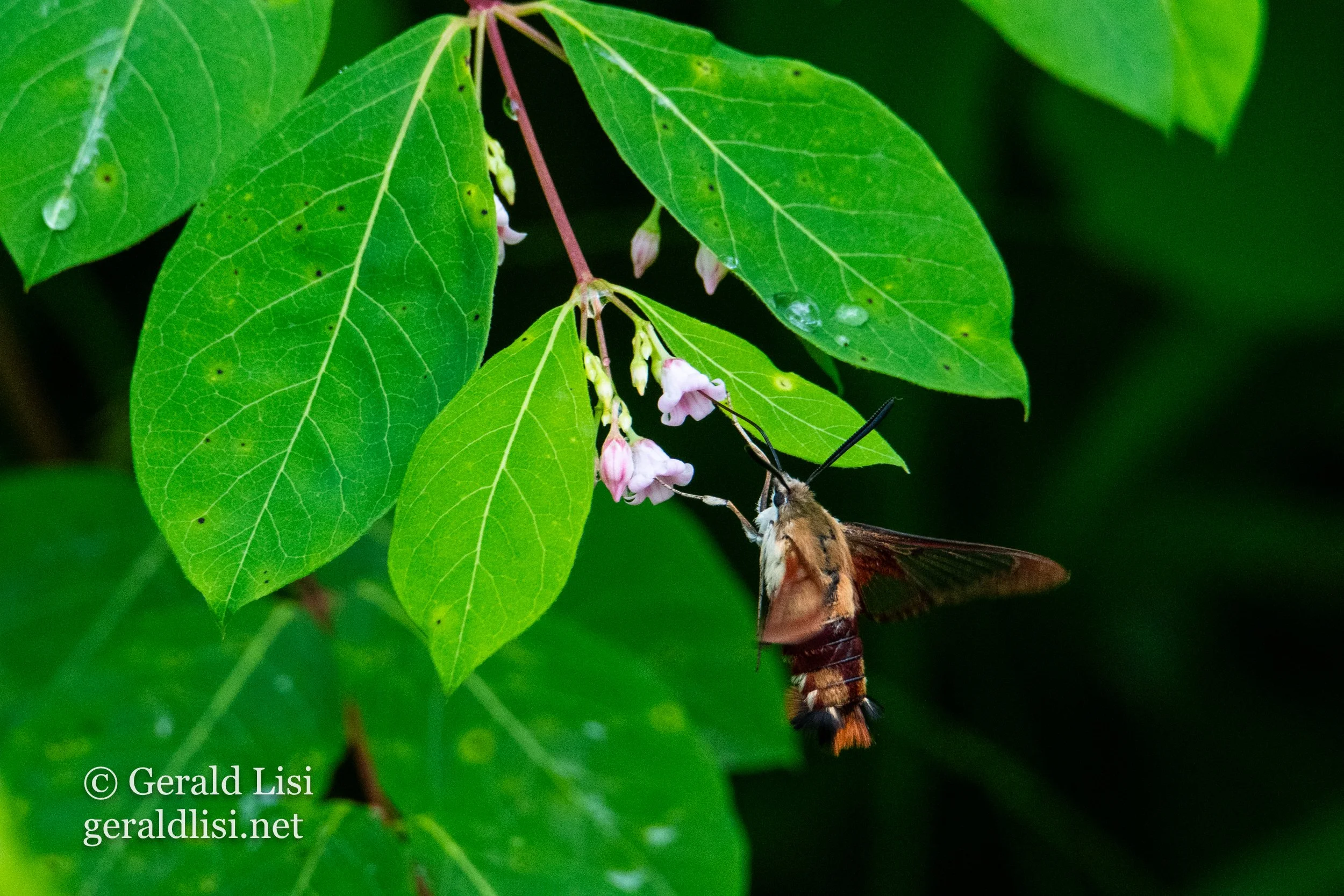
P.S. Below are some photos in keeping with the tradition of this newsletter, and in the spirit of the mission of Wild Niche! Speaking of which my last post, ‘Bird Party at the Pagoda (Dogwood)’, was highly relevant to this. If you missed it please take a look here: https://gerald-lisi.squarespace.com/blog/2025/11/2/bird-party-at-the-pagoda-dogwood?p
Bluejay in White Ash
Monarch Butterfly feeding on Goldenrod nectar
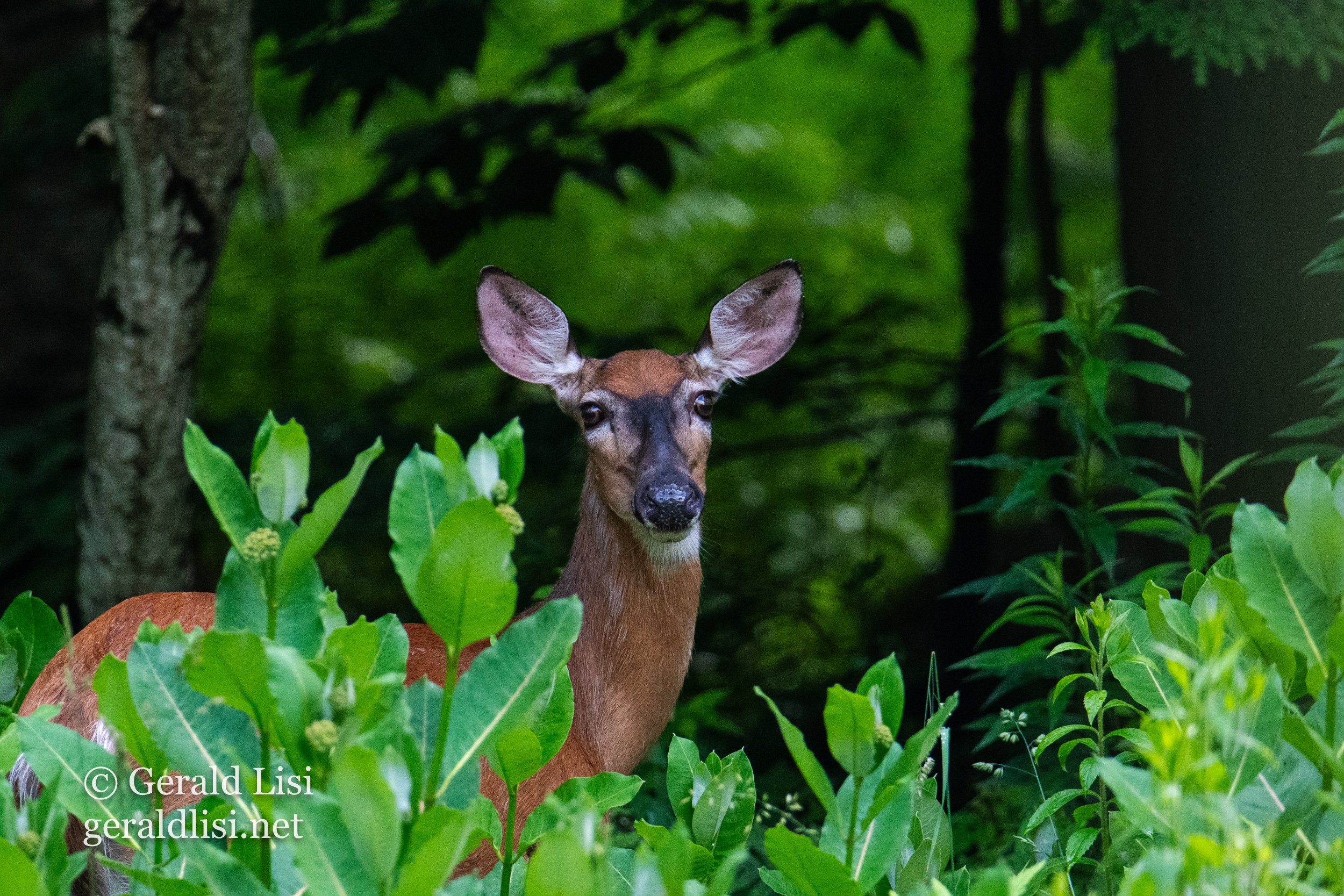
White-tailed Deer Fawn in a natural forest clearing
Ovenbird singing in Sugar Maple
Luna Moth on Sensitive Fern
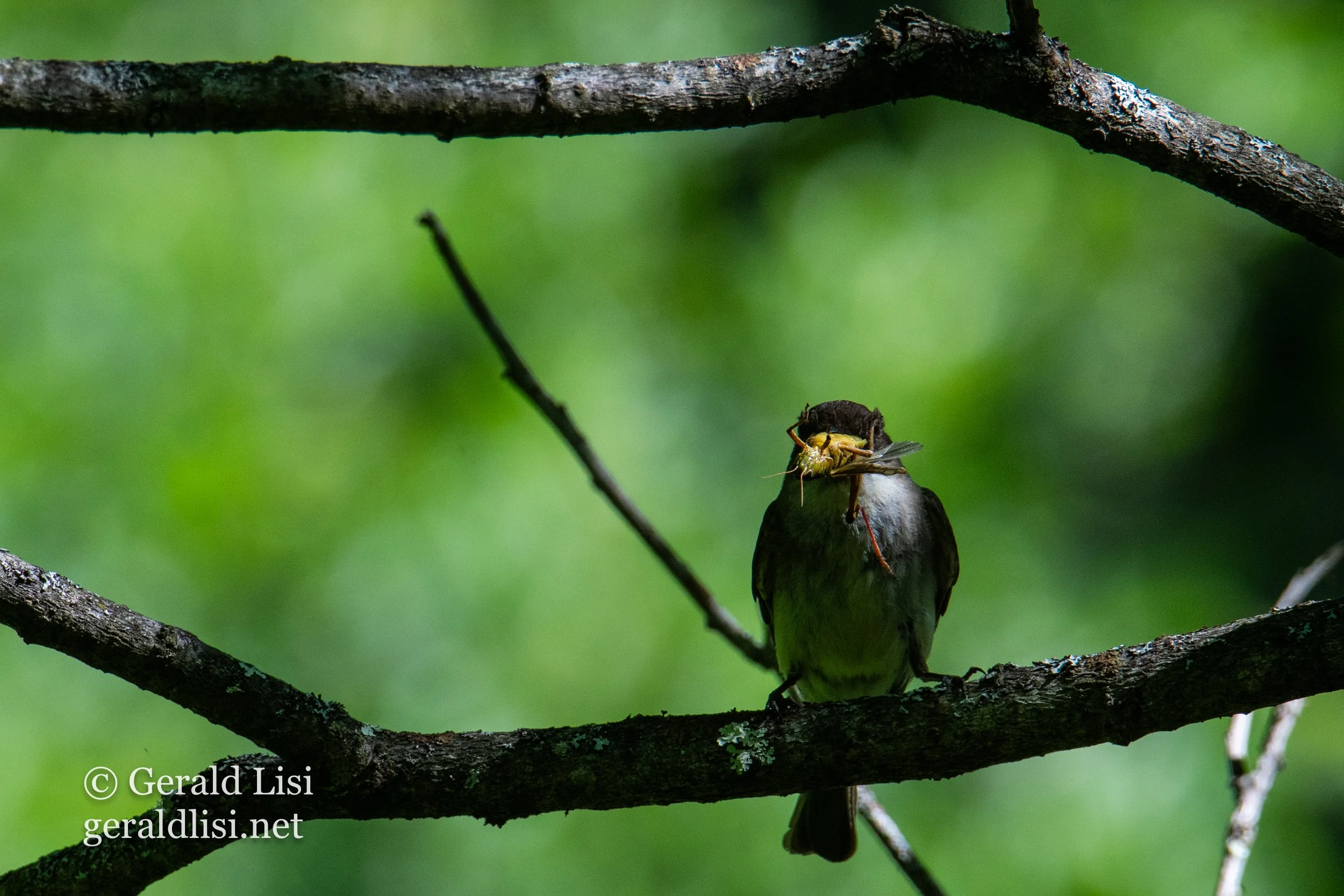
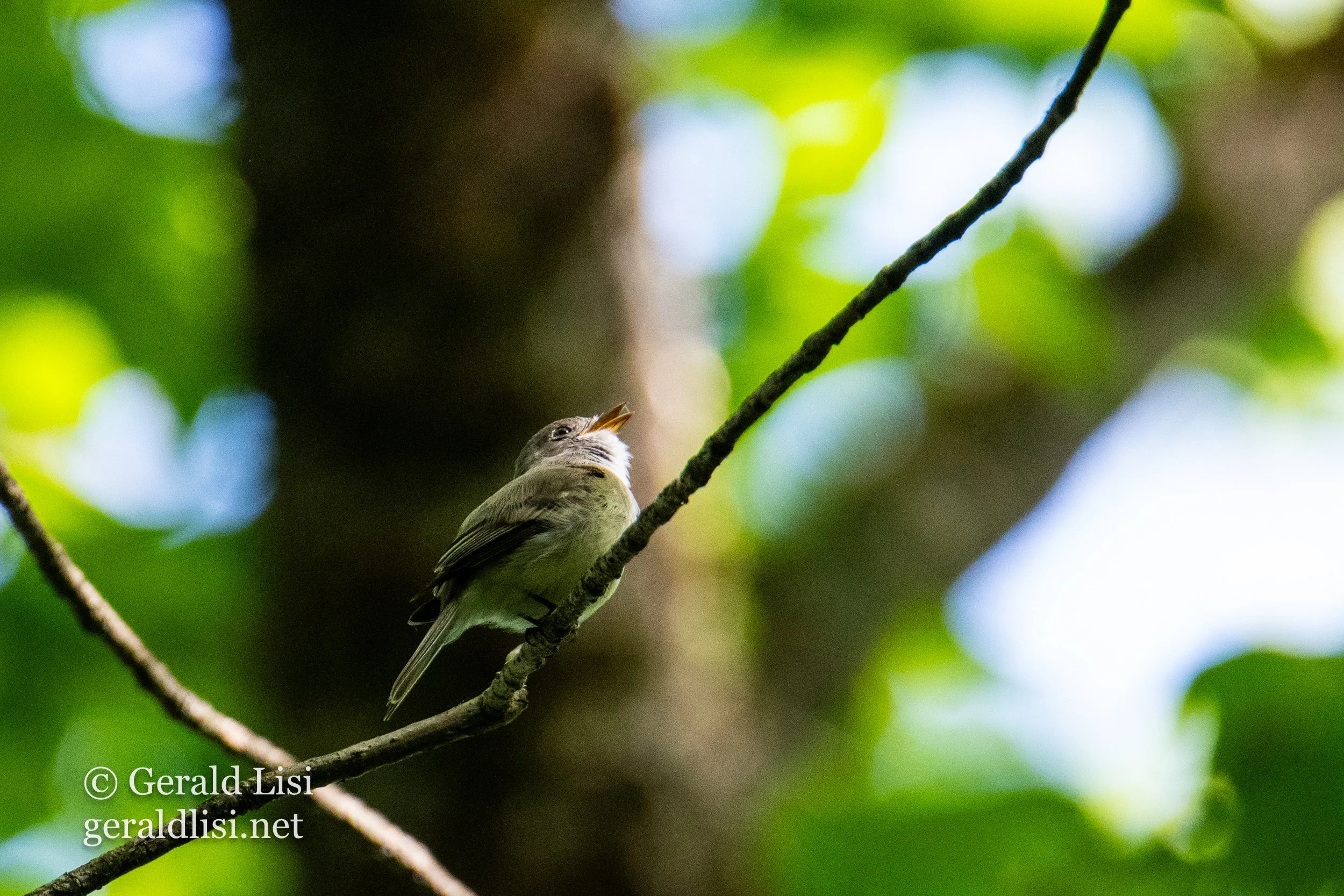
Eastern Phoebe in Staghorn Sumac
Bird Party at the Pagoda (Dogwood)
Greetings and salutations, my friends. I’m going back to late summer here for a super zoomed in post. When the berries on a Pagoda Dogwood in my yard ripened I had the great pleasure of watching at least a dozen birds of several species visit this native shrub for a feast. As a lover of native plants and birds I relished this pagoda party, and I thought you might enjoy a few photos of the festivities.
American Robins and other thrushes are serious frugivores (fruit eaters), so seeing a few Robing take more than their share of this bounty was no surprise.
The scarfing of berries happens so quickly, and often without a clear view, but I was glad to catch this Robin with berry in bill.
This juvenile Hermit Thrush would have been still getting used to feeding his or her self, which was temporarily quite easy in these bountiful branches.
Perhaps the same Hermit Thrush, or another juvenile. You can see that many of the red fruit-bearing stems had been picked clean at this point.
Black-capped Chickadees aren’t big fruit eaters, but they can be found wherever there’s action.
Tufted Titmice are larger cousins of Chickadees, with similar diets and habits.
This Titmouse found a nice caterpillar on the popular Pagoda Dogwood. While fruits are important foods for many birds, the greatest nutritional contribution of plants to birds is the caterpillars that feed on their leaves.
This female Yellow Warbler was a fun surprise as I had not seen this species in the yard before. She and her mate had likely finished raising this year’s young by now and she was enjoying the freedom to wander, and eat all the insects she caught herself.
I’ve seen Red-eyed Vireos hunting caterpillars on many occasions. This was my first time seeing them eat fruit, and by far my closest look at them foraging.
I had seen and heard this Red-eyed Vireo pair a lot at this point, but getting to photograph them together in this beautiful plant was a real treat.
That concludes this little reminiscence of late summer. How distant it seems already. I do have some current news to share though: my 2026 calendar is now available! If you’re interested you can find it at my store, https://gerald-lisi.squarespace.com/store-1?p
Thanks for your time and attention, folks! I hope you feel it was well spent.
Midsummer Medly
The subtitle of this installment could be “Cool Beings I got good photos of in my yard this July and August.” At least a few hours of most of my weekends are spent slow birding. The more and the faster you move the more you are going to drive birds, and other wildlife, away from yourself. Stopping to smell the proverbial (and literal) roses isn’t just about enjoying their fragrance. The stopping part leads to observations, and while one quietly ponders them wild creatures nearby are put at ease. Next thing you know there might be birds foraging just a few arms lengths away. If you’re only interested in birds slow birding will have mixed results, and you should really consider broadening your horizons. A bit of botany, herpetology, mycology, geology, etc, can make any outdoor spot interesting. And as long as you don’t get tunnel vision in these other pursuits either I promise you, the birds will come to you. On that note let’s move on to those Cool Beings.
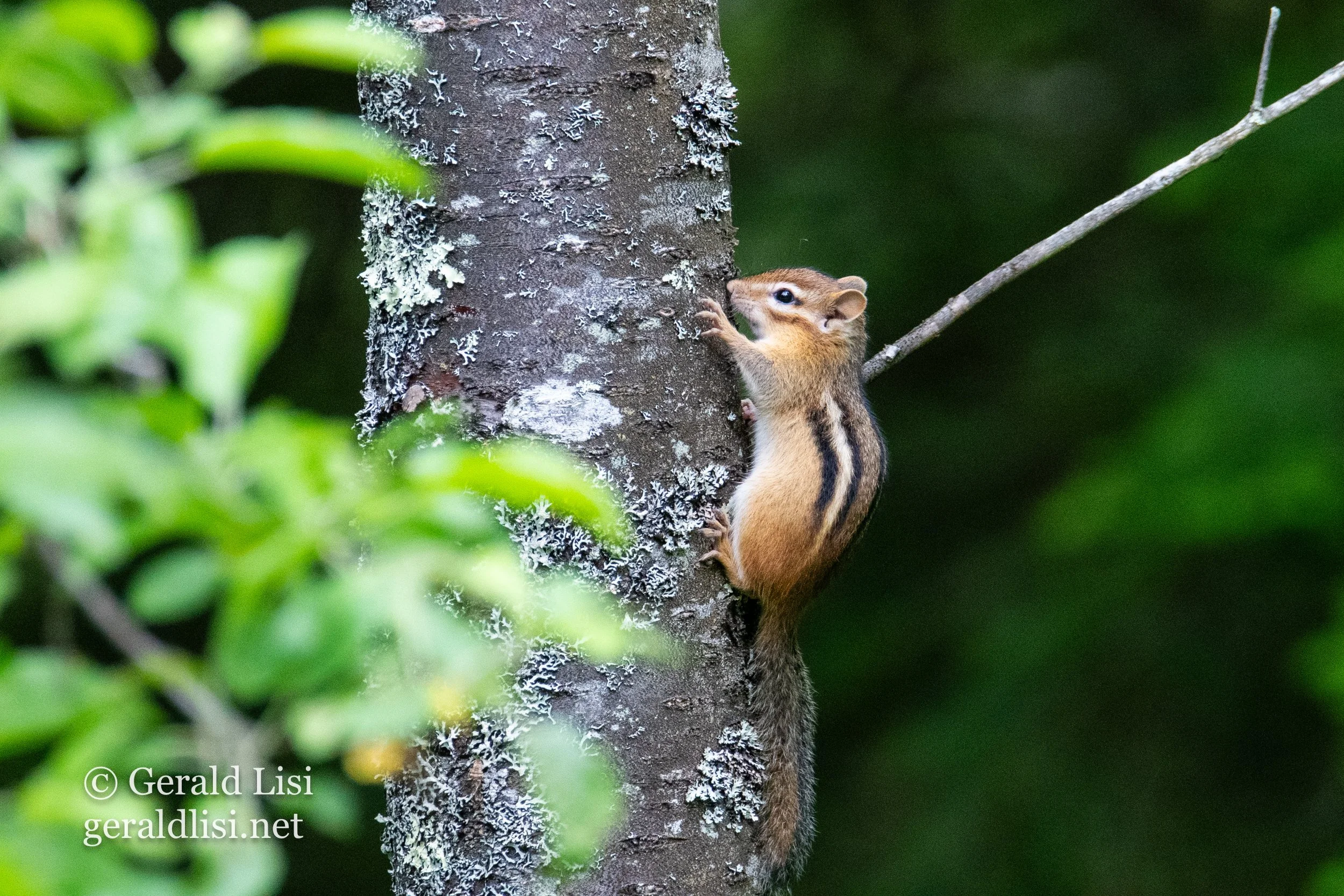
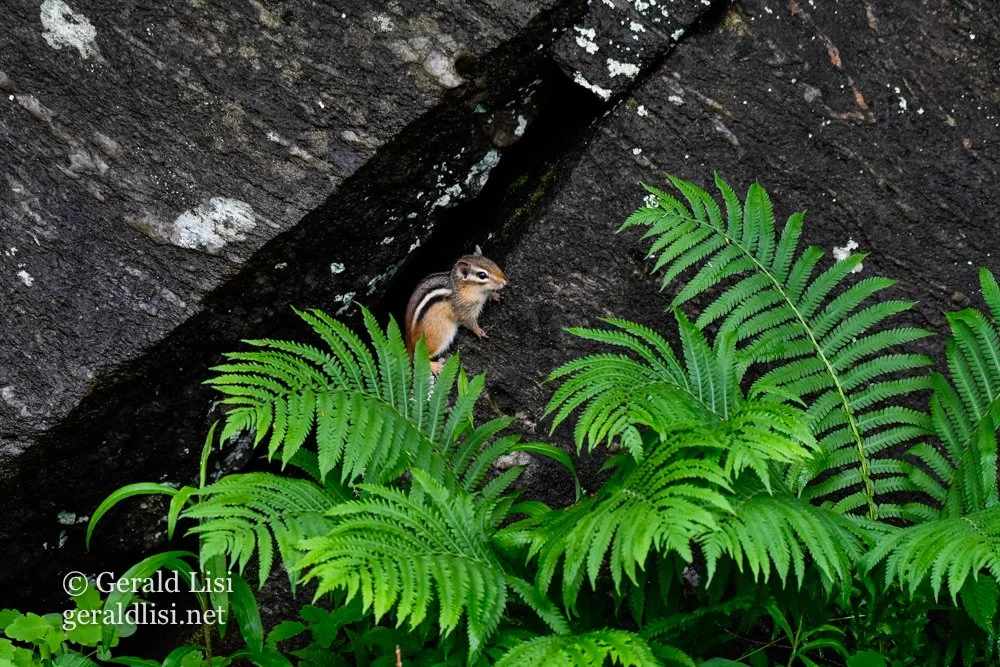
I feigned dismay when I saw this Chipmunk eating my blueberries, but I had already opted against putting nets over the bushes. She paused her harvest to make sure I wasn’t out to get her, giving me the opportunity to frame her sweet little profile with fruit-laden blueberry branches.
Ghost Pipe aka Indian Pipe, Monotropa uniflora, is a plant of the Heath Family, Ericaceae. Members of this family, including blueberries, often share mycorrhizal networks with trees, especially conifers. photosynthesis products from the trees are shared with the mycorrhizal fungi who reciprocate with minerals and nutrients reclaimed from the decomposition of organic matter. Many forest understory plants rely on the sugars made by the trees, who enjoy much better access to sunlight. In some cases species completely lose their own ability to photosynthesize. The complete lack of chlorophyll (a green pigment used in photosynthesis) in Ghost Pipe is a classic example of this phenomenon. Non-photosynthetic plants are generally referred to as parasitic. They do rely on the photosynthesis of the trees on the other end of their mycorrhizal networks, but it’s important to recognize the contributions these flowering plants make to the greater ecological communities to which they belong. Bumblebees are the pollinators of Ghost Pipe, and they raise their young on the pollen they gather from them, as is generally the case with Bumblebee-flower relationships. I have also noticed that this plant very often gets eaten, although I don’t know by who. Likely deer and other plant-munching mammals.
After glimpsing Garter Snakes fleeing my footsteps in my yard a few times, just a tail disappearing into a thicket, I was delighted to see this one’s sweet little face as he climbed a Mugwort. If you are afraid of snakes please let me assure you that Garter Snakes are not at all dangerous to people or pets. They are however predators of slugs and snails (and many other little critters), so gardeners should welcome them with great enthusiasm.
Great Spangled Fritillary on Common Milkweed.
Milkweeds are rightly famous as favored food plants of Monarch Butterfly larvae (caterpillars), their flower nectar feeds many many species of insects, including adult Monarchs.
American Toad in Polytrichum (his butt parasol is a Wild Strawberry leaf).
Toads are delightful creatures, and I am always happy to see one. The Hair-cap Moss complemented his portrait quite nicely.
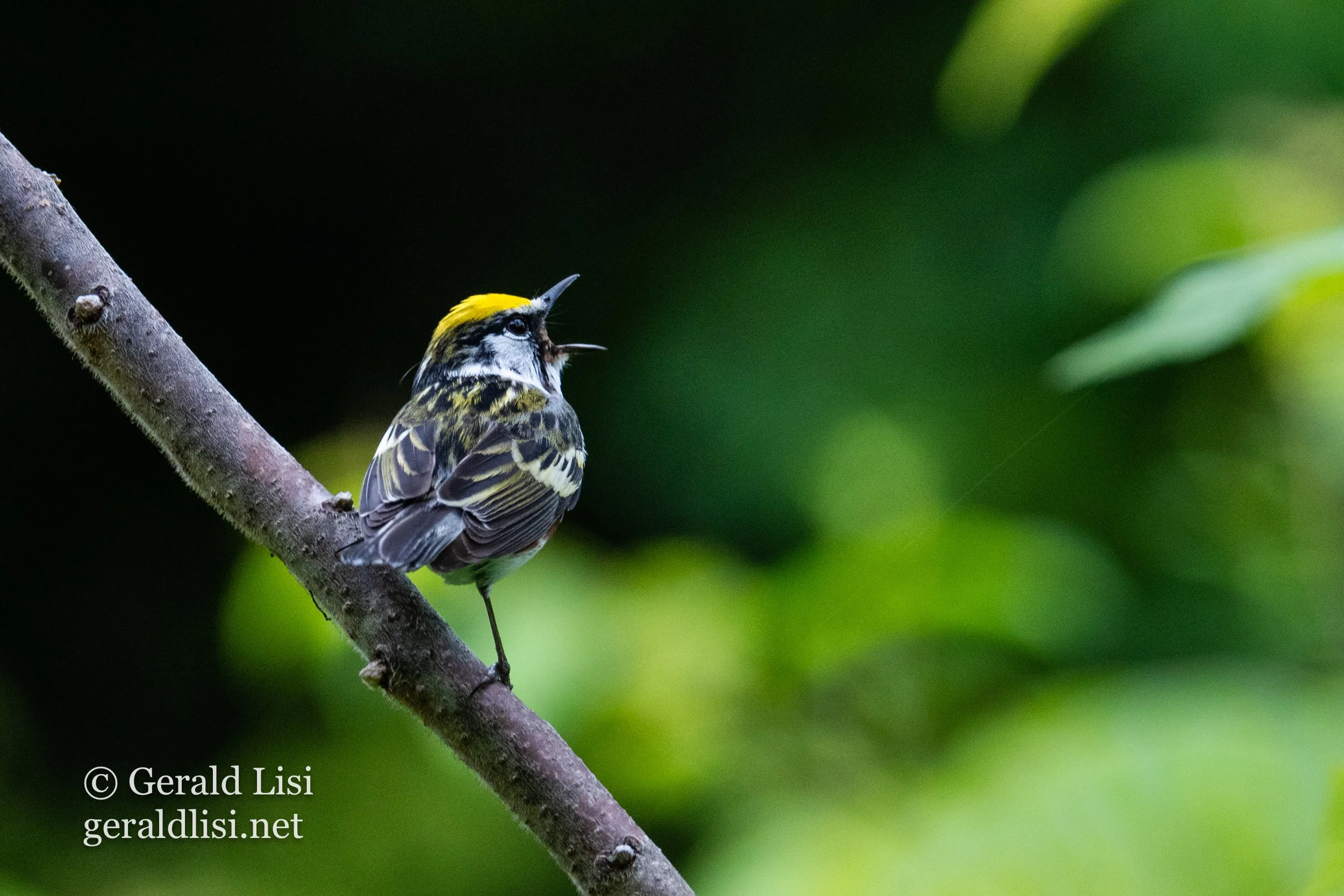
Chestnut-sided Warbler fledgling in Red Maple.
Chestnut-sided are one of the most abundant and conspicuous wood warblers in central Vermont. But once the chicks have fledged the songs of warblers, and other birds drop of dramatically. This is the time listen more carefully for the little voices of fledglings begging their parents for food.
Common Loon with chick
This is the only observation in this post that wasn’t made at home. This could well have been right up the road, but it was actually on Rollins Pond in the Adirondacks, where a friend of mine rents out boats.
Blackburnian Warbler male in Red Oak.
I heard him singing quite a bit this spring, and got a few way-up-in-the-trees shots of this. But as I often say, when they (various tree-top-singing-warblers) go quiet you might actually get a decxent look at them foraging in lower branches. In this case he was gathering food for his chicks. Continuing to hunt with prey items in the bill, rather than stopping to eat it before proceeding, is indicates that you’re watching a parent on one of their hundreds of daily foraging trips to feed their rapidly growing chicks.
As Douglas Tallamy keeps trying to tell us, one of the major contributions of wild plants to their ecosystems is in the feeding of myriad species of caterpillars, many of which are primary sources of nutrition for the young of most species of birds. Oaks, he reports in ‘Nature’s Best Hope,’ are one of the ecological heavy hitters in this way. “If you think of a plant as a bird feeder, which is exactly what it is, then in most regions the oak makes the most food” Tallamy writes.
Three weeks later I spotted this juvenile Blackburnian Warbler, who is almost certainly one of the progeny of the father pictured above. It’s awesome to have one of my favorite birds successfully breeding virtually right outside my door.
That’s all for now, folks. I hope you found some beauty here, and learned a thing or two. If you are reading this as an email please consider forwarding it to someone that might enjoy it. If you’re reading this on my website please consider subscribing at my home page, www.geraldlisi.net. Thanks for reading, and best wishes to you all.
Back in June
Greetings and salutations! I am still here, and do have some things to share with you. I actually selected images for a June post, but didn’t get past that step. So, one month later I offer you these photographic highlights of my late-spring/early-summer naturalist explorations. Enjoy!
It was actually back in May, the 31st, when I had the pleasure of watching this Scarlet Tanager for a few minutes. He was in the deep shade of the forest early on an overcast morning, so the light was not in my favor for photography. But this is undoubtedly one of Vermont’s most striking breeding birds, so I was clicking away with great enthusiasm. Here I managed to get a clear view of him through a window framed with Beech leaves.
Here he is perched on the boughs of an Eastern Hemlock, whose still-developing new leaves reveal the season of the shot.
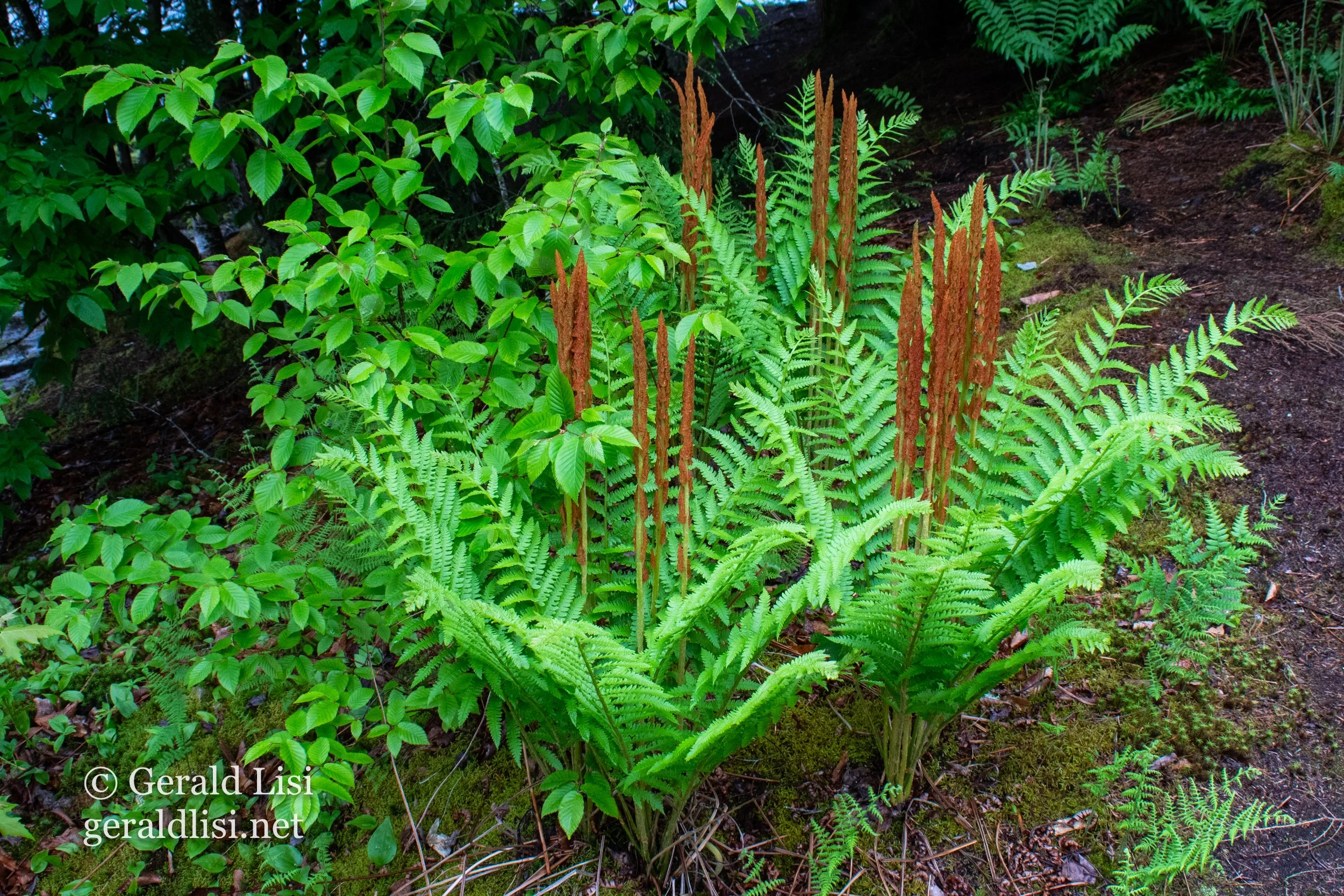
Speaking of fresh spring growth I encountered this Cinnamon Fern at the perfect time to appreciate the namesake fertile fronds. Many species of ferns produce sori, their spore-bearing structures, on the undersides of their leaves, but Cinamon Fern is among those who produce separate sterile and fertile fronds.
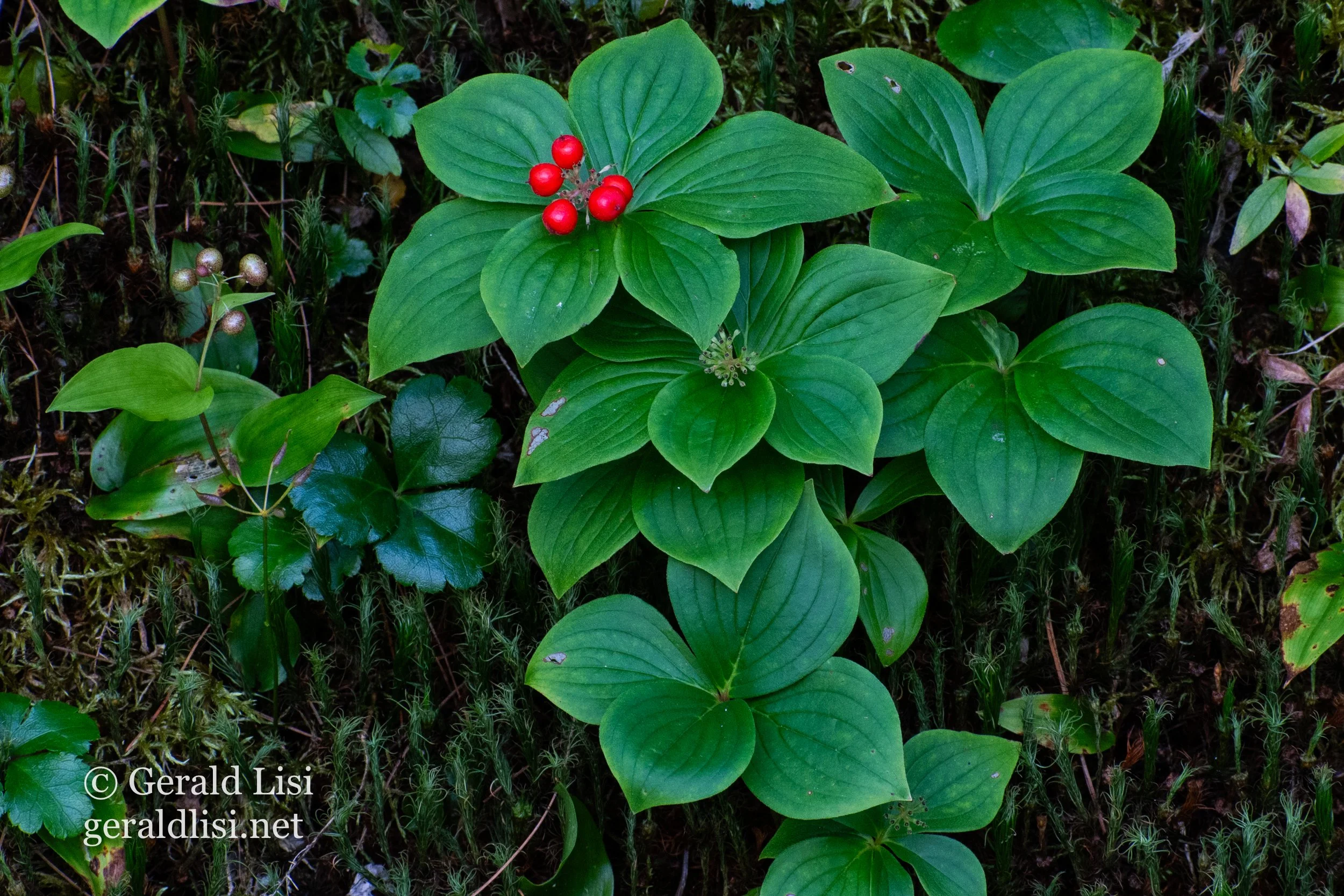
Here we see a favorite of the forest floor. Bunchberry, aka Dwarf Dogwood, bears an inflorescence of small white flowers subtended by showy, white bracts. Said bracts are often misinterpreted as the petals of a single flower, but the bunch of berries that follow, one from each flower, reveal the actual arrangement. Here they are already developing into berries. This plant is nestled amongst Bead Lilies.
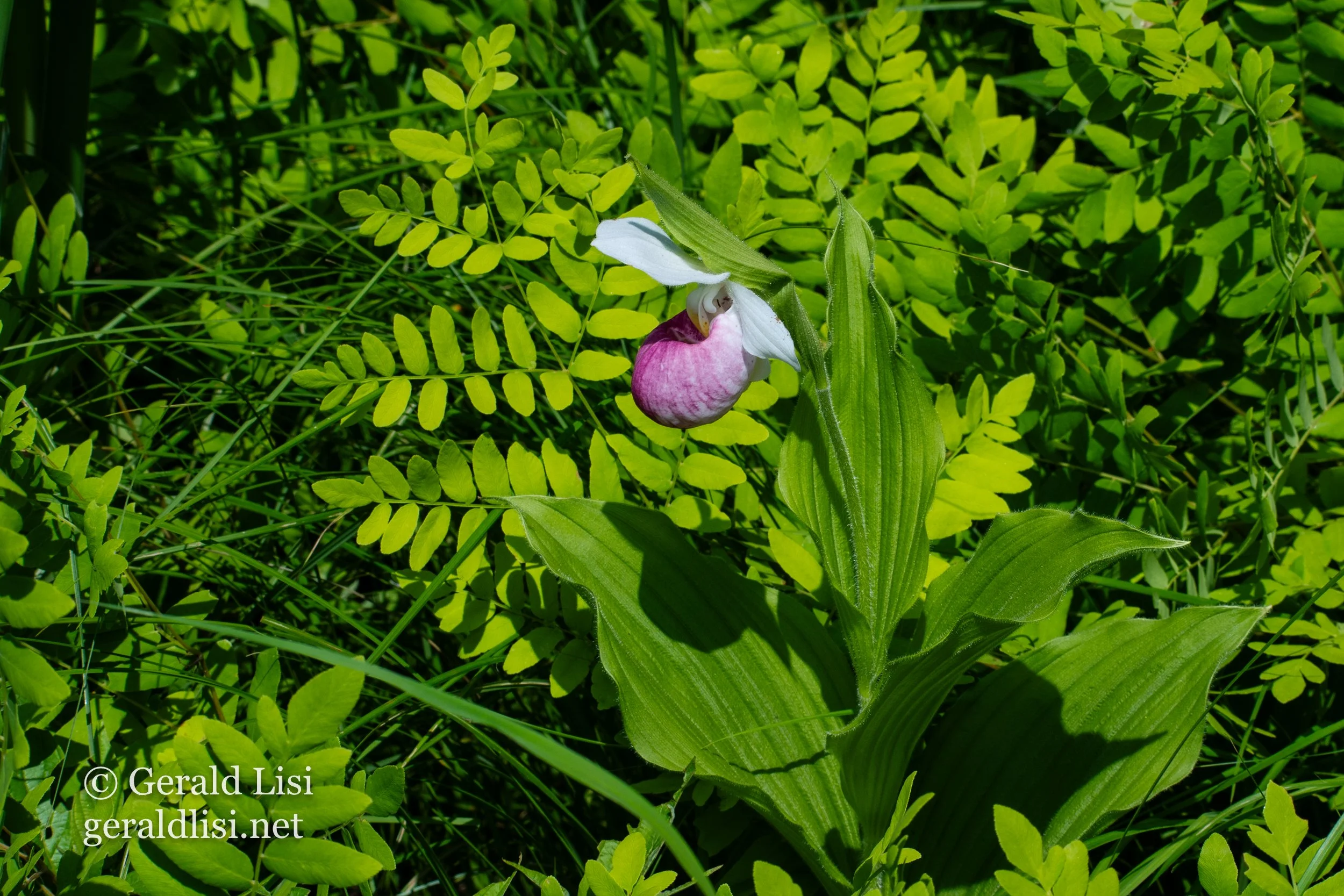
I was orchid hunting when I took the last two pictures. Specifically I was trying to find Pink Lady Slippers in flower. This is a photo of what turned out to be the first of dozens. This individual, well over a foot tall, was growing in a particularly photogenic spot.
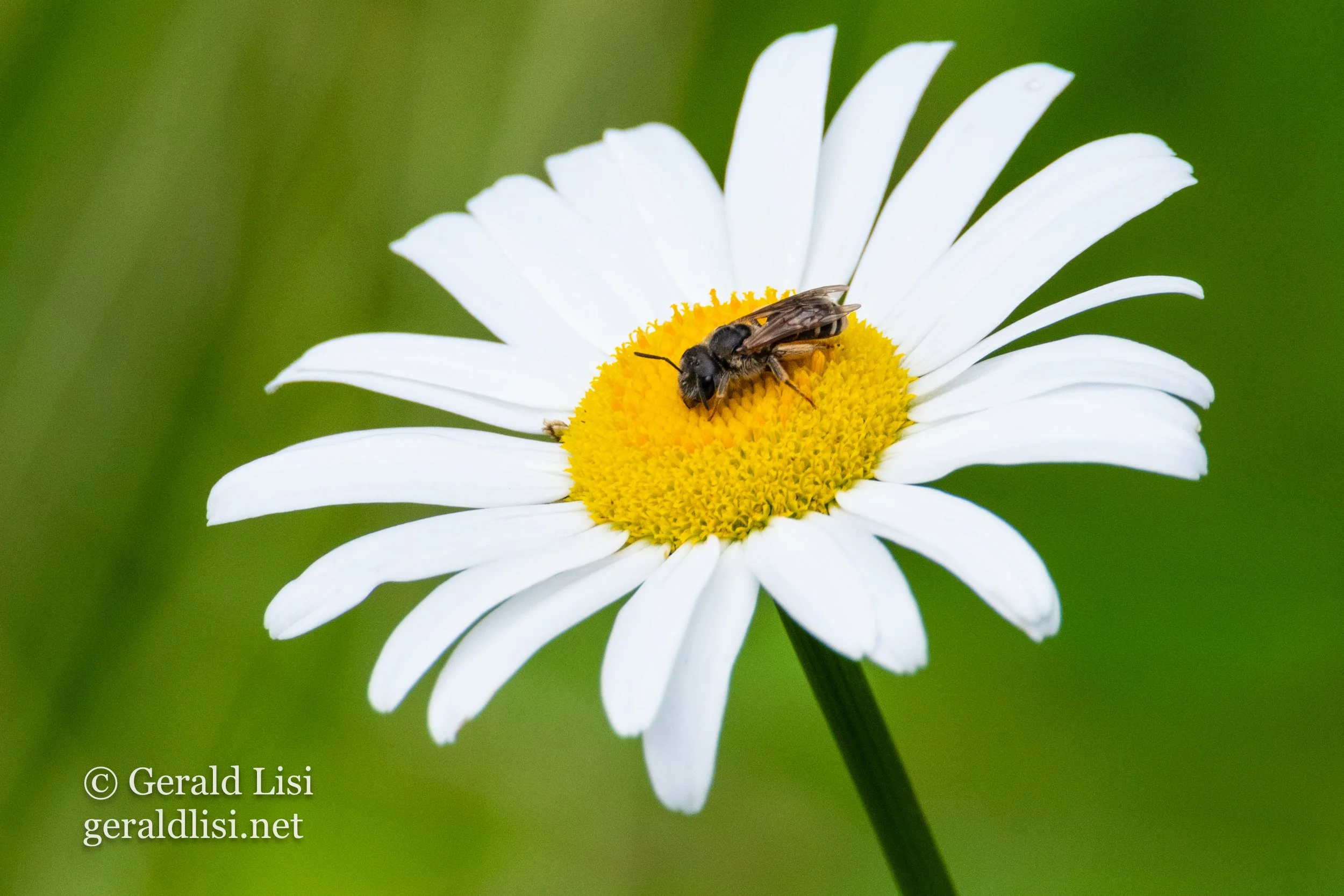
The forest of the last three photos surrounds a fen where I encountered another botanical delight; Pitcher Plants. There were no clear views of the modified, insect-trapping, leaves that give these plants their name through the sedges they grew amongst, but their maroon flowers were opening. I was additionally delighted to see and photograph the tiny bee that was on one of this flower’s sepals. I suspect this is some species of solitary bee, but my bee knowledge is limited, unfortunately.
Thanks to the Vermont Atlas of Life on the Vermont Center for Ecostudies I was able to identify these mating dragonflies as Crimson-ringed Whitefaces.
Stunted White Cedar and Tamarack manage to grow in the saturated soils of the fen. Here a Bluejay hunts for food from a branch of the former.
Another day, while birding at home, I had the pleasure of seeing this Blue-headed Vireo pulling what was probably a larval moth of some sort from its silken pupation tent. Many a caterpillar never metamorphoses due to the appetites and foraging skills of birds.
I was fortunate this spring to hear a lot of female American Redstart songs, and even get clear views of this little lady belting it out. The songs of most songbirds in the northern hemisphere are performed by males, but in a few species females sing their own songs as well. Both sexes are strongly territorial during nesting season and this image captures that behavior in this female Redstart.
One day a particularly loud and rapid exchange of Tufted Titmouse calls led my eyes to a whole family of these delightful birds. This juvenile and her siblings were still getting fed by their parents, but were probably quite close to fending for themselves at that point. Here we see adult plumage fully developed, but the fleshy gape at the base of baby birds’ bills is still apparent.
That’s it for this time, folks! Thanks for joining me. If you are reading this on my website or if a friend forwarded this email to you, you can subscribe to my somewhat-monthly newsletters at https://www.geraldlisi.net/ Wishing you inspiring encounters with the wild world until I next share some of mine with you.
It's (Almost) All About the Birds
After a solid year of monthly posts I fell off in April. Working long hours every week has relegated my photography to weekend hobby status. The long-awaited spring greening of the landscape is an absolute favorite event of mine. But, it’s May’s dramatic influx of migratory birds that has most drawn my lens this spring. So it’s these captivating creatures that will dominate this post, after I kick it off with another kind of delightful vertebrate.
This tiny Red Eft was a most welcome preview of the mass movement of these juvenile Eastern Newts that takes place every summer in the Northern Forest.
One dark morning early this month was brightened for me by the realization that Black-throated Blue Warblers had returned.
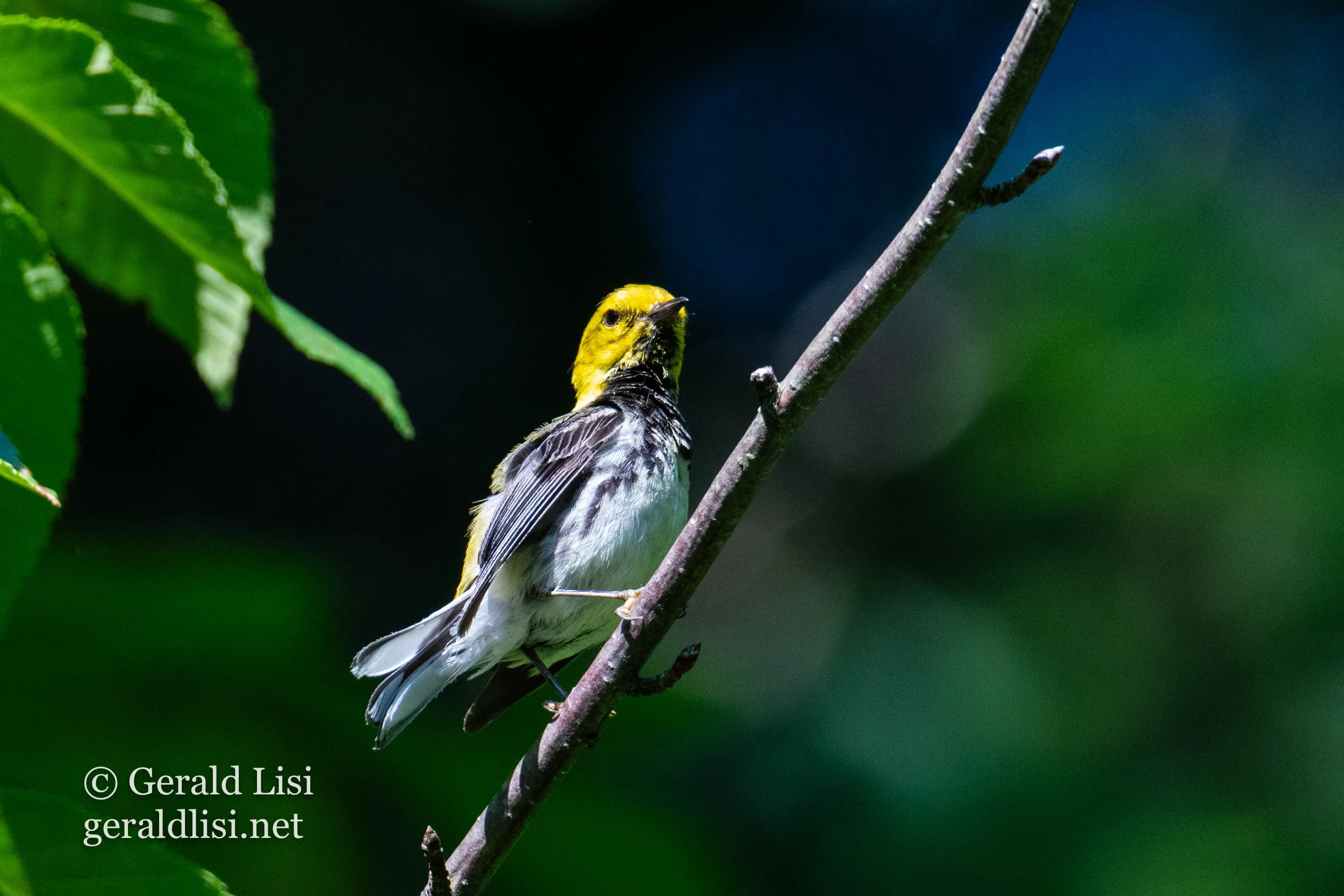
The throat of males is also part of the namesake for Black-throated Green Warblers. After chasing this guys songs through the canopy for more than a few minutes I lucked out when he alighted in a Sumac just ten feet away from me.
Also presenting himself in the late-to-leaf-out Staghorn Sumac was this Myrtle (Yellow-rumped) Warbler.
The Warbler game mostly involves craning one’s neck to scan the canopy from which a male’s song is emanating. Frequently one must settle for audio identification, but the relative lack of foliage in early May and this Black and White Warbler’s choice of singing perch enabled me to catch him in the act.
Pine Warblers do live up to their names, and I generally fail to spot the songster high in a White Pine. But foraging for insects brings many of the upper-canopy-singing warblers closer to the ground. I was very pleased to get this Pine Warbler shot in a flowering and leafing-out Paper Birch. Catkins of male flowers dangle below him and the remnants of last year’s seed “cones” are at his head level. Note also that if this tree was done leafing out this warbler would not be visible. The first couple weeks of warbler season affords the best views.
The biggest float in my spring warbler parade was presented by Northern Parulas. I was hearing, and even seeing, them so much earlier this month. Here a male sings in a Speckled Alder. The catkins behind him belong to a Willow.
So strong was my Northern Parula mojo that I even got a good look at this female, without the benefit of song to point me in the right direction. Although it was almost certainly the song of the guy in the previous picture that drew this little beauty to an Aspen branch in the same thicket. The plumage of female warblers is a less-colorful variation on that of the males, with that of some species having little or no bright colors at all, but the lady Northern Parulas are nearly as colorful as the males.
Closing of the warbler section of this post with an Ovenbird singing the ubiquitous “teacher teacher TEAcher TEACHER” of spring and summer in deciduous and mixed forests of the northeastern United States. Ovenbirds are one of a few outlier species in the Wood Warbler family that have thrush like appearances and habits.
For actual thrushes today i have for you this Veery, who granted me my closest yet looks at this often-heard denizen of Vermont woods.
Less often heard and rarely seen is the Wood Thrush. This guy’s truly enchanting song drew me like the piping of Pan, but I held little hope of beholding the feathered minstrel. The Spirits of the Forest smiled on me this day though, and I am very happy to share my first look at a Wood Thrush with you.
While I am indeed a woodsling, I am hardly allergic to the rivers, ponds and streams that so beautifully punctuate the forested landscape. The water draws me just as it does birds who are not at home in the deep shade of the forest. As strict pescivores Osprey bound to the bodies of water that feed them. I barely managed to get a couple pictures of my first Osprey of the year (they also migrate north to breed). But what a way to kick off Osprey season. She had just pulled this beautiful trout out of the Waterbury Reservoir.
Almost immediately after being dazzled by the Osprey I spotted the distinct silhouette of my first Loon of the year 10 yards across the water. A mate was soon revealed too, and both thankfully made their way closer to me between dives.
Back to the woods we go, with yet another first of year in then form of this male Rose-breasted Grosbeak in a Red Oak. He was o good ways off, but much closer than the only other one I have managed to photograph.
Well ahead of the mostly May arrivals of the birds above was that of the Eastern Phoebe, our most familiar flycatcher in the northeast, but for added color I share this one in the early-May flowering and leaf-out of a Gray Birch.
And now I close this set of images with the stunning beauty of a Common Grackle in a Quaking Aspen. The high-key exposure required to get feather details on an overcast day revealed her shimmering blue hood.
Thanks for joining me, my friends. If these birds gave you just a touch of the joy they did me then It was well worth the time (mine and yours). A bit of related news before I go: on Global Big Day, May 10th 2025, the announcement of said day on the Cornell Lab of Ornithology’s Merlin app prompted me to have my first go at a Big Day. I was going to be birding anyway, so I decided to see how many species I could identify in one day. Better birders than myself have much bigger Big Days than my first, but after a long and thoroughly enjoyable day of birding I had seen and/or heard forty-four species. For those interested I will list them below. Until next time, I wish you many encounters with wild others, and glimpses of wild self they grant.
Black-capped Chickadee, Hairy Woodpecker, Hermit Thrush, Ovenbird, American Crow, Ruby-crowned Kinglet, Eastern Phoebe, Blue-headed Vireo, Pine Warbler, Northern Parula, Common Yellowthroat, Chestnut-sided Warbler, Gray Catbird, Red-eyed Vireo, Yellow-rumped (Myrtle) Warbler, Red-breasted Nuthatch, Common Grackle, Red-winged Blackbird, American Robin, European Starling, Mallard, Turkey Vulture, Song Sparrow, Yellow Warbler, Bluejay, Common Merganser, Osprey, Spotted Sandpiper, Common Loon, Yellow-bellied Sapsucker, Ruffed Grouse, Downy Woodpecker, Chipping Sparrow, Canada Goose, Veery, American Redstart, Rose-breasted Grosbeak, Pileated Woodpecker, Black-throated Green Warbler, Brown Creeper, Wood Duck, Northern Flicker, Louisiana Waterthrush, and Wood Thrush!
Not Spring, Not Winter
According to the calendar spring started on March 20th. I’ve always felt that was completely arbitrary. Spring involves many delightful events, but to me the ones that officially kick it off are the emergence of shoots from herbaceous perennials and the leafing out of deciduous trees and shrubs. As I write on the 30th of March these long-anticipated botanical activities have not yet unfurled spring’s myriad green flags, but that’s not to say that spring is not in the air.
A better way to say it is that spring is on the wing (high fives self for stumbling into this rhyme). Warmer temperatures and especially increasing day length have activated the mating instinct in every bird I see or hear. Testosterone can hardly be contained within their little bodies and its results are being released in frequent calls, songs and woodpecker drumming, as well as driving courtship chases and mate-competition altercations. These particular signs of spring were in fact manifesting by the 20th, but have amplified significantly in the last few days. Yesterday all of this excitement was juxtaposed with half a foot of fresh snow. Does this mean it’s still winter? I can’t say that I am of that opinion, but it’s certainly not spring either.
One thing that I love about the change of seasons is how some elements of the one that’s ending overlap with those of the one that’s beginning. Nature is complex and defies our efforts to neatly divide it’s parts into categories. I’ve always been enthralled by ecotones, where one natural community type transitions to another. Now I’m thinking of the change of seasons as a temporal metaphor for this spatial phenomenon. This niche analogy only goes so far, but I think it’s worth exploring since it draws from the wonder that the more than human world provides. Meanwhile the only wonder I’ve been getting from the human world is wondering what the hell is wrong with people. Present company excluded, of course. The obvious point of all of this is birds. Let’s look at some birds.
This Song Sparrow is a new arrival in my yard. While some of these ground-foraging birds somehow manage to overwinter in Vermont most arrive from southern vacation spots around now.
Fox Sparrows pass through Vermont on leisurely migrations too and from their northern breeding grounds.
Slate-colored Dark-eyed Junco females are light gray above with varying amounts of light brown on their sides and backs. I’ve had a handful of Juncos around the house all winter, but on the morning of the 30th I counted 28. They have contributed more tha their share to soundscape of the changing season.
Here we see that the male Slate-colored Dark-eyed Juncos are much darker with no brown. Note the pink bill in both sexes. Males in this flock greatly outnumber females, which is common across species.
Pine Siskin in Staghorn Sumac. I had very little Siskin action this winter, but am pleased to report that a flock arrived recently. Flocks of these little finches follow the cone crops of conifers, birches and alders, and like other finches they visit bird feeders.
American Robin male finishing off a cluster of Staghorn Sumac berries. Most Robins head south for the winter. Fruiting trees provide winter fare for the early arriving males, who are establishing nesting territories, and the few who overwinter. As soon as the ground is bare they switch to worms, of course, and other ground-dwelling invertebrates.
Once his belly was full this guy perched for quite a while on this birch branch.
Hairy Woodpecker males are distinguished by the red spots on the backs of their heads. Downy Woodpeckers have the same plumage patterns, but are smaller with shorter bills, and they tend to forage on the branches rather than trunks of trees. This guy was chasing around his lady love, squeaking with amorous delight as he did so. I’ve heard similar courtship vocalizations from Flickers and Sapsuckers, but this was my first time seeing this species doing it.
This Crow is one of four who spend some time here. They are most likely a mated pair and the young from last year.
The other Corvids that visit my yard are Bluejays, and are similarly likely to be a mated pair and last year’s young. Their is a Ravn family in the area too, who sometimes visit my woods, but not the yard.
So there’s a few of the birds whose company I enjoyed at home on the 29th. My full species list for the day was as follows.
Slate-colored Dark-eyed Junco, Song Sparrow, Fox Sparrow. Black-capped Chickadee, Tufted Titmouse, Red-breasted Nuthatch, White-breasted Nuthatch, Brown Creeper, American Goldfinch, Pine Siskin, American Robin, Downy Woodpecker, Hairy Woodpecker, Pileated Woodpecker, American Crow, Bluejay, Mourning Dove
That’s eighteen species, which is more than I’ve had here since October. Spring is indeed on the wing!
Surprise! Birds aren’t the only charismatic vertebrates I have to share with you. Imagine my delight when this Long-tailed Weasel zipped across my porch. I was sure he would be gone when I rushed out the with my camera, but fortune and the bold/curious behavior of these weasels was on my side.
Here he peeks from under the steps outside my bedroom. After his inspection I suspect any rodents around the house have been converted to weasel flesh. Just a couple nights before I had a five hundred pound Black Bear out there, certainly a male. He stole a fresh block of suet from my feeder, but was good enough to leave the feeder itself. No pictures as this was the middle of the night. As much as I would like to see him in daylight a fed bear is a dead bear, so I had to scare him off. A simple rapping on the window sufficed to have him swiftly loping off into the woods.
I’ve never gotten good Long-tailed Weasel photos before, and this was my first time seeing them in their north-country winter coats. The white pelage seen here will sooj be replaced with a shorter coat of browns, with a bit of a dark mask. Seeing a photographing this guy was a real treat. It helps to be in the woods of Vermont, but wherever you are there’s wildlife that will surprise you right outside your door. Pay attention and you will be rewarded!
That’s it for this month, my friends. Thanks for taking the time for this. If you’re reading this in an email please consider forwarding it to someone who might enjoy it. If you’re reading it on my website or in a forwarded email please consider visiting my home page to subscribe, https://www.geraldlisi.net/ . Thanks and take good care!
Looking back on, and forward to, summer
What a winter it’s been here in Vermont. It’s my first living here since '97/’98, and one more like I remember them as a kid in the eighties than what I hear they’ve been like in recent years. I’ve been more welcoming of so much snow than some, but by now we’re all looking forward to warmer, greener days. I’m eagerly anticipating spring, which is closer to two months than one from arriving here in central Vermont. But, I’ve not spent a spring here since taking up photography, so I will share some summer images to sooth our winter-weariness.
A little waterfall in Green Mountain National Forest near Warren.
Pale Jewelweed, an indicator species of rich woods, near the stream pictured above.
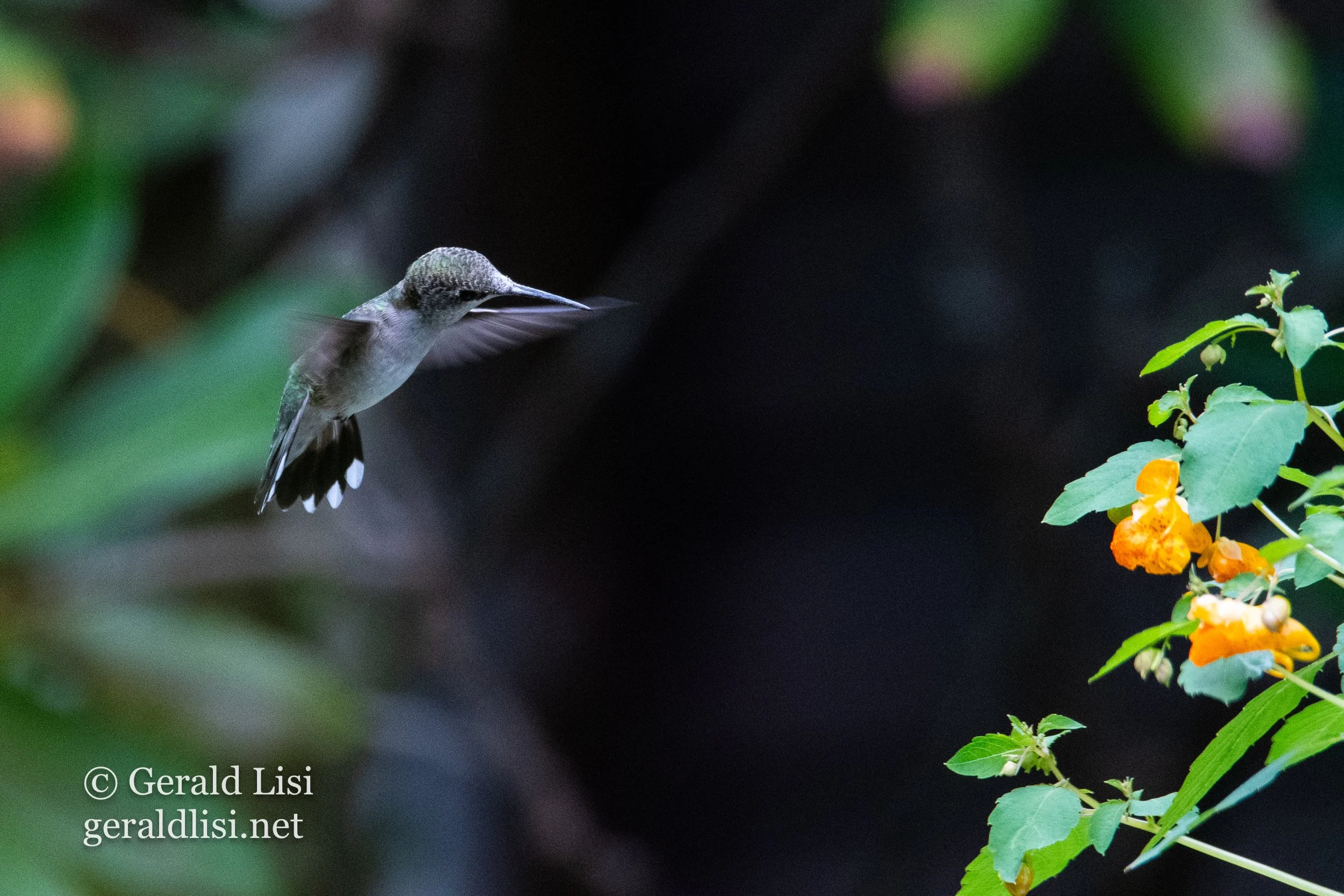
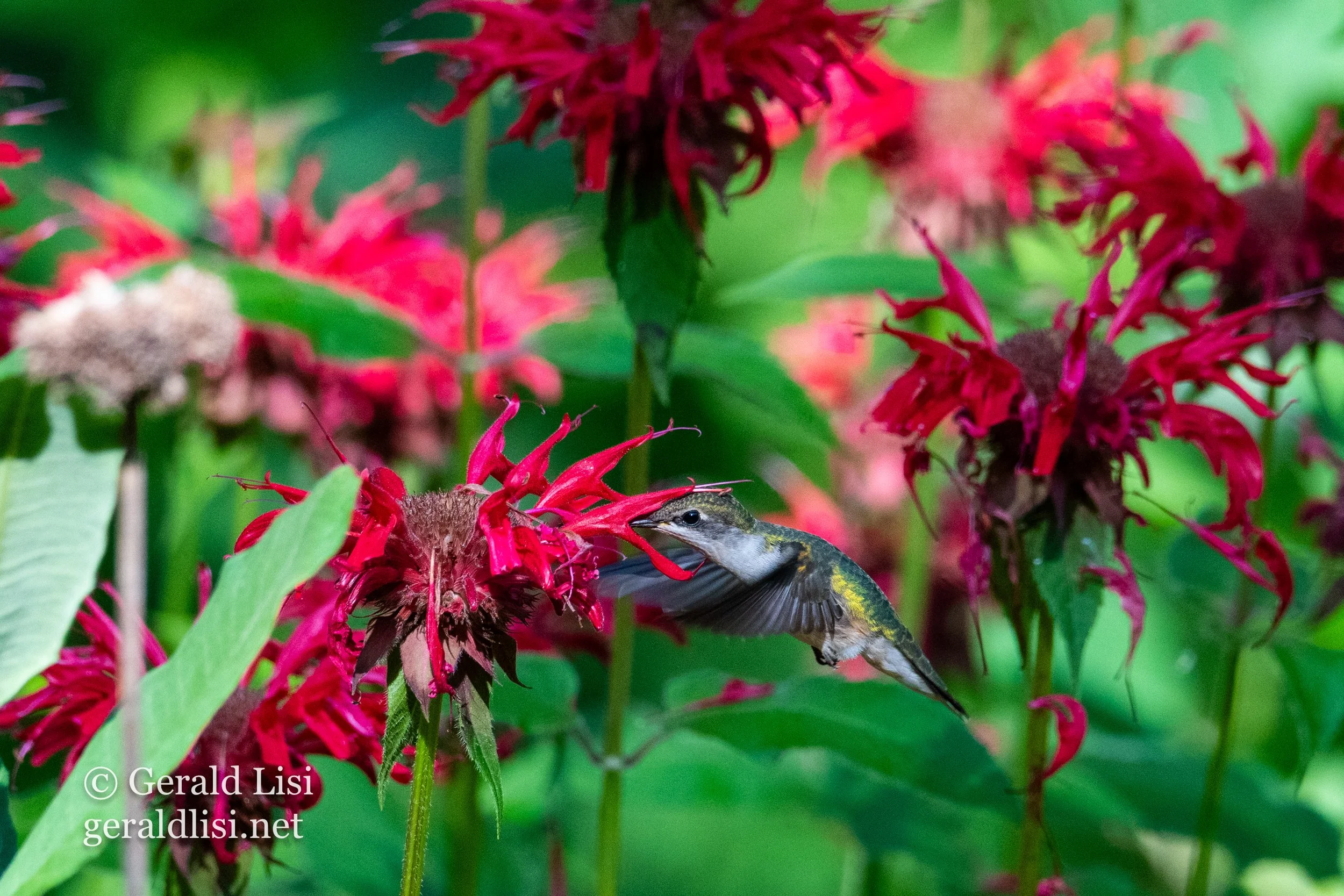
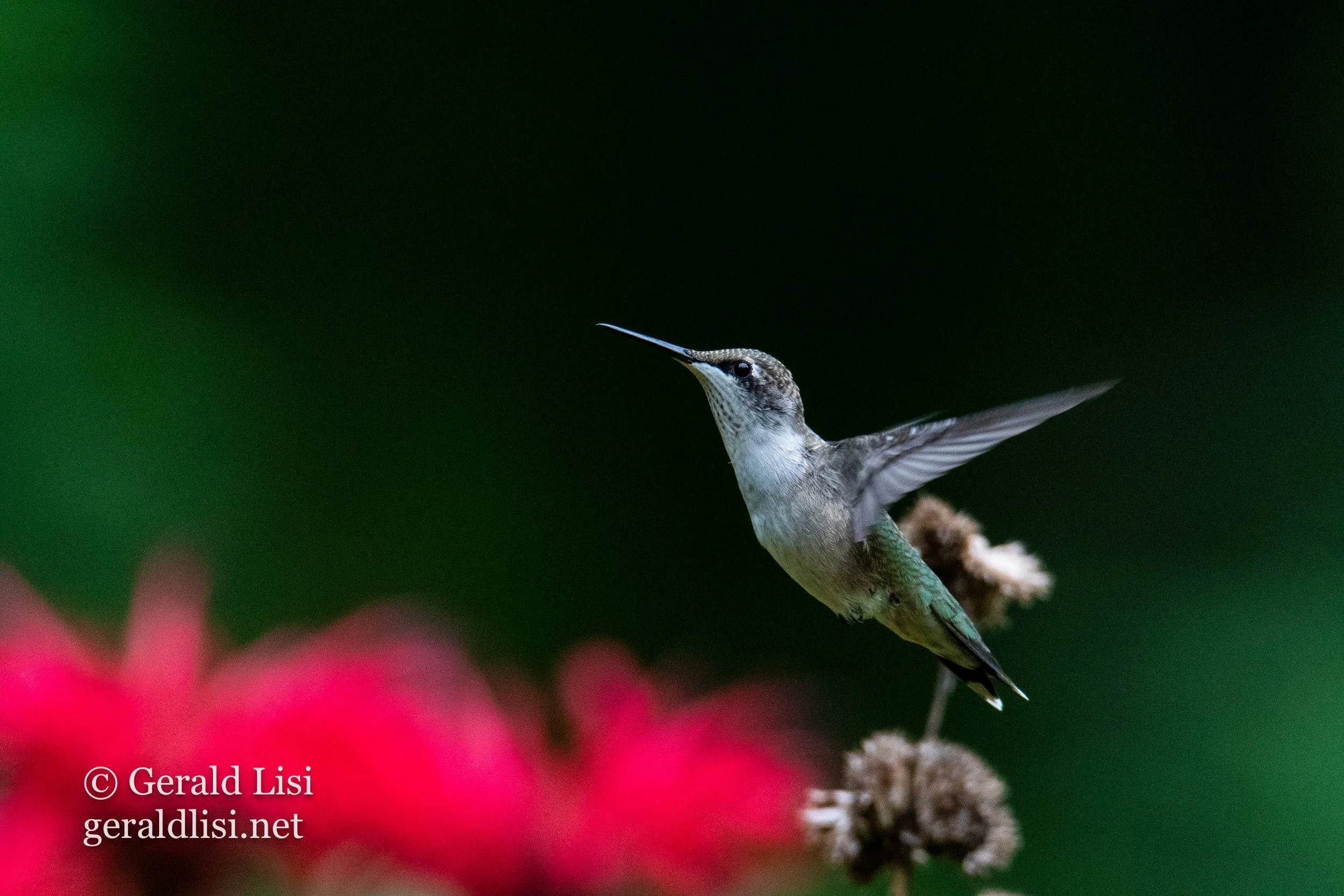
Female Ruby-throated Hummingbird in Lilac. The name of this species refers to the gorget of the males, but the pearly white white throats of females help to distinguish them from females of other species. This isn’t necessary in Vermont where we have only one species, with very rare exceptions, but at the western and southern parts of this eastern hummingbird’s range it’s good to know. Tail feathers also have useful field marks for female hummingbird identification.
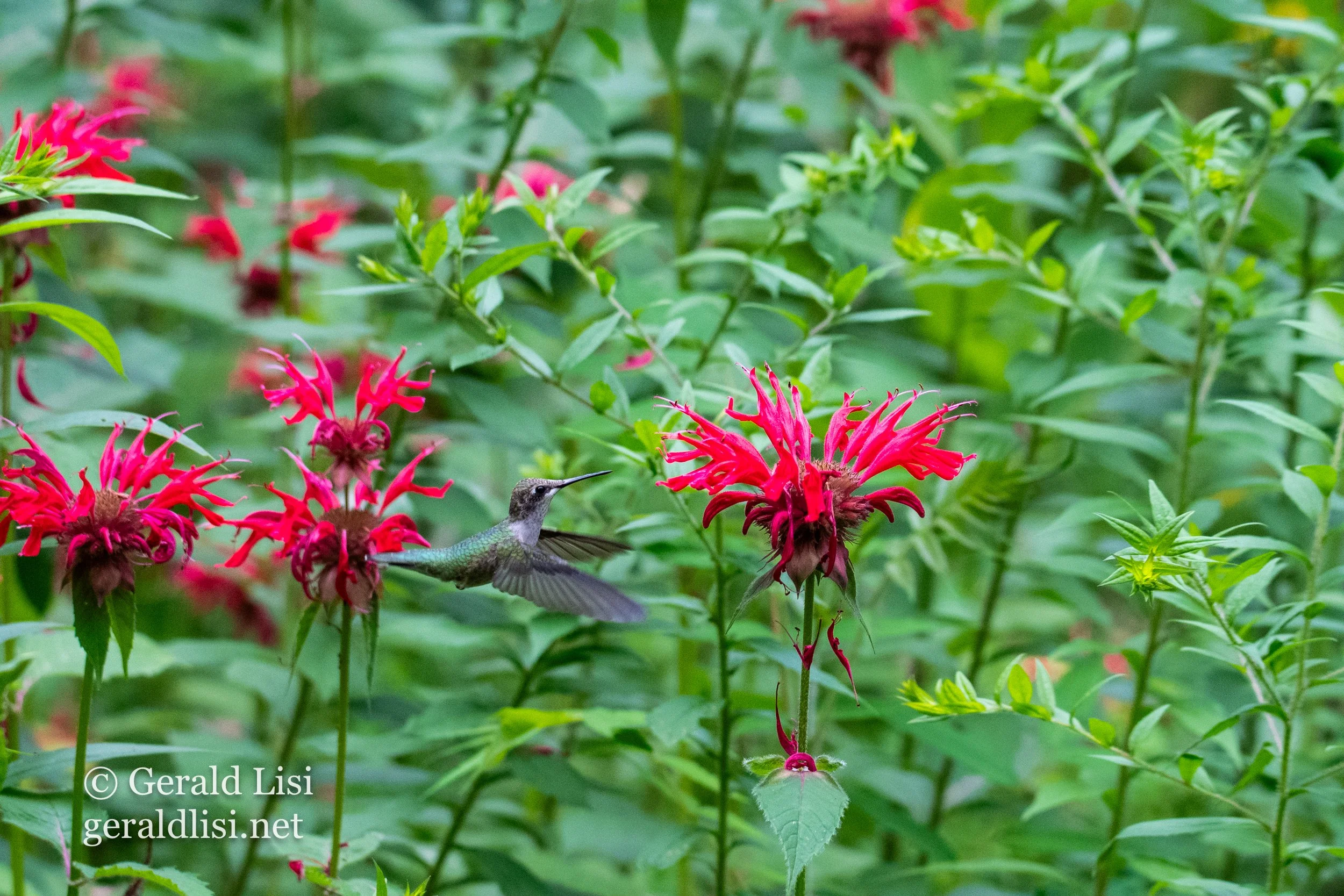
Here she is enjoying Bee Balm nectar. This flower should really be named for hummingbirds not bees, since it is very much adapted to being pollinated by them.
Juvenile Broad-winged Hawk. Most Buteos, Red-tailed Hawks being the most common and widespread example, favor open environments, but Broad-winged Hawks are forest raptors.
Broad-winged Hawks are very vocal. After learning their loud whistle of a call in June I quickly discovered that they are very common. in the Vermont woods.
When I first spotted him this young Porcupine was napping in this apple tree. I was most appreciative when he woke up for a photo shoot. Like Beavers, porcupines feed on cambium, the living inner bark of trees, but they climb rather than fell them to access it.
Staghorn Sumac with freshly formed fruits. They were untouched for a couple months before Robins feasted on them.
This Eastern Chipmunk did a fine job of filling up her cheek pouches, probably with the seeds of the Red Maple she is under. They cache their food supplies in chambers within their tunnel systems.
Even in profile those cheek pouches are clearly well stuffed.
Fritillary on Joe Pye Weed. I think this is a Silver-bordered Fritillary, but I’m no Lepidopterist. Please let me know in a comment or email response if you can confirm or correct my ID. Joe Pye Weed is a boon to nectar-loving insects, and a beloved component of the summer color palette of wet meadows in the northeast.
Monarch on Goldenrod. The thickness of the black lines on this individual’s wings identify her as a female. I don’t know which species of Goldenrod this is. There are many here, all of which are crucial late-summer nectar sources. Allergies at this time of year have long been wrongly attributed to Goldenrod, but are actually due to Ragweed and some late-flowering grasses. Wind-pollinated plants cause allergies, not those whose pollen is insect-distributed.
That’s it for this edition, my friends. Thanks for your time and attention. I hope you enjoyed this sampling of summer splendors. It’s hard to believe right now, but summer will return. Eventually. If you are viewing this in an email please consider forwarding it to someone who might appreciate it. If you’re viewing it on my website please sign up to get my posts in your email at https://www.geraldlisi.net/ Until next time, please take care of yourselves, each other, and the land you live on.
Hunger Mountain in January
This newsletter will have very little of each, news or letters that is, but there will be pictures. I have had a few good winter walks this month, and one in particular yielded some photographs I like. The trailhead for Waterbury Trail up Hunger Mountain is just a few miles away from my home, so it’s an obvious choice when I feel the need for a bit of a hike. Snowy woods and mountains hold a special enchantment, which I have attempted to capture with varying degrees of success in the images below. I present these without captions. Just take in the beauty. I was certainly inspired when I made these. I hope some of that translates in your viewing of them.
I’d say the cliche of a winter wonderland is apt in describing Hunger Mountain that day. There. are a few here that I quite like, but I’m particularly pleased with that last one, taken at the summit.
One announcement for those of you in central Vermont: The Montpelier Art Walk is Friday the 7th of February, and I will be showing prints at Woodbelly Pizza. You can find information about all of the artists and venues here: https://montpelierartwalk.org/february-7-2025/ I hope to see you there!
Snow Birds
My title is literal, and not the ironic expression used for people with separate winter and summer homes who avoid the snow. While I could certainly comment on that, it’s actual birds in snow that interest me here. More specifically we will be looking at some of the badass birds that tough it out though the winters in the northern Green Mountains of Vermont. This is a small fraction of the birds that live here in the warmer months. An elite group I would argue, and not in the derisive way of sociopolitical dialogue. No, membership in the community of wild animals that survive, and even thrive in, the northern winters is indeed a meritocracy.
How do they do it? Well, various ways of course, in terms of finding enough food, but certain general features of bird anatomy and physiology are essential. The outer feathers on most birds’ bodies (all in the group discussed here) are waterproof, and the inner feathers, known as down, provide the best insulation on Earth. So, as usual with birds, so much of them is about the feathers. But what about their poor, naked legs and feet? These are kept warm, or at least not frozen, by an incredible adaptation called countercurrent circulation. I won’t get into a technical description, but countercurrent circulation uses close contact between in-going and out-going blood vessels to warm the feet without cooling the rest of the body.
There’s my short introduction. So short you didn’t need to skip it, but I’ll bet you did. Anyway, let’s look at some birds!
We begin with this Black Capped Chickadee in a Pin Cherry, since these gregarious little charmers are familiar favorites throughout their considerable range. Chickadees tend to be one of the most seen species at feeders. But, no matter how much suet and sunflower seeds they stuff in their sweet little faces they’ll still spend hours searching the nooks and crannies of trees and shrubs for insects and spiders.
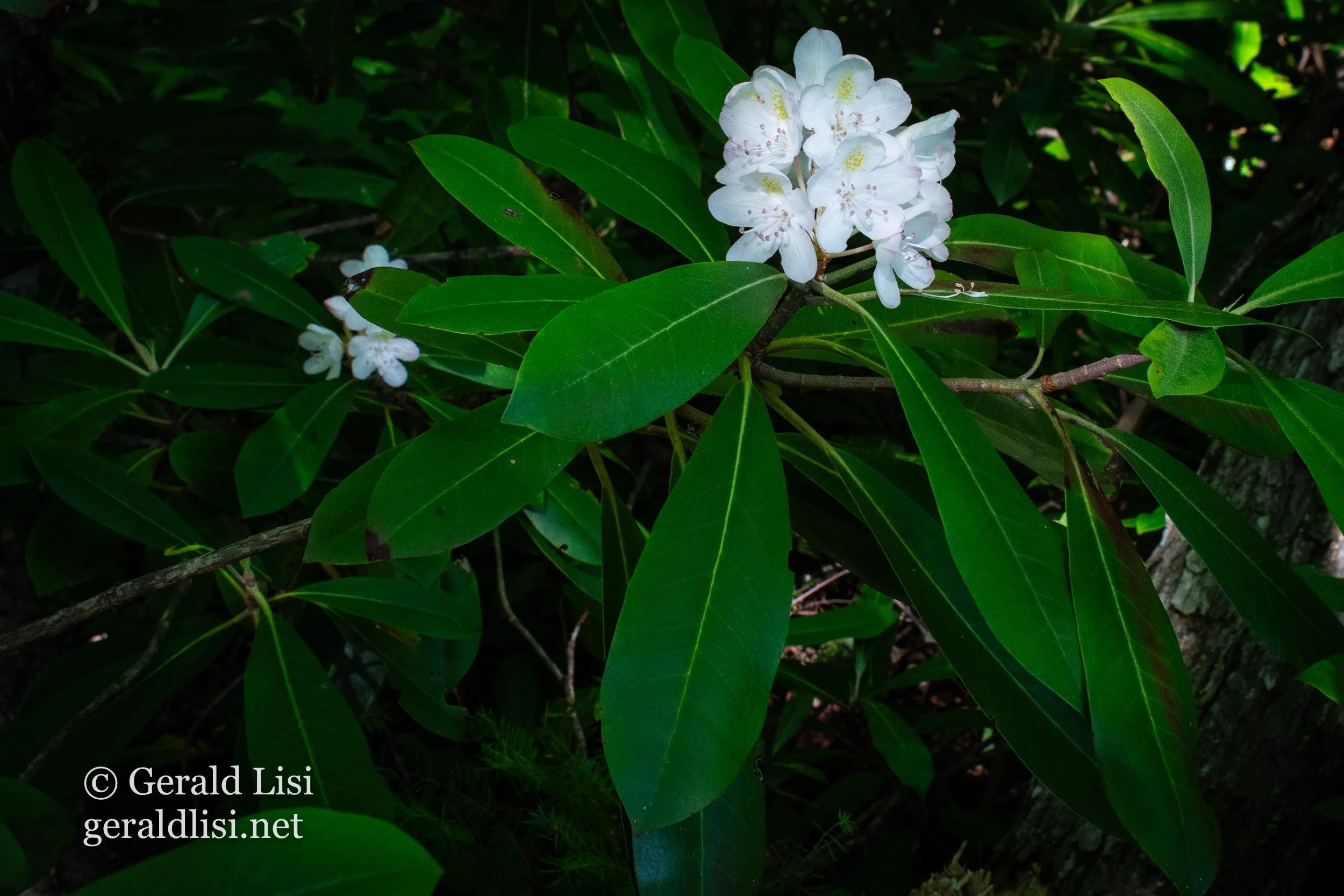
There’s no snow on the Rhododendron this Red-breasted Nuthatch is perched in (right by my door), but this was taken this month, December 2024. These tiny birds have voices that are as endearing as their faces, and as the only Nuthatch of the western Washington lowlands they have been a beloved part of my day to day life for the last twenty-six years. I’m so glad they’re here too, and that I have another every-day Nuthatch now too.
As I watched this White-breasted Nuthatch hunt for spiders and insects in the crown of this Yellow Birch I was thrilled to see him start making his way down the trunk towards me. White-breasted Nuthatches are twice the size of the Red-breasted, but somehow manage to have voices that are softer and sweeter. Of the two species I have had more encounters with White-breasted Nuthatches since returning to Vermont. The novelty is still fresh, so I’m loving that.
Here’s that same Nuthatch further down that same tree gifting me an absolute bird-photography highlight of the year. Thanks, little buddy!
American Crows are snow birds, and are particularly photogenic in this context. I’ve been slowly but surely ingratiating myself to the local murder. I wouldn’t have gotten this close to these two a month earlier. As ever-curious omnivores Crows are well equipped for the challenge of finding food in the lean times. Ravens are here year-round as well, but their tolerance is harder to earn. If I could do a post on Ravens in snow alone before the winter is over I would be most satisfied.
Our other Corvid, the Bluejay, is also a year-round resident. While Jays are distinct from their Crow and Raven cousins in many ways, they have being clever omnivores in common. I’m looking forward to getting a nice close up of a Bluejay in snow, but in the meantime this one amongst winter twigs will have to do.
Here’s an American Goldfinch on that same Rhododendron (which you’ll see even more of). This species is named for the summer plumage of the males. There’s much less difference between the sexes in their winter plumage, but the touches of yellow on this individual suggest a male. The cheerful flight calls of these little finches reveal their presence all year long, and this winter they are the only finch I have seen so far.
Going all the way back to a visit in January of 2016 with this photo of a Purple Finch female eating White Ash seeds. Finches are seed eating specialists, and the presence or absence of Ash keys and Ash-leaved Maple samaras determine their whereabouts in a given winter. The easiest way to distinguish female Purple Finches from female House Finches, who are also present year-round, is by the “eyebrow” seen here.
This male Purple Finch was the presumed mate of the female seen in the previous photo. While clearly not purple the males of this species are redder than those of House Finches. They also lack the brown caps and belly streaks of that species. Another year-round finch in northern New England is the Pine Siskin, although they can seem like winter finches since they’re more conspicuous in the winter. There are three strictly winter finches here; the Common Redpoll, the Evening Grosbeak, and the Pine Grosbeak. I’ve not seen any of these species yet this winter, but all of the winter finches are at the top of my wish list.
Tree Sparrows are winter visitors who breed in the far north. They head south to places like northern New England and the Great Lakes states to get away from the cold. Rugged! While they may actually enjoy the relative warmth, it’s most likely the relative abundance of food that makes them migrate.
Another view of the same Tree Sparrow, because who wouldn’t want to more of this sweetheart? I’m so glad I made a point of getting out to take her picture that day, because it turns out that she was just passing through. Hopefully she rejoined her flock, because that’s how these birds roll in the winter.
Historically their range barely reached southern Vermont, but Carolina Wrens have recently expanded their range northward. They have become a regular breeder here, and some even stay through the winter. I was very excited to discover one doing just that right outside my door. Hoping for better pictures, but for now just seeing and documenting this is exciting for me.
Mourning Doves seen through the window. You won’t hear their enchanting namesake song in the winter, but the whistle of their wings is a frequent sound as these skittish birds move back and forth between the ground and the trees.
Wild Turkeys live here year round, but these giants become quite conspicuous in the winter. This is part of a family of nine, which would be mom and this year’s young. Toms, the adult males, roll solo, and I’m sorry to say that I haven’t seen one yet.
Get a load of those wings! They’re mostly only used for short bursts of flight, to escape a predator or get into a tree for food or roosting.
A Pileated Woodpecker excavates a Balsam Poplar snag for Carpenter Ants. These crow-sized woodpeckers are North America’s largest since the untimely demise of the Ivory Billed. This is a female. The red of a male’s crest comes all the way to the base of his bill, and he has a red malar (mustache stripe). Pileated Woodpeckers require mature trees for their nest cavities, which become prime real estate for other wildlife after their first and only use by the woodpeckers. Like the Plieated our other winter woodpeckers, the Hairy and the Downy, are year-round residents.
And now I leave you with this Tufted Titmouse in a Paper Birch. I’ve been thrilled every time I heard or saw these larger cousins of chickadees this year. I’m delighted that I get to see their charming faces and and hear their endearing voices all year long.
That’s all for now, folks. I thank you sincerely for your time and attention, for they are our most precious resources. Where we focus our attention determines the quality of our too-brief time in this world, so I hope you found some beauty here, and learned a thing or two. If you’re so inclined I would love to read a quick note about where you are and what some of the winter birds are there. If you’re reading this in the newsletter just hit “reply.” If you’re on my website there’s a comment form right below this. Happy New Year!
Prairie Dogs, Bison and Badlands
If the title of this post makes you think of South Dakota then you are correct. After a couple months of recent Vermont content I am returning to my summer road trip that brought me here from Washington. Today I am sharing images from my scenic detour through the jaw-dropping Badlands National Park.
This means you will mostly be looking at landscape photography, but first I’ll show you images of two iconic mammals of the Great Plains. As I approached the entrance of Badlands National Park I was delighted to see Bison to my left. As I pulled off the road to the right I saw and exclaimed “Prairie Dogs!” While I had just photographed a couple lone Bison two days before in Yellowstone I was no less excited to see several here, and this was actually my first chance to photograph Prairie Dogs.
Black-tailed Prairie Dogs, Cynomys ludovicianus.
Prairie Dogs are not dogs (family Canidae), as I suspect most people realize. What may be less obvious is that they are squirrels (family Sciuridae). The dog reference in their name refers to the barking sound they use as an alarm for each other when they spot predators. These colonial ground squirrels were abundant throughout the Great Plains before of European settler colonialism decimated their habitat and persecuted them as agricultural pests.
Prairie Dogs are keystone species, which means that if they are removed from an ecosystem many other species will decline or disappear from that ecosystem themselves. Both plant and animal diversity benefit from how Prairie Dogs live their lives. By keeping all of the vegetation in their colonies cut short they enable plants that would otherwise be shaded out by tall grasses to become established. Plant diversity begets animal diversity by way of myriad specific relationships between plant and insect species. Prairie Dogs also benefit other vertebrates, as prey for numerous carnivorous mammals and several species of raptors. One of these carnivores, the Black-footed Ferret, Mustela nigripes, preys almost exclusively on Prairie Dogs. With Prairie Dogs extirpated from most of their historical range it’s no surprise that Black-footed Ferrets are an endangered species. One species of owl also relies heavily on Prairie Dogs, but not as food. Burrowing Owls, Athene cunicularia, don’t actually burrow, but they do nest in the burrows of other animals, especially Prairie Dogs. Less Prairie Dogs means less nesting habitat for Burrowing Owls. Neither Prairie Dogs or Burrowing Owls are classified as endangered like Black-footed Ferrets, who number about 300 in the wild, but populations of both have been declining for years. But Prairie Dogs are now protected in areas where Black-footed Ferrets have been reintroduced. This is a great start. Promoting tolerance and appreciation of Prairie Dogs outside of protected areas would be a boon to Black-footed Ferrets, Burrowing Owls, and many other species.
Standing up on their hind legs to survey their environment for predators is common behavior for many species of squirrels.
American Bison, Bison bison.
The story of American Bison (also known as buffalo) is better known than that of Prairie Dogs, and even more tragic. They nearly followed the Passenger Pigeon into extinction. The wholesale slaughter of Bison was similar to that of Passenger Pigeons in that it involved over-harvesting and the destruction of natural habitat. But it was even more nefarious in that the deliberate extermination of Bison was a major part of the genocide of indigenous people whose lives were largely built around them.
Fortunately the destruction of these incredibly important animals was not complete, and efforts to restore them since the early nineteen hundreds have been fairly effective. Particularly inspiring to me is the fact that Bison are being restored on the lands of many Native American tribes. But the great herds that roamed for a hundred thousand years could not return to the North America of today. Still, with continued effort on their behalf the wild herds that exist today could grow, and be at the center of landscape-scale ecological restoration and rewilding.
I felt some joy in spending time with with Prairie Dogs and Bison, but that happiness was tempered by grief for their long suffering at the hands of callous, ignorant people. There may have been more heaviness than elation in my heart as I got back in my car. But I hope that as I quickly move past this vast subject I leave you with a sense of hope. American Bison and Black-footed Ferrets were brought back from the brink, and Black-tailed Prairie Dogs have persisted against the odds. In making a better world for wildlife we improve our own prospects. Restoring the Earth’s wildlife and wild lands could ensure our long-term survival as a species, but it could do more than that. It could heal our broken hearts.
After a short drive away from the Prairie Dogs and Bison the grassland abruptly gave way to fissures in the Earth. I took the first parking space I could, put my wide-angle lens on my camera and stepped out of my car. Anticipation gave way to awe as rippled canyons sprawled out before me, etched with the strata of deep time. The powerful winds complemented the dramatic geology, if not my attempts to hold my camera steady. Here I will leave my labored prose behind, and hope that you enjoy the pictures ahead.
That’s all for now, folks. Thank you for your time and attention. I hope you’re feeling love for Prairie Dogs and Bison, and that it may inspire you to support their conservation and restoration. I also hope that my photos of Badlands National Park did justice to its awesome beauty in your eyes. If you would like to support my work you can do so at my store, https://www.geraldlisi.net/store-1, where my 2025 calendar, hand-made cards, prints, and a kids’ wildlife book are available. If you are reading this as an email please forward it to someone that might enjoy it. If you’re reading this on my website please sign up for my newsletter at https://www.geraldlisi.net to get future editions in your inbox. Until next time, my friends. Please take care of yourselves, each other, and the land you live on.
Vermont’s Autumn Spectacle
I anticipated Vermont’s famous fall foliage this year with great excitement, not having seen it from beginning to end in twenty-seven years, and my high expectations were fully met. Growing up in Vermont autumn never ceased to amaze me. Sure, some years are more spectacular than others, but to my eyes it was never less than amazing.
Now, as a nature photographer who is increasingly focused on landscapes, this autumn in central Vermont was a fantastic opportunity to practice my craft and build my portfolio. Fortunately I was able to dedicate many hours on many days to these pursuits. Where last month’s post saw me saying “good enough” to many images in order share some of my summer’s birding highlights, this month I am show you examples of what I consider to be some of my best work. Taste is subjective, of course, and I know that some of you enjoy my wildlife photography more than my landscapes. I also know that for some it is the opposite. Regardless of where you fall on that taste spectrum I appreciate your time and attention. I hope that at the least you find beauty in these pictures, and that perhaps you will even glimpse some of the wonder and awe that I felt while making them.
Worcester seen from Blush Hill in Waterbury.
Witch Hazel, Hamamelis virginiana.
Virginia Creeper, Parthenocissus quinquefolia.
Gray Birch, Betula populifolia and Hemp Dogbane, Apocynum cannabinum.
Moscow.
Stowe Pinnacle seen from Moscow.
Hunger Mountain seen from Waterbury.
Spruce Mountain with White Pine and Goldenrod seen from Marshfield.
Sadie Foss Road, Calais.
Sodom Pond, Adamant.
Owl’s Head and Stillwater Marsh, Groton State Forest.
Winooski River and Spruce Mountain, Plainfield.
Winooski River, Duxbury.
Camel’s Hump from Moretown.
Red Maple leaves on rotting Paper Birch.
That’s it for now, folks. I hope you enjoyed this selection of landscape images. If you did then you should also like my all-landscapes 2025 calendar, which is now available, as well as a new selection of greeting cards. You can find them here: https://www.geraldlisi.net/store-1
If you are reading this in an email please consider forwarding it to someone who might enjoy it. If you’re reading it on my website please consider subscribing to get my monthly post in your inbox. Just enter your email address at https://www.geraldlisi.net/ and make sure to respond to the confirmation email. Thanks and take care!
My Birdy Summer
I’m not much of a birder, which is to say that I’m not that good at it. I rarely keep lists while birding, and I don’t use eBird. Also, my birding by ear is very weak, and any good birder knows that recognizing songs and calls is the gateway to most of the avian universe. I could certainly go on about my shortcomings as a birder, but that would be tiresome, so let’s get on with how mediocre I am as a bird photographer.
My bird photography is crap on average, but you don’t see most of it. Judging by the images I choose to share here and on social media it’s pretty good. That’s an average again, taken from a quality range between “good enough” and “actually really good,” which is not to be mistaken for “great.”
In spite of all this self bashing of my credentials as a birder and bird photographer this post will be comprised entirely of bird photograph, (aside from this drivel and the captions of course). Because here’s the thing: I love birds. I meany I REALLY LOVE BIRDS. Ever since I decided to finally dig into my first Sibley Field Guide, perhaps fifteen years ago, I have been tumbling head over heels down a feather-lined tunnel system whose chambers echo with the sounds of countless syrinxes.
Most of this wonderful adventure has occurred so far in western Washington, which is an excellent setting for such a thing. But a change of environments can be quite rewarding for a birder, and when that change involves three thousand miles of distance the differences can be significant. So it was that my return to Vermont this June involved a great deal of excitement about the bird life here. Now, after a summer shared with dozens of bird species, and many hours spent trying to photograph them, I present you with selections from the good-enough, pretty-good, and actually-really-good results.
Ovenbirds create a major component of the soundscape in the Northern Forest in June and July. The swelling staccato of their songs has enchanted me since I first gave it a proper listen several years back. These warblers are outliers in their family. Natural selection in the forest floor habitats they share with thrushes has given them a distinctly thrush-y appearance. An exquisite example of convergent evolution. This Ovenbird has procured a juicy caterpillar, most likely for one of their chicks. The ability of Lepidopteran larvae to turn leaves into protein and fat enables hundreds, if not thousands, of bird species to feed their rapidly-growing young.
The voices of Red-eyed Vireos are the most heard by this bird nerd during the summer in the northern Green Mountains. Their deceptively simple songs come from all directions, at short intervals, all day long. Getting a good look at one on the other hand is no simple matter. Their entire bodies can be hidden behind the leaves of their deciduous canopy habitat. Of course when I did get a clear view of this one it was in the deep shade, where my equipment performs poorly, but Red-eyed Vireos were far to big a part of my birdy summer to be left out of this collection.
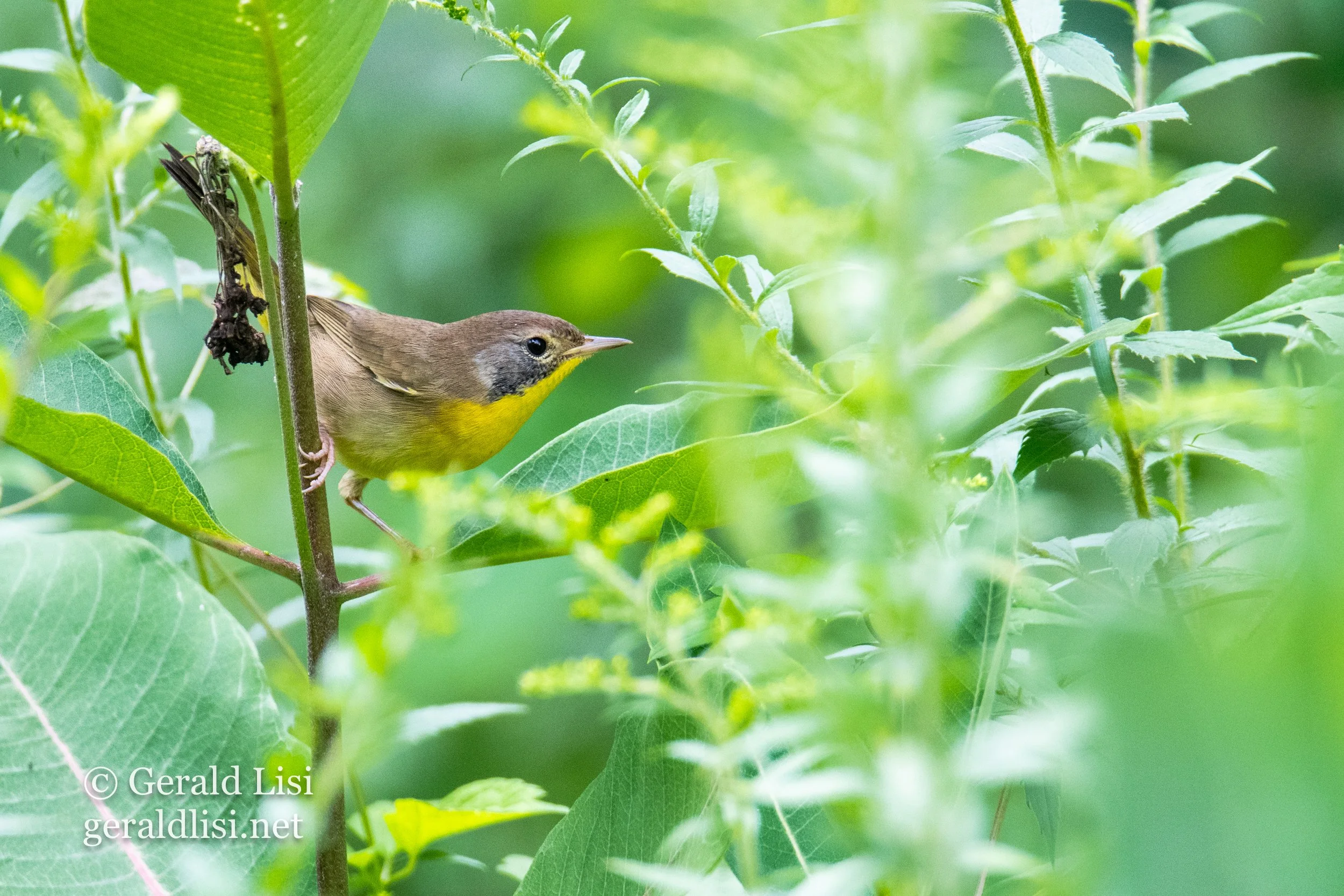
Common Yellowthroats are one of the easier warblers to spot since they live their lives at or below eye level in wet meadow and marsh edges. Olive and yellow feathers are common in this large, delightful family of song birds, but an adult male Common Yellowthroat’s black mask with white border above and yellow throat and breast below give a positive ID of this species.
Tufted Titmouse in Eastern Hemlock.
These larger cousins of chickadees have similar habits and charms, and they have crests! They are not so common as Black-capped Chickadees though, and I still get excited every time I see one.
Broad-winged Hawks are very vocal, with a distinct whistling call. Once I learned that call I quickly realized that these forest hawks are all over central Vermont. I was lucky enough to have this juvenile frequent the woods by my home.
These young Wild Turkeys were just poults when I first saw them. Here I barely managed to catch them fleeing into the forest yet again. Their mom taught them well.
Here's half of the breeding pair of Common Loons that claim a beloved local pond as their nesting territory. A friend of mine took me for a paddle in search of them and their chicks one July morning, and the loons obliged us! I remembered well how beautiful these icons of wild waters are, but was also struck by how big they are.
The loon chicks mostly stuck together, and a parent was always nearby. At this point they were still entierly dependant on thei parents' fishing skills, but learning to catch their own must have come very soon.
Bluejay in White Ash. A childhood favorite of mine, as for many other I'm sure, before I knew about warblers, vireos, wrens, kinglets and so many other kinds of birds. I still love Bluejays of course, and all of the other corvids.
Blackburnian Warbler in Paper Birch.
No close ups of this bird for me. Typical of many Wood Warblers, they sing their songs from high in the trees where even a long lens, spotting scope or a pair of binoculars often won't provide a good look. It's when they're silently foraging on lower branches that those of us who obsess about seeing these birds are most often finally rewarded.
This Northern Parula was one of my lifers (first sighting of a species) of the summer. In typical warbler fashion I heard their songs many times and repeatedly craned my neck for extended periods of time before I actually got a decent view of this guy singing.
Black and White Warblers nave a foraging style like that of the nuthatches, gleaning insects and spiders from bark rather than leaves as they wind their way down trunks and branches.
I was surprised to hear this American Redstart singing in late August, weeks after the songs of most other birds had stopped. Here he listens to another male who is singing nearby. With this year's young now raised this territorial behavior most likely is about control of foraging grounds.
This Black-throated Green Warbler female gifted me many nice glimpses as she hunted in the trees of my backyard. Unlike many warbler species whose females lack the brights colors of males Black-throated Green females have the same basic plumage patterns as males, minus the namesake black throat.
Black-throated Blue Warblers were perhaps the most exciting lifer for me this summer. This male in Plainfield was the second individual I had the pleasure of seeing and photographing.
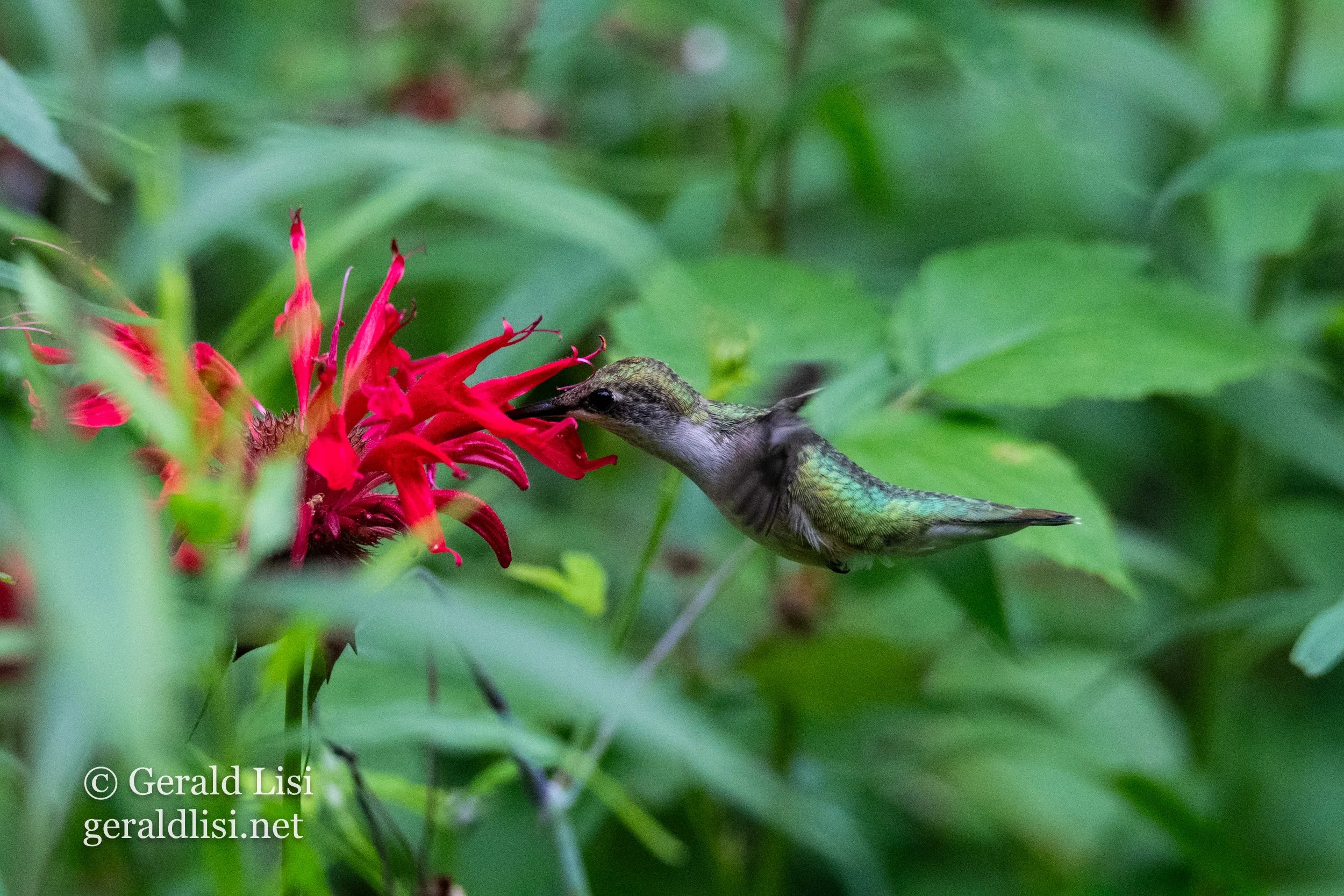
Moving from one family of small, colorful birds to another, I am happy to leave you with this female Ruby-throated Hummingbird. After repeated unsuccessful stakeouts of this Bee Balm patch my persistence was finally rewarded with the shoot that yielded this shot of her hovering between sips of nectar.
Sixteen pictures of fifteen species of birds is a very small sample of my birdy summer, but I think this is about as long as a post should be. If you’re still with me I thank you for your time and attention. I do hope it was rewarded. May you cross paths with many birds, and allow their feathers, voices and behaviors to draw your attention away from less wonderful things.
A Few Hours in Yellowstone, June 5th
One should spend a few days in Yellowstone National Park, not a few hours. I didn’t have a few days to spare, but I couldn’t just drive right past it. A friend who put me up in Livingston the previous night said that at the least I should see Mammoth Hot Springs, which was a bit over an hour away. I gladly took the advice, and ultimately decided I would drive through the park and out the west entrance rather than backtrack up to I-90. The next morning I found that there was road work on the way to the park, which more than doubled my travel time to the park entrance. By the time I got to Mammoth Hot Springs it was nearly noon, and the harsh midday sun was far from ideal for photography. But, the springs and the landscape around them were incredible, and I did the best I could. There’s a whole lot of Yellowstone between Mammoth Hot Springs and the west entrance of the park, but I’m not trying to cover all of that here. What I am sharing with you now is mostly selections from the springs and some wildlife highlights from my subsequent drive through Yellowstone. Enjoy!
The mountains of northwestern Yellowstone seen from Livingston, Montana the previous evening. The entire drive through Montana was incredible, and I was constantly struggling not to stop on the side of the freeway to take pictures. I was grateful that my friend in Livingston walked me to this incredible view, which will have to stand in for all of the jaw-dropping scenery drove through that day.
On the drive from Livingston to Yellowstone I spotted this beautiful Pronghorn. She was a couple hundred feet away, and the full sun was already high in the sky, but I wasn’t going to waste my first opportunity to photograph this awesome mammal.
The main parking areas at Mammoth Hot Springs were full when I got there, of course. But, I enjoyed some fantastic views on the walk from the next parking area up the road.
This stream fed by the springs ran under the trail.
Steam rises from an unseen pool at the edge of the hot springs.
Shallow pools on the a massive hill built by calcium carbonate deposition from the springs. The white is limestone, while colors in the water are from thermophilic cyanobacteria.
Thermophile mats on limestone terraces.
Juniper by one of the vents.
A Killdeer forages in a dry pocket created by a natural mote.
I wasn’t expecting to see Sandhill Cranes. An awesome surprise!
An American Bison licks his nose for the camera. Silliness aside, seeing wild Bison is profoundly moving. May they return to more of their ancestral lands in the centuries to come.
This old Bighorn Sheep ram has true grit. He lingered by the road after the rest of the herd finished their very slow crossing. Cars and RV’s didn’t concern them, and of course the drivers welcomed the chance to see these mountain icons up close. Not the setting I would choose given the option, but still a great pleasure to photograph them.
Having driven ahead and found a pull off to better enjoy the Bighorns I was also rewarded with a cautious visit from this Hoary Marmot.
By now it was late afternoon and I had some much better light for photographing the western edge of the park. I believe these mountains are known as Wapiti Ridge
And with that I close this edition. Thank you for the gift of your attention. I hope you feel that it was rewarded. If you are a subscriber please consider forwarding this email to someone who might enjoy it. If you are reading this on my website please consider subscribing at https://www.geraldlisi.net. If you would like to support my work please visit my store at https://www.geraldlisi.net/store-1. If you would like prints of any of the images in this post please email me at woodsling@geraldlisi.net. Or, if you are so inclined you can make a patronage gift on Venmo where I am @Gerald-Lisi or PayPal where I am Gerald Lisi Photography. Thanks again to anyone who is reading this. Please be kind to yourselves, to each other, and to the land you live on.
North Cascades Highway, June 1st
As promised in my previous post I am sharing a bit of my recent road trip before deep diving into Vermont natural history. Not every day of the trip will get a post, but day one definitely does.
After twenty-six years of living in my second home of western Washington I began my journey back to my first home of Vermont on the first of June, 2024. I-90 would take me most of the way, but at a dear friend’s brilliant suggestion I took a circuitous and very scenic route for the Washington leg of the journey. I had taken I-90 over the Cascades many times already, and Highway 2 quite a few, but somehow had never done the whole stretch of North Cascades Highway. This was a fine time to rectify that folly.
Those who are kind enough to follow my photography generally seem to think of me as a wildlife photographer. I am endlessly enamored with birds and other animals, and can’t seem to stop trying to take their pictures. But, wild landscapes also capture my gaze and stir my heart, so I am always hoping to improve my landscape photography. North Cascades National Park is a spectacular place for such efforts. I could easily spend several days there shooting landscapes, but several hours was all I could afford. Luckily this was enough time to yield a few keepers, and I am happy to share them with you below.
Mossy Western Redcedar by the Skagit River. The light was difficult for this shot, but I loved the juxtaposition of dark, mossy trees against glowing aqua water.
Douglas Fir and Western Redcedar tower along the Skagit. Bigleaf Maple and Red Alder lean out from beneath them.
Douglas Fir line the rocky cliffs of the North Cascades.
Putting the cliff in the previous image in context, we see the massive boulders below which are buried in raging snow melt every spring.
The presence of Paper Birch in the northernmost part of Washington’s North Cascades is an ecological novelty to me. Having this common and iconic tree of Vermont growing among the Douglas Fir that epitomize the Pacific Northwest forests connects my two homes. Paper Birch is actually present from coast to coast in Canada, and in much of Alaska, but only dips down into the coldest northern regions of the lower forty-eight of the United States.
Subalpine Fir in the North American Alps. The spires of this high-mountain specialist predominate around tree line on this western slope, with Mountain Hemlock being the second most common species. Tree diversity declines sharply at high elevations.
Mountain Hemlocks frame rugged peaks. The yellow seen on the dead ones is Wolf Lichen.
Kinnickinnick thriving on a south-facing granite outcrop.
A Lodgepole Pine limb hangs over lichen-speckled granite.
One of the spectacular views from Washington Pass Overlook. The leaning tips (“drooping leaders” in ecological jargon) of the Mountain Hemlock distinguish them from the Subalpine Fir.
I’ll leave this on a high note, 5,477 feet to be precise. I do hope you enjoyed these images, and maybe learned a thing or two. If you are a subscriber please consider forwarding this email to someone who might enjoy it. If you are reading this on my website please consider subscribing at geraldlisi.net. If you would like to support my work please visit my store at https://www.geraldlisi.net/store-1. If you would like prints of any of the images in this post please email me at woodsling@geraldlisi.net. Or, if you are so inclined you can make a patronage gift on Venmo where I am @Gerald-Lisi or PayPal where I am Gerald Lisi Photography. I thank you sincerely for taking the time to read this and look at my photography. Please be kind to yourselves, to each other, and to the land you live on.
May I still Share May with You?
I think that indeed I must share May with you, even if June is nearly over now. My April newsletter marked a full year of monthly posts, with the first nine being exclusive to my email subscribers. I didn’t want to skip May, but it was a whirlwind of a month and I just couldn’t find the time to post. I did manage a few good photo shoots though. Since May is my favorite month, and because this May was my last living in beautiful Washington state I feel the need to get it on record.
After this post I will veer away from the monthly-recap format, in terms of both frequency and content. This month has provided several months worth of posts, so I will be sharing highlights from my drive across the country before deep diving into the flora and fauna of Vermont. But for now let’s look at a bunch of birds, a few plants, a mammal, and a mountain in the lovely Snoqualmie Valley of western Washington!
Bigleaf Maple’s fruits mature in May. The double samara is the calling card of all maples. This image would be great in a field guide, if I do say so myself. Are any publishers reading this?
Black-headed Grosbeak in a Beaked Hazelnut. One of the most heard birds during spring in the Duvall area, where I lived, is also one of the most striking. I must admit that until a few years ago I mistook the “drunken robin” calls of these birds for, well, drunken robins.
The exquisite leaves of Western Redcedar. The bright green tips are the spring’s new growth.
Speaking of Western Redcedar, here’s a gorgeous Band-tailed Pigeon sitting in one.
Since this Band-tailed Pigeon was such a good model I can also show you her lovely wings and back. Speaking of field guides….
Fringecup Flowers rising through young Thimbleberry leaves and Giant Horsetail. As seen in some other white flowers those of Fringecup turn magenta as they age.
A major highlight of my spring, and indeed that of many western Washington birders, was the presence of Evening Grosbeaks. These denizens of mountain conifer forests are known to grace the feeders of bird lovers in the lowlands during the winter. Apparently this species had a great mating season last year and/or their spring food supplies in the mountains were lacking because May saw them greedily gobbling black sunflower seeds as we gratefully gawked through our windows. Too much alliteration? Sorry, not sorry.
Like other finches Evening Grosbeaks are sexually dimorphic. Pictured here is the female. Unlike some other grosbeaks (Black-headed, Rose-breasted, and Blue) Evening Grosbeaks are finches. The giant bills that join them in name are the result of convergent evolution, not a recent common ancestor. One other North American finch has this trait and resulting name: the Pine Grosbeak. Since I mentioned evolution by natural selection while discussing finches I am reminded of an excellent book: ‘The Beak of the Finch’ by Jonathan Weiner, explores Peter and Rosemary Grants’ fantastic long-term research on Darwin’s Finches in the Galapagos Islands. It’s extraordinary how rapidly evolution by natural selection can initiate speciation under the right circumstances.
Moving back to quick, simple captions, here we see a male Evening Grosbeak in a tree you should now be able to identify.
Not my best Steller’s Jay photo, but it may be my last, for a while at least. I’ve gone from being nostalgic about Bluejays, who I now enjoy daily again, to getting sentimental about Steller’s Jays, who graced my days for the last twenty-six years.
A young elk bull of the much celebrated herd in North Bend. I don’t suppose he’ll be winning any harems this year, but perhaps after another trip around the sun. Speaking of elk, I must confess some misgivings about the June photo in my 2024 calendar. I’ve been in two households this month where my calendar was displayed. This makes me happy of course, but I’m not sure that that photo should have made the cut. It’s certainly not bad, but the composition just isn’t up to calendar snuff. Anyway, I hope the handful of people that have my calendar have enjoyed it, but I’m glad they’ll be turning the page shortly.
One last look at Mt Si, and it was a spectacular one from the North Bank of the Snoqualmie River. The tall trees in the foreground are Black Cottonwood. The northeast is graced by many Populus species (cottonwoods, poplars, and aspens), but none attain the awesome stature of the Black Cottonwoods (Populus trichocarpa) growing by the rivers and lakes of the Pacific Northwest.
A pair of Barn Swallows enjoy a moment of rest together under a pier at Deception Pass. Their nest, and many others, were also under the pier.
A pair of Pileated Woodpecker nestlings eagerly await a food delivery. By the look of them they were close to fledging. Finding this nest fulfilled a long-time wish of mine, a birthday-week present from the universe.
My friend and I waited for about an hour for a parent to come feed the nestlings. It was so worth it when Mom showed up and the kids went crazy. "Feed me!" "No, feed ME!" Etcetera, on and on. Of course she had plenty of regurgitated ants and other insects for both of them. It was a joy to witness this.
And the first feeding goes to…. the chick on the top! The other chick is still yelling for food the entire time.
“Hang on. Let me regurgitate some more bugs.” Chicks yelling… Note the chick on the bottom shifting to the left.
And now the other chick gets their portion. Seemed pretty equitable, and judging by the look of these two I would say it generally was. By now they’ve been out in the world for weeks. Their parents taught them how to catch their own damn food, and now insist that they do so. I wish them all the best and am grateful for this little peek into their lives.
Alright, had enough? I sure hope so, because that’s all, folks! I do hope you enjoyed the photos and learned a thing or two. If you would like to support my work please consider visiting my store at https://www.geraldlisi.net/store-1 . If you would like prints of any of the images in this post please email me at woodsling@geraldlisi.net. Or, if you are so inclined you can make a donation on Venmo where I am @Gerald-Lisi or PayPal where I am Gerald Lisi Photography. I thank you sincerely for reading this newsletter. I’ll have another one for you soon. Until then, please take care of yourselves, of each other, and of the land you live on.
Leaf Out!
April sees the greening of the western Washington lowlands. With the waking of the trees comes the emergence and/or accelerated activity of so much animal life. Clouds of midges, flies and mosquitos feed swallows, while butterflies, bees and wasps feed at flowers. The voices and pheromones of birds fill the air as the urgent business of pairing, mating and nesting drives avian metabolisms into overdrive. The fruits of early-flowering plants are already forming by the end of the month as another wave of blooming unfolds. April here is a great month for birding and botanizing, and if you’re lucky you might encounter some snakes and lizards. Below I offer photographic evidence of my own such adventures.
Black Cottonwood, Red Alder and Bigleaf Maple leaf out in a riparian forest by the Snoqualmie River.
A pair of tree swallows (male in the top of the frame) enjoy a little rest together after a full morning of catching insects on the wing.
My first-of-year Black-throated Gray Warbler searches Red Alder leaves for caterpillars. Resident song birds like Robins, Song Sparrows, Bewick’s Wrens and Dark-eyed Juncos are already nesting when these migrants arrive in the latter half of April.
Audubon's Yellow-rumped Warbler male.
Unlike most wood warblers we have this species year round on the West Coast. They do become more conspicuous in spring though, both because of their bright breeding plumage and because of their courtship behavior.
Like all warblers they eat insects, but Yellow-rumped, which also includes the Myrtle form, are unusual in that they sally for flying insects. This behavior involves flying out from a perch to catch a flying insect then returning to their perch to eat it. Sallying is the fly catching behavior that gives Tyrant Flycatchers, Family Tyrannidae, their name. Most Wood Warblers, Families Parulidae and Peucedramidae, pick insects and arachnids from leaves, but Yellow-rumped Warblers are fly catching wood warblers!
While Audubon’s are common here we also get some Myrtle Yellow-rumped Warblers. This one is surrounded by the flowers and growing leaves of Bigleaf Maple. As I write the leaves are big and green, and baby samaras are emerging from the fading flowers.
Black Twinberry flowers summon hummingbirds to drink nectar and transfer pollen. This wetland shrub is a member of the honeysuckle family.
Saskatoon Serviceberry flowers feed bees, and their dark blue berries are enjoyed by many birds and mammals.
A Black-capped Chickadee searches a willow fruits for insects.
The fruits of this other willow nearby were bursting forth with their cottony, wind-borne seeds.
This baby Garter Snake was about the thickness of a pencil.
A Northern Alligator Lizard plays peekaboo with me.
If you don’t share my adoration for reptiles I trust this Canada Goose gosling will get your “cute!” response going.
That’s all for this time, my friends. If you’re reading this as an email please feel free to respond with any feedback, and if you’re on my website you can comment below. If you’re not getting my emails but would like to you can subscribe here: https://www.geraldlisi.net/
I hope that your spring is affording you some wild encounters, and their gifts of wonder and awe. Please take care of yourselves, each other, and the land you live on.
March into Spring!
March is a good month in western Washington, and my final March here has not disappointed. We’ve had a good deal of sunshine, along with plenty of rain and some hail. The sun is always a major mood booster after months inside of giant, gray clouds, and my spirits are equally buoyed by the awakening of plant life. The greening of the forest floor proceeds slowly but surely as the month proceeds. The leaves of Western Bleeding Heart and Pacific Waterleaf emerge in the first week, and the former flowers in sunnier places by the last. Stinging Nettles rise, demanding respect and tempting foragers. The wind-pollinated trees and shrubs let it all hang out; Hazels, Alders, Cottonwoods and Willows release and receive pollen as the ancients did, before plants partnered with insects to satisfy their sexual needs. Of course many insects are hatching or awakening now too, and these invertebrate links between plants and vertebrates in the food chain are welcomed to the mouths of birds and bats, and the anthers and stigmas of flowering plants.
Tree Swallows and Violet-green Swallows arrive from the other America to feed on early insects and secure nest sites. Rufous Hummingbirds, first males then females arrive, for their breeding season too, but most of the migratory breeding birds will show up in April. Meanwhile our year-round resident birds are rapidly gearing up to satisfy their biological imperatives. The songs and calls increase by the day, and fierce competition for mates and nesting sites enliven the pulse of the avian world. It is primarily that world that has drawn my lens this month, and thus it will dominate the photographic offerings of this post. I will also share a favorite wildflower, photographed today, March 31st. But in the meantime, let’s look at birds!
March is our last chance to see overwintering Trumpeter Swans, Cygnus Buccinator, before they fly to their northern breeding grounds. This individual on Lake Washington is looking quite regal. Safe journey and successful mating, your highness!
An Anna’s Hummingbird, Calypte anna, incubates her two eggs in a typically exquisite nest. The cup, which is only a couple inches across, is made of spider silk and moss, adorned with bits of lichen. It is lines with soft material, Cattail seed fluff in this case since she’s by a wetland. My friend, who goes by “Whispering Wind” on Instagram and Facebook, has a gift for finding hummingbird nests, and she shared this one with me.
Following up on this nest three weeks later we found two chicks very close to fledging. Here they silently beg their mom for regurgitated insects and flower nectar. The colorful gapes of chicks send a “put food here” message without the danger of attracting predators with loud begging vocalizations.
A Bushtit, Psaltriparus minimus, drops from a willow twig after gleaning it for insects and spiders. Like Anna’s Hummingbirds, Bushtits have only recently expanded their range out of the Southwest into the Pacific Northwest, but both are now common and beloved here.
A Black-capped Chickadee, Poecile atricapillus, searches a dead cottonwood leaf for spiders, insect eggs or larvae. The “deee deeee” mating song of this familiar favorite is a quintessential, and joyous, sound of spring.
The songs of Bewick’s Wrens, Thryomanes bewickii, are a delightfully prevalent sound in March. I’ve not photographed them in the act for years, but I did have the brief opportunity for this closeup a couple weeks ago. Thanks, little buddy, and good luck with the baby making!
Any self-respecting Cattail marsh, or other North American wetland, should have resident Marsh Wrens, Cistothorus palustris. These wonderful little wrens are mostly secretive, even singing their very complex songs while concealed by vegetation. But luckily the need to find mates and deter competitors does sometimes embolden the males to sing from conspicuous perches. After hearing this guy belt it out many times from afar I was thrilled to see he was on exhibition when I approached his virtuosic voice.
A Pied-billed Grebe, Podilybus podiceps, cruises Union Bay in Seattle, where so much of my early journey into birding and bird photography took place. While their breeding plumage (feathers) are the same as the rest of the year, their bill coloration changes, and gives them their common name.
Several Pied-billed grebes were present on this visit, and all were catching fish like the pros they are.
A California Scrub Jay, Aphelocoma californica, looks for action from a fence post. These Corvids are uncommon where I live, but abundant in oak woodlands of southwest Washington, Oregon, and yes, California and Baja California. Of course when I finally get a chance for some closeups of one they’re on an ugly post. Still, I’ll take it!
From the fence post into the grass, where moments after this shot our hero grabbed a fat, juicy caterpillar. I do have a picture of them with prey in bill, but it didn’t make the cut.
A Great Blue Heron, Ardea herodias, displays his magnificent plumage. When songbirds fluff their feathers they look like cute little “floofs”, but the same maneuver in a Great Blue evokes a samurai warrior in armor. It’s fitting since the yellow bill of death truly is the katana of the avian world.
After that grim reference to death by keratin I hope I can calm you with this lovely patch of Western Trillium, Trillium ovatum. The blooming of this beauty is indisputable proof that spring has sprung indeed.
That’s it for this time, my friends. Thanks for joining me. I hope you found some beauty and learned a thing or two. If you had this forwarded to you as an email, or are reading it on my website, please consider joining my mailing list yourself at https://www.geraldlisi.net/ Until next time, Take care of yourselves, of each other, and of the land you live on.
Short-eared Owls and "Friends"
Short-eared Owl, Asio flammeus.
Short-eared Owls, Asio flammeus, are a medium-sized owl found across much of the world. As denizens of grasslands and other open habitats, the heavily-forested Pacific Northwest coast long had little to offer these owls, but land conversion for agriculture has created habitat for them in the Puget Trough. Here they are considered fairly common, while in other regions of Washington they are uncommon, rare or absent (birdweb.org). The attraction of wet, grassy fields in places like the Skagit Valley is an abundance of voles. Short-eared Owls also eat mice, and some other, larger small mammals. But, here it’s all about the voles, most likely Townsend’s Voles in most cases, which are far larger than any mice I know of.
My friend and I have visited this particular spot in search of Short-eared Owls every winter for the last few years. This has yielded some distant spottings and a whole lot of nothing, but our timing was spot on this occasion. As we rounded the bend there were rows of cars parked on each side of the road, and people with long lenses, spotting scopes and binoculars standing beside them. While I have no affinity for crowd birding my distaste was quickly overrun by the excitement of seeing the owl pictured above right by the side of the road. Amazingly there was a parking space directly across the road. As soon as I parked we high fived and got our cameras out. Some pictures were taken from the car, and when we saw that the owl seemed in no rush to leave we got out for better and different views. Below are my highlights from this spectacular afternoon of birding.
Taking off to look, or more aptly listen, for voles. Their facial disk creates the flat appearance of their face in profile. This feather arrangement, which is seen in many owl species, acts as a dish that routes sounds to owls’ ears on the sides of their heads.
After a brief flight the owl settled onto another perch. A dead thistle stalk in this case. The fact that it easily supports this owl drives home how light they actually are. When we look at birds most of what we see is feathers. The ever-so-subtle “ears” in these owls’ name are somewhat apparent in this shot. In contrast, the namesake tufts on the closely related Long-eared Owl are highly conspicuous.
Before I share more owl photos with you let’s look at some of the “friends” mentioned in the title. I use quotes because Short-eared Owls don’t seem to have friends, with the possible exception of their mates and young during breeding season.
“I just flew in from the Lower Cretaceous and boy are my arms tired.” Apologies to my social media followers who already saw this caption with the frame taken right after this one. That’s a slightly sharper photo, and a more flattering picture of this Great Blue Heron, but this one highlights a fascinating bit of bird anatomy. As this heron let out their Pterodactyl gronk they revealed the jointed bones of their lower mandible. Various long-billed birds have jointed beak bones that serve them in various ways. In the case of Great Blue Herons it helps them to swallow the astonishingly enormous prey they sometimes capture. I once watched one swallow a huge catfish over the course of about five minutes. I didn’t think they would get it down, but they sure showed me.
This Great Blue Heron was here for the same reason as the Short-eared Owl: voles. While they are wading bird that hunt fish and other prey in the water it’s not uncommon to see Great Blues hunting in fields for rodents, and snakes in the warmer months. In the case of winter vole and mice hunting this makes them competitors with Short-eared Owls, but the owls seem to ignore this particular competitor.
A pair of Trumpeter Swans from a nearby grazing flock fly by. Short-eared Owls are likely indifferent to these giant vegetarians, but I was excited to see them flying low only twenty feet away.
One more Trumpeter shot. They are a major winter birding highlight here.
Can you guess what this Northern Harrier is after? Yes, it’s voles, and the overlapping ecological niches of Northern Harriers and Short-eared Owls makes them bitter enemies. Not only are they hunting the same prey in the same place at the same time, but they regularly attempt to steal that prey from each other after it’s captured. As members of the hawk family Harriers have a remarkable bit of evolutionary convergence with owls. While it’s less pronounced than in owls, they do in fact have facial disks. Because voles tunnel under fallen dead grass sound is a more reliable way of locating them than sight.
Perhaps the worst enemy of a Short-eared Owl is another member of its own species. This heavily-cropped image shows a typical attack on an interloper. While there were several Shorties present they mostly seemed to partition the field into separate hunting grounds.
Now I leave you with a few more owl flight shots. As the grey afternoon got darker my simple kit’s capabilities were increasingly challenged, but I did get several flight shots that I like. Enjoy!
That’s it for now, folks! Thanks so much for joining me. I hope you found some beauty and inspiration in these images, and that you learned a thing or two. To receive my monthly blogs as newsletters please enter your email address at https://www.geraldlisi.net/
Until next time, take care of yourselves, each other, and the land that you live on.
Winter's Wealth of Waterfowl
American Wigeons rest and preen on Red Alder logs. Flocks of dozens to hundreds of these handsome ducks winter on the waters and fields of the west coast.
January is not a great month for outdoor photography in western Washington. The average day is wet and gray, de-saturating the already drab colors of the winter landscape. I’m sorry to report that this January I’ve not used my camera a single time. But, in Januaries past what has often gotten me out to shoot are the many duck species that grace our waters. So, I’ve gathered some favorite duck pictures from the archives to share with you.
Most of these images were captured at Union Bay and other parts of Lake Washington in Seattle. The diversity of ducks around the lake and it’s associated marshes is very impressive. In fact, it represents most of the fresh-water duck species found across North America. This post will cover a handful of them, including both winter migrants from the north and year-round residents.
Ducks are broadly divided into two categories based on their foraging habits. There are the dabbling ducks, who gather food at or near the surface of the water, and diving ducks, who pursue prey below the water’s surface. Here I share four species of dabblers with you, and seven divers.
A pair of Green-winged Teals relaxes as the sun settles into the horizon. Catching these two in this wonderful light was a highlight of my first winter with a DSLR and a long lens, back in January of 2015! I could do better now, but I still like this image. Green-winged Teals are a favorite of mine. The namesake speculum (wing patch) is seen here on the female. The same metallic green graces the male’s head, along with a rich chestnut brown. Green-winged Teals are the smallest North American dabbling duck, at just over half the size of a Mallard.
The ubiquitous Mallard is particularly abundant here in winter, when year-round residents are joined by migrants who breed in the north. Those migrants, like all of the others in this post, come south because the northern ponds and lakes freeze. The rare snow that made for such a nice background in this picture can be a major hardship for ducks when it’s cold enough to freeze our lakes and ponds. These mallards were actually photographed recently in Duvall, where I live now. Here in the country, where there is duck hunting, they are understandably very skittish. But in the city they become more comfortable with people. That tolerance combined with their large size makes urban ducks great subjects for practicing bird photography. The rest of the images in this post are examples of me doing just that.
A male Gadwall warms his bill and breath, while his mate comments on the weather. Wet and gray of course! Female Gadwalls look similar to Mallards, but notice the white, rather than blue, speculum, and the steep forehead.
A giant Black Cottonwood log in his path gave me a rare view of this Northern Shoveler’s orange feet! The huge, top-heavy bills of these dabblers give them their name. Shovelers are filter feeders. Their specialized bills take in more water, and thus filter out more seeds and tiny plants and animals from it.
A pair of Hooded Mergansers sit in the rain between dives for fish. This is our smallest and most distinctive Merganser species.
A female Common Merganser enjoys some dry time, presumably with a belly full of fish. The “common” in the species name is belied by the elegant beauty of this distinguished lady. Her thin bill can be quickly opened and closed under water, and its edges are serrated to grip the slippery skin of fish.
The male Common Merganser is very distinct in his breeding/primary plumage, but his summer molt will leave him looking almost exactly like a female. Bald Eagles will go after about any bird on the water, but diving ducks have an advantage over dabblers in their escape. I have seen Common Mergansers disappear into the water as an eagle tried to grab them. I’ve also seen Mallards, dabblers, chased at full speed through the air by eagles. Most likely the pursuit began when the eagle tried to take the duck on the water’s surface, and flight was their only means of evasion.
Moving briefly to salt water now, to show the other North American species of Merganser. This male Red-breasted Merganser was seen on the Salish Sea, aka Puget Sound, from the downtown Seattle Waterfront. During winter they fish all of the North American coasts, but like so many ducks, geese and swans they breed across Alaska and Canada. Seen up close like this the males of this species and the Common Merganser can be distinguished pretty easily, but the females are more similar to each other. Mergansers seen on salt water are more likely Red-breasted, and those on large bodies of fresh water are more likely Common. Hooded Mergansers prefer ponds and marshes.
Ring-necked Ducks are divers who breed in boreal waters. While those waters are frozen they live in warmer parts of the US and Mexico. Notice they don’t have thin bills like mergansers. These ducks dive for mollusks and other invertebrates, as well as some plants. Females, who must be camouflaged while incubating eggs, have the earth-toned plumage.
This Lesser Scaup looks very pleased with himself. He’s about to swallow a freshwater mussel whole. His powerful gizzard will crush the shell, enabling his stomach to digest the flesh inside. Lesser Scaups are regular winter visitors, but less abundant in my area than their close relatives, the Ring-necked Ducks. Greater Scaups are seen too, but even less than the Lesser.
Here a pair of Lesser Scaups scan the sky for eagles, which is a prudent move for birds on Lake Washington. Notice that while her plumage is different than the males, the shape of the female is essentially identical.
Here we see a trio of Common Goldeneyes, with a female Bufflehead in the background. If you’re not already familiar with Goldeneyes can you guess the genders of these ones? Small groups of Common Goldeneyes are a regular sight on our lakes in winter. Occasionally a few Barrow’s Goldeneyes are seen with them. Common Goldeneyes can be sen across the lower forty-eight, but only in winter.
A Bufflehead drake (male duck) catches some rare winter sunshine as he cruises the shallows of Lake Washington for mussels and snails. They eat various invertebrates, and some plants, depending on the specific habitat and time of year, but winter lake fare is primarily mollusks. This photo, taken in January of 2017, is still one of my favorite bird pictures that I have taken. Buffleheads are quite small for ducks, and if you move towards the shore they tend to move away from it. Also, the iridescent colors seen on this drake’s head are barely visible if at all in the overcast weather that predominates here in the winter. So, when this guy swam right by me while I was enjoying the sun on a dock I was thrilled.
“I don’t follow the crowd.” Every winter a few Eurasian Wigeons end up with flocks of American Wigeons, particularly on the west coast. The females are hard to distinguish, but this Eurasian Drake’s reddish head stands out clearly next to the green eye patches of his American companions. Wigeons are dabbling ducks, but they also regularly forage like, and with geese, grazing grasses and other tender green plants.
That’s it for this edition, folks. Thanks for joining me. I hope you found some beauty here, and learned a thing or two about ducks. I have plenty more duck pictures, and could say lots more about them. If that sounds good to you please let me know in a comment below, or by responding if you’re reading this as an email. If you would like to join my mailing list you can do so here: https://www.geraldlisi.net/ Take good care of yourselves, each other, and the lands you live on. Until next time!
Spring Wildflowers of the Western Washington Lowland Forest
Don’t let the title fool you. This is not a field guide, and it is far from a complete representation of spring wildflowers of the western Washington lowland forest. It really should have been called “Select Spring Wildflowers of the Western Washington Lowland Forest”, but that would have been one too many words in an already wordy title. Insert “That I Photographed This Year” after “Forest” and my desire to be perfectly clear about the subject would be completely fulfilled, and the title would be absurdly wordy. As well as this introduction is going I think that I am going to get out while I’m ahead. Oh, wait! Please also add “Native” before “Spring” to the expanded title described above. Alright? Good. Now, without further delay I present to you, select native spring wildflowers of the western Washington lowland forest that I photographed this year.
Here we see a nice little patch of May Lily, Maianthemum dilatatum, which is known for forming patches much larger than this. Another, horrible, common name for this plant is “False Lily of the Valley.” They do resemble Lily of the Valley of course, but that hardly makes May Lily a false version of it. May is in fact the flowering time of this species. They aren’t lilies though, but members of Asparagaceae, the asparagus family.
Candy Flower, or Siberian Miner’s Lettuce, Claytonia siberica. Claytonias are found across North America, with many members of the genus known as Spring Beauties. The leaves of Claytonias do make a good salad green, and though I haven’t tried it yet you can also cook and eat their tubers.
Enchanter’s Nightshade, Circea alpina is named for the Circe, the enchantress of Greek myth. The “nightshade” in the name is enigmatic however, as no one who is familiar with Solanaceae, the nightshade family, would mistake this member of Onagraceae, the evening primrose family, for a nightshade.
The delicate leaves of Pacific Bleeding Heart, Dicentra formosa, are a “sight for sore eyes” when they appear in March. In April their flowers provide an early nectar source for bees and hummingbirds. Several weeks later long, green seed pods protrude from the bottoms of the still-pink hearts.
The urn shaped flowers of Salal, Gaultheria shalon, are telltale signatures of Ericaceae, the heather family. They are buzz pollinated by bumblebees, which means that the vibration frequency of the bumblebees' wings shakes loose the pollen from the anthers inside the urn. When they stick their pollen-dusted, fuzzy little faces into the next flower to reach the nectar with their tongues some of the pollen sticks to the stigma, initiating fertilization.
The flowers of Salmonberry, Rubus spectabilis, have petals of the most exquisite magenta. This distinguishes them from most other members of genus Rubus (raspberies and blackberries), which have white flowers. Salmonberry is particularly fond of wet ground beneath Red Alder and Black Cottonwood, where they form dense thickets that can be taller than a really tall guy.
Thimbleberry, Rubus parviflorus, is a gentle bramble. In fact its completely thorn-free stems make it hardly a bramble at all. I wouldn’t describe the broad, deep red raspberries dry, but their tiny drupelets are less juicy than others. This actually has the effect of concentrating their wonderfully sweet and tart flavor.
In May Western Starflower, Lysimachia latifolia, brightens the forest floor in the western Washington lowlands. The white to pink petals of their flowers have the curious habitat of varying in number, from five to nine, but most often in my experience six, as seen here, or seven. This perennial of family Primulaceae (Primrose) emerges from a small bulb, which is edible but nobody's favorite for flavor. A beautiful flower that could save your life in a wilderness survival situation.
Bald-hip Rose, Rosa gymoncarpa, has flowers just a centimeter or two across. While most rose hips are adorned with the persistent sepals of the flowers from which they grew, the sepals of this species are shed as the fruit matures. This brightener of shady places has rambling stems densely covered with soft prickles.
Nootka Rose, Rosa nutkana, has much larger flowers than Bald-hip, at 1.5 to 2 inches across. Their exquisite fragrance permeates the sunny forest edges they call home. The tall smooth stems of this wild rose are punctuated with two large thorns at each node.
Pacific Ninebark, Physocarpus capitatus, is named for its shreddy bark, “Capitatus” refers to the heads of white flowers. This many-stemmed shrub can grow taller than ten feet, and is often a component of impenetrable thickets in wet woods.
The vines of Orange Trumpet Honeysuckle, Lonicera ciliosa, crawl over sunny clearings and climb deciduous trees and shrubs in search of light. The tubular flowers are hummingbird pollinated, and form translucent red berries that are eaten by Finches, Flickers and other frugivorous birds.
The flowers of American Brooklime, Veronica americana, have the distinct appearance of all Speedwells. In some other species the flowers are too small to fully appreciate with the naked eye, but it’s worth kneeling in front of American Brooklime to admire their diminutive blooms. This is a relatively large Speedwell, especially when growing in the edge of brooks where it can reach two or three feet in length.
Cooley’s Hedge Nettle, Stachys cooleyae, is not a nettle. The bilabiate flowers, square stems and opposite leaves identify it as a member of the mint family, Lamiaceae. Another common feature of this family is an abundance of aromatic oils, but nobody is making tea or seasoning food with this musky-smelling mint. As an herbaceous perennial this plant would not make a proper hedge, but its rhizomatous spreading and stems up to nine feet tall, perhaps five on average, do enable to fill a lot of space.
Twinflower, Linnaea borealis, is a circumboreal species, growing in high latitudes across the northern hemisphere. In western Washington it now grows mostly in the mountains, but it thankfully persists in mature and old-growth forests in the lowlands. This member of the honeysuckle family, Caprifoliacea, is so small that it’s hard to tell that it’s a woody plant, but it is in fact a subshrub.
Piggyback Plant, Tolmiea menziesii, is one of several woodland Saxifrages, family Saxifragaceae, in this region. Cultivars of this species are grown in gardens, and even as house plants. I suppose this reinforces my feeling that it is a very attractive plant. Every spring I have another go at photographing it, but without a macro lens it’s hard to do the delicate little flowers justice.
Another woodland Saxifrage, and a favorite of many a naturalist and woods walker, is Trefoil Foamflower, Tiarella trifoliata. The tiny white flowers are hard to see in detail, but their beauty is in numbers, and how they sparkle like stars in the dark of the forest floor.
Thanks for joining me on this virtual plant walk. I have always had a strong affinity for plants, and in the last couple of years I have been trying to strengthen my botanical photography skills. I hope that you found some beauty in the photos I shared, learned a thing or two, and most importantly were inspired to get out and pay attention to wild plants wherever you live. If you are so inclined please do leave a comment below, and use the menu at the top of my page to explore more of my work.