
Blog

A Few Hours in Yellowstone, June 5th
One should spend a few days in Yellowstone National Park, not a few hours. I didn’t have a few days to spare, but I couldn’t just drive right past it. A friend who put me up in Livingston the previous night said that at the least I should see Mammoth Hot Springs, which was a bit over an hour away. I gladly took the advice, and ultimately decided I would drive through the park and out the west entrance rather than backtrack up to I-90. The next morning I found that there was road work on the way to the park, which more than doubled my travel time to the park entrance. By the time I got to Mammoth Hot Springs it was nearly noon, and the harsh midday sun was far from ideal for photography. But, the springs and the landscape around them were incredible, and I did the best I could. There’s a whole lot of Yellowstone between Mammoth Hot Springs and the west entrance of the park, but I’m not trying to cover all of that here. What I am sharing with you now is mostly selections from the springs and some wildlife highlights from my subsequent drive through Yellowstone. Enjoy!

The mountains of northwestern Yellowstone seen from Livingston, Montana the previous evening. The entire drive through Montana was incredible, and I was constantly struggling not to stop on the side of the freeway to take pictures. I was grateful that my friend in Livingston walked me to this incredible view, which will have to stand in for all of the jaw-dropping scenery drove through that day.

On the drive from Livingston to Yellowstone I spotted this beautiful Pronghorn. She was a couple hundred feet away, and the full sun was already high in the sky, but I wasn’t going to waste my first opportunity to photograph this awesome mammal.

The main parking areas at Mammoth Hot Springs were full when I got there, of course. But, I enjoyed some fantastic views on the walk from the next parking area up the road.
This stream fed by the springs ran under the trail.

Steam rises from an unseen pool at the edge of the hot springs.

Shallow pools on the a massive hill built by calcium carbonate deposition from the springs. The white is limestone, while colors in the water are from thermophilic cyanobacteria.

Thermophile mats on limestone terraces.

Juniper by one of the vents.
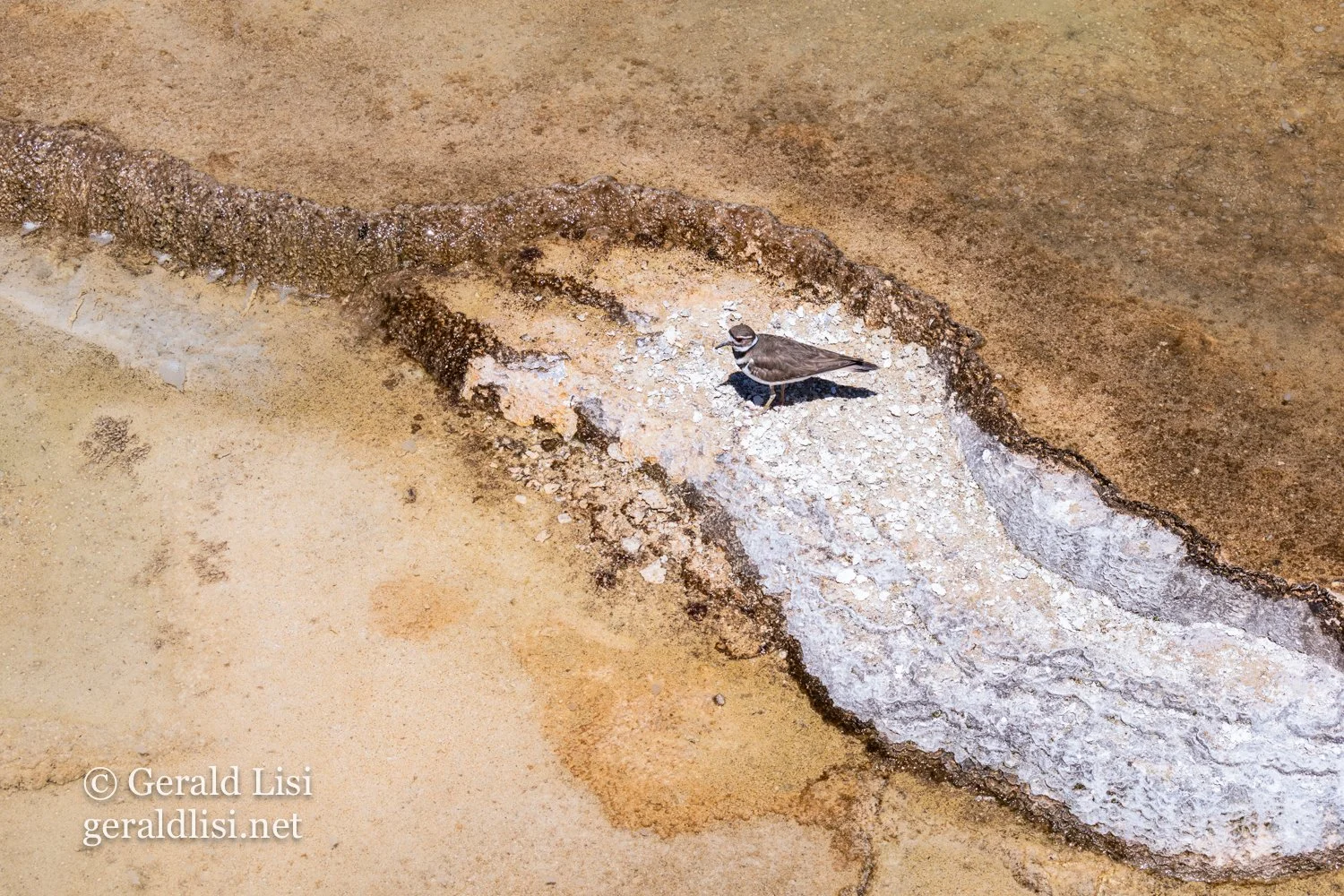
A Killdeer forages in a dry pocket created by a natural mote.

I wasn’t expecting to see Sandhill Cranes. An awesome surprise!

An American Bison licks his nose for the camera. Silliness aside, seeing wild Bison is profoundly moving. May they return to more of their ancestral lands in the centuries to come.

This old Bighorn Sheep ram has true grit. He lingered by the road after the rest of the herd finished their very slow crossing. Cars and RV’s didn’t concern them, and of course the drivers welcomed the chance to see these mountain icons up close. Not the setting I would choose given the option, but still a great pleasure to photograph them.
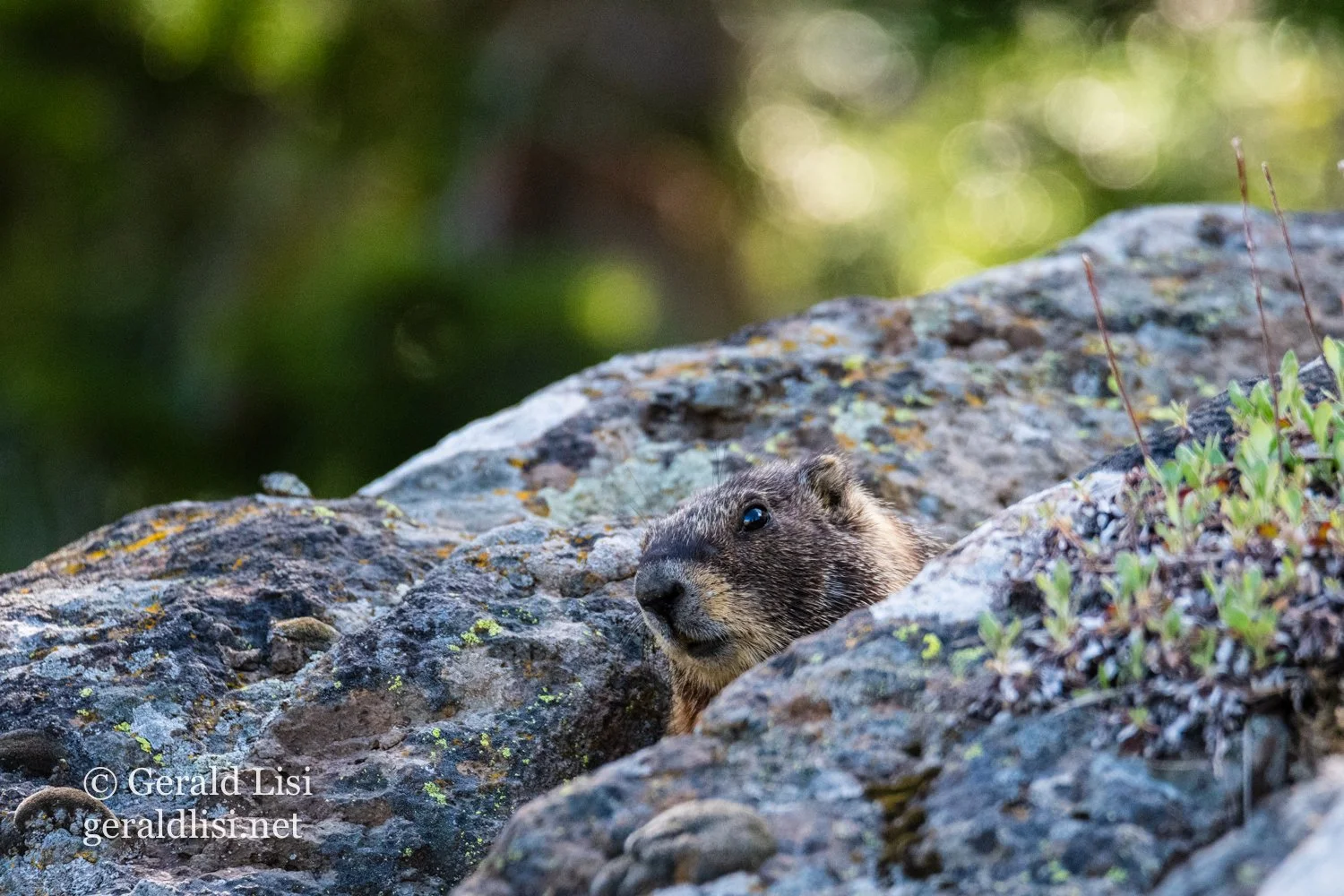
Having driven ahead and found a pull off to better enjoy the Bighorns I was also rewarded with a cautious visit from this Hoary Marmot.

By now it was late afternoon and I had some much better light for photographing the western edge of the park. I believe these mountains are known as Wapiti Ridge
And with that I close this edition. Thank you for the gift of your attention. I hope you feel that it was rewarded. If you are a subscriber please consider forwarding this email to someone who might enjoy it. If you are reading this on my website please consider subscribing at https://www.geraldlisi.net. If you would like to support my work please visit my store at https://www.geraldlisi.net/store-1. If you would like prints of any of the images in this post please email me at woodsling@geraldlisi.net. Or, if you are so inclined you can make a patronage gift on Venmo where I am @Gerald-Lisi or PayPal where I am Gerald Lisi Photography. Thanks again to anyone who is reading this. Please be kind to yourselves, to each other, and to the land you live on.

North Cascades Highway, June 1st
As promised in my previous post I am sharing a bit of my recent road trip before deep diving into Vermont natural history. Not every day of the trip will get a post, but day one definitely does.
After twenty-six years of living in my second home of western Washington I began my journey back to my first home of Vermont on the first of June, 2024. I-90 would take me most of the way, but at a dear friend’s brilliant suggestion I took a circuitous and very scenic route for the Washington leg of the journey. I had taken I-90 over the Cascades many times already, and Highway 2 quite a few, but somehow had never done the whole stretch of North Cascades Highway. This was a fine time to rectify that folly.
Those who are kind enough to follow my photography generally seem to think of me as a wildlife photographer. I am endlessly enamored with birds and other animals, and can’t seem to stop trying to take their pictures. But, wild landscapes also capture my gaze and stir my heart, so I am always hoping to improve my landscape photography. North Cascades National Park is a spectacular place for such efforts. I could easily spend several days there shooting landscapes, but several hours was all I could afford. Luckily this was enough time to yield a few keepers, and I am happy to share them with you below.

Mossy Western Redcedar by the Skagit River. The light was difficult for this shot, but I loved the juxtaposition of dark, mossy trees against glowing aqua water.

Douglas Fir and Western Redcedar tower along the Skagit. Bigleaf Maple and Red Alder lean out from beneath them.

Douglas Fir line the rocky cliffs of the North Cascades.

Putting the cliff in the previous image in context, we see the massive boulders below which are buried in raging snow melt every spring.

The presence of Paper Birch in the northernmost part of Washington’s North Cascades is an ecological novelty to me. Having this common and iconic tree of Vermont growing among the Douglas Fir that epitomize the Pacific Northwest forests connects my two homes. Paper Birch is actually present from coast to coast in Canada, and in much of Alaska, but only dips down into the coldest northern regions of the lower forty-eight of the United States.

Subalpine Fir in the North American Alps. The spires of this high-mountain specialist predominate around tree line on this western slope, with Mountain Hemlock being the second most common species. Tree diversity declines sharply at high elevations.

Mountain Hemlocks frame rugged peaks. The yellow seen on the dead ones is Wolf Lichen.

Kinnickinnick thriving on a south-facing granite outcrop.

A Lodgepole Pine limb hangs over lichen-speckled granite.

One of the spectacular views from Washington Pass Overlook. The leaning tips (“drooping leaders” in ecological jargon) of the Mountain Hemlock distinguish them from the Subalpine Fir.
I’ll leave this on a high note, 5,477 feet to be precise. I do hope you enjoyed these images, and maybe learned a thing or two. If you are a subscriber please consider forwarding this email to someone who might enjoy it. If you are reading this on my website please consider subscribing at geraldlisi.net. If you would like to support my work please visit my store at https://www.geraldlisi.net/store-1. If you would like prints of any of the images in this post please email me at woodsling@geraldlisi.net. Or, if you are so inclined you can make a patronage gift on Venmo where I am @Gerald-Lisi or PayPal where I am Gerald Lisi Photography. I thank you sincerely for taking the time to read this and look at my photography. Please be kind to yourselves, to each other, and to the land you live on.

May I still Share May with You?
I think that indeed I must share May with you, even if June is nearly over now. My April newsletter marked a full year of monthly posts, with the first nine being exclusive to my email subscribers. I didn’t want to skip May, but it was a whirlwind of a month and I just couldn’t find the time to post. I did manage a few good photo shoots though. Since May is my favorite month, and because this May was my last living in beautiful Washington state I feel the need to get it on record.
After this post I will veer away from the monthly-recap format, in terms of both frequency and content. This month has provided several months worth of posts, so I will be sharing highlights from my drive across the country before deep diving into the flora and fauna of Vermont. But for now let’s look at a bunch of birds, a few plants, a mammal, and a mountain in the lovely Snoqualmie Valley of western Washington!

Bigleaf Maple’s fruits mature in May. The double samara is the calling card of all maples. This image would be great in a field guide, if I do say so myself. Are any publishers reading this?

Black-headed Grosbeak in a Beaked Hazelnut. One of the most heard birds during spring in the Duvall area, where I lived, is also one of the most striking. I must admit that until a few years ago I mistook the “drunken robin” calls of these birds for, well, drunken robins.

The exquisite leaves of Western Redcedar. The bright green tips are the spring’s new growth.

Speaking of Western Redcedar, here’s a gorgeous Band-tailed Pigeon sitting in one.

Since this Band-tailed Pigeon was such a good model I can also show you her lovely wings and back. Speaking of field guides….

Fringecup Flowers rising through young Thimbleberry leaves and Giant Horsetail. As seen in some other white flowers those of Fringecup turn magenta as they age.

A major highlight of my spring, and indeed that of many western Washington birders, was the presence of Evening Grosbeaks. These denizens of mountain conifer forests are known to grace the feeders of bird lovers in the lowlands during the winter. Apparently this species had a great mating season last year and/or their spring food supplies in the mountains were lacking because May saw them greedily gobbling black sunflower seeds as we gratefully gawked through our windows. Too much alliteration? Sorry, not sorry.

Like other finches Evening Grosbeaks are sexually dimorphic. Pictured here is the female. Unlike some other grosbeaks (Black-headed, Rose-breasted, and Blue) Evening Grosbeaks are finches. The giant bills that join them in name are the result of convergent evolution, not a recent common ancestor. One other North American finch has this trait and resulting name: the Pine Grosbeak. Since I mentioned evolution by natural selection while discussing finches I am reminded of an excellent book: ‘The Beak of the Finch’ by Jonathan Weiner, explores Peter and Rosemary Grants’ fantastic long-term research on Darwin’s Finches in the Galapagos Islands. It’s extraordinary how rapidly evolution by natural selection can initiate speciation under the right circumstances.
Moving back to quick, simple captions, here we see a male Evening Grosbeak in a tree you should now be able to identify.

Not my best Steller’s Jay photo, but it may be my last, for a while at least. I’ve gone from being nostalgic about Bluejays, who I now enjoy daily again, to getting sentimental about Steller’s Jays, who graced my days for the last twenty-six years.

A young elk bull of the much celebrated herd in North Bend. I don’t suppose he’ll be winning any harems this year, but perhaps after another trip around the sun. Speaking of elk, I must confess some misgivings about the June photo in my 2024 calendar. I’ve been in two households this month where my calendar was displayed. This makes me happy of course, but I’m not sure that that photo should have made the cut. It’s certainly not bad, but the composition just isn’t up to calendar snuff. Anyway, I hope the handful of people that have my calendar have enjoyed it, but I’m glad they’ll be turning the page shortly.

One last look at Mt Si, and it was a spectacular one from the North Bank of the Snoqualmie River. The tall trees in the foreground are Black Cottonwood. The northeast is graced by many Populus species (cottonwoods, poplars, and aspens), but none attain the awesome stature of the Black Cottonwoods (Populus trichocarpa) growing by the rivers and lakes of the Pacific Northwest.

A pair of Barn Swallows enjoy a moment of rest together under a pier at Deception Pass. Their nest, and many others, were also under the pier.

A pair of Pileated Woodpecker nestlings eagerly await a food delivery. By the look of them they were close to fledging. Finding this nest fulfilled a long-time wish of mine, a birthday-week present from the universe.

My friend and I waited for about an hour for a parent to come feed the nestlings. It was so worth it when Mom showed up and the kids went crazy. "Feed me!" "No, feed ME!" Etcetera, on and on. Of course she had plenty of regurgitated ants and other insects for both of them. It was a joy to witness this.

And the first feeding goes to…. the chick on the top! The other chick is still yelling for food the entire time.

“Hang on. Let me regurgitate some more bugs.” Chicks yelling… Note the chick on the bottom shifting to the left.

And now the other chick gets their portion. Seemed pretty equitable, and judging by the look of these two I would say it generally was. By now they’ve been out in the world for weeks. Their parents taught them how to catch their own damn food, and now insist that they do so. I wish them all the best and am grateful for this little peek into their lives.
Alright, had enough? I sure hope so, because that’s all, folks! I do hope you enjoyed the photos and learned a thing or two. If you would like to support my work please consider visiting my store at https://www.geraldlisi.net/store-1 . If you would like prints of any of the images in this post please email me at woodsling@geraldlisi.net. Or, if you are so inclined you can make a donation on Venmo where I am @Gerald-Lisi or PayPal where I am Gerald Lisi Photography. I thank you sincerely for reading this newsletter. I’ll have another one for you soon. Until then, please take care of yourselves, of each other, and of the land you live on.