
Blog

Leaf Out!
April sees the greening of the western Washington lowlands. With the waking of the trees comes the emergence and/or accelerated activity of so much animal life. Clouds of midges, flies and mosquitos feed swallows, while butterflies, bees and wasps feed at flowers. The voices and pheromones of birds fill the air as the urgent business of pairing, mating and nesting drives avian metabolisms into overdrive. The fruits of early-flowering plants are already forming by the end of the month as another wave of blooming unfolds. April here is a great month for birding and botanizing, and if you’re lucky you might encounter some snakes and lizards. Below I offer photographic evidence of my own such adventures.

Black Cottonwood, Red Alder and Bigleaf Maple leaf out in a riparian forest by the Snoqualmie River.
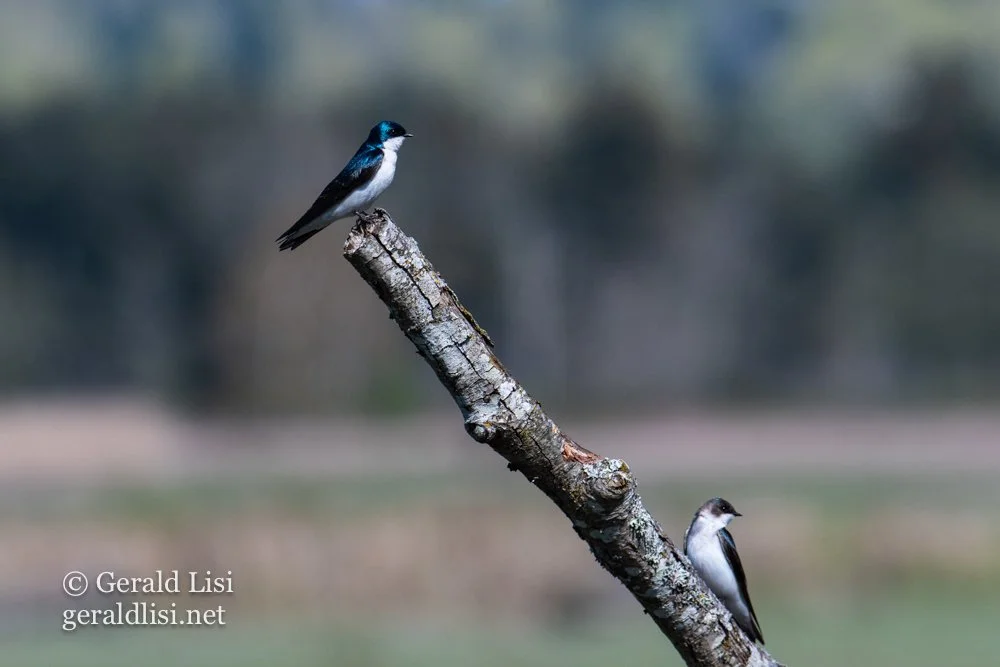
A pair of tree swallows (male in the top of the frame) enjoy a little rest together after a full morning of catching insects on the wing.

My first-of-year Black-throated Gray Warbler searches Red Alder leaves for caterpillars. Resident song birds like Robins, Song Sparrows, Bewick’s Wrens and Dark-eyed Juncos are already nesting when these migrants arrive in the latter half of April.
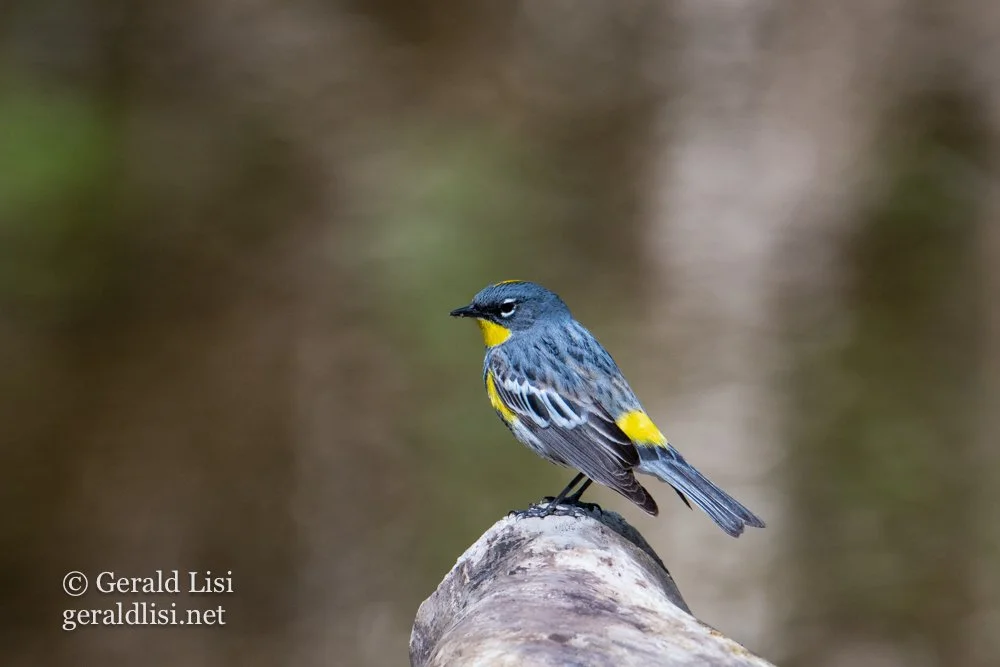
Audubon's Yellow-rumped Warbler male.
Unlike most wood warblers we have this species year round on the West Coast. They do become more conspicuous in spring though, both because of their bright breeding plumage and because of their courtship behavior.
Like all warblers they eat insects, but Yellow-rumped, which also includes the Myrtle form, are unusual in that they sally for flying insects. This behavior involves flying out from a perch to catch a flying insect then returning to their perch to eat it. Sallying is the fly catching behavior that gives Tyrant Flycatchers, Family Tyrannidae, their name. Most Wood Warblers, Families Parulidae and Peucedramidae, pick insects and arachnids from leaves, but Yellow-rumped Warblers are fly catching wood warblers!

While Audubon’s are common here we also get some Myrtle Yellow-rumped Warblers. This one is surrounded by the flowers and growing leaves of Bigleaf Maple. As I write the leaves are big and green, and baby samaras are emerging from the fading flowers.

Black Twinberry flowers summon hummingbirds to drink nectar and transfer pollen. This wetland shrub is a member of the honeysuckle family.

Saskatoon Serviceberry flowers feed bees, and their dark blue berries are enjoyed by many birds and mammals.

A Black-capped Chickadee searches a willow fruits for insects.
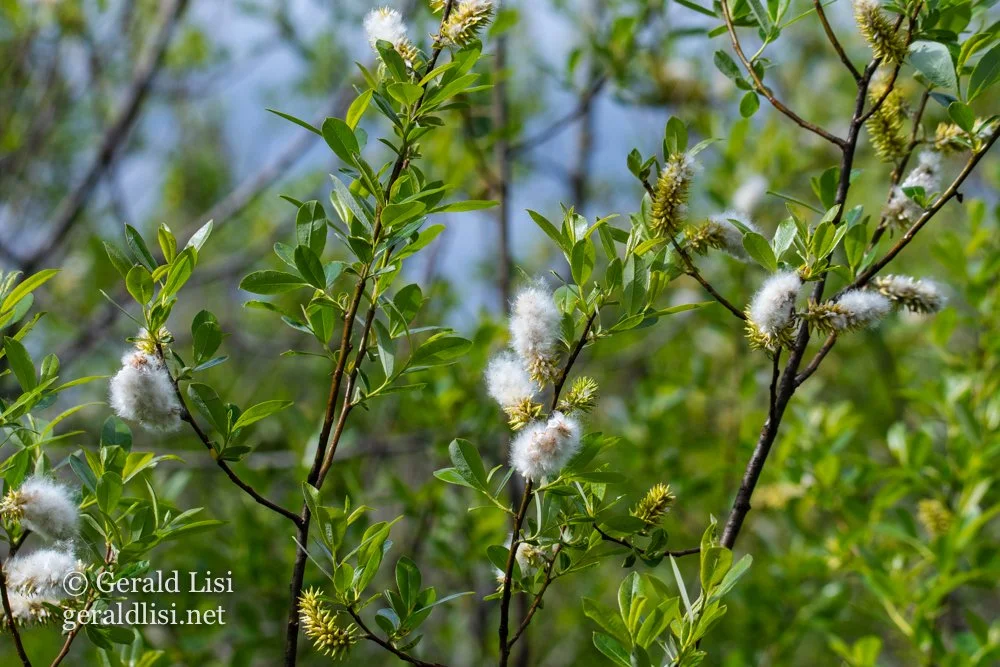
The fruits of this other willow nearby were bursting forth with their cottony, wind-borne seeds.

This baby Garter Snake was about the thickness of a pencil.

A Northern Alligator Lizard plays peekaboo with me.
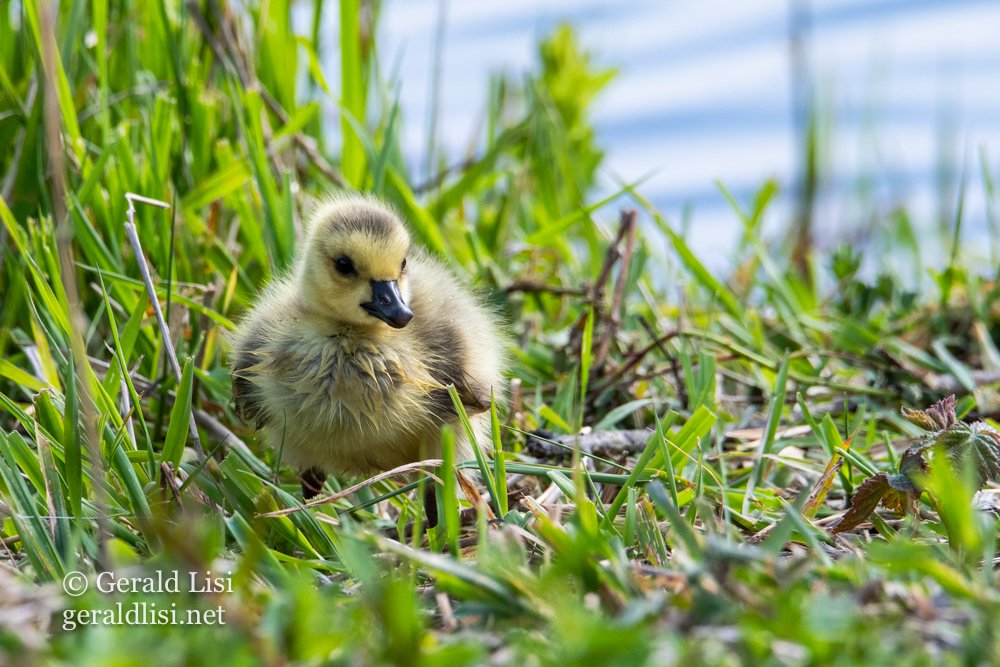
If you don’t share my adoration for reptiles I trust this Canada Goose gosling will get your “cute!” response going.
That’s all for this time, my friends. If you’re reading this as an email please feel free to respond with any feedback, and if you’re on my website you can comment below. If you’re not getting my emails but would like to you can subscribe here: https://www.geraldlisi.net/
I hope that your spring is affording you some wild encounters, and their gifts of wonder and awe. Please take care of yourselves, each other, and the land you live on.

March into Spring!
March is a good month in western Washington, and my final March here has not disappointed. We’ve had a good deal of sunshine, along with plenty of rain and some hail. The sun is always a major mood booster after months inside of giant, gray clouds, and my spirits are equally buoyed by the awakening of plant life. The greening of the forest floor proceeds slowly but surely as the month proceeds. The leaves of Western Bleeding Heart and Pacific Waterleaf emerge in the first week, and the former flowers in sunnier places by the last. Stinging Nettles rise, demanding respect and tempting foragers. The wind-pollinated trees and shrubs let it all hang out; Hazels, Alders, Cottonwoods and Willows release and receive pollen as the ancients did, before plants partnered with insects to satisfy their sexual needs. Of course many insects are hatching or awakening now too, and these invertebrate links between plants and vertebrates in the food chain are welcomed to the mouths of birds and bats, and the anthers and stigmas of flowering plants.
Tree Swallows and Violet-green Swallows arrive from the other America to feed on early insects and secure nest sites. Rufous Hummingbirds, first males then females arrive, for their breeding season too, but most of the migratory breeding birds will show up in April. Meanwhile our year-round resident birds are rapidly gearing up to satisfy their biological imperatives. The songs and calls increase by the day, and fierce competition for mates and nesting sites enliven the pulse of the avian world. It is primarily that world that has drawn my lens this month, and thus it will dominate the photographic offerings of this post. I will also share a favorite wildflower, photographed today, March 31st. But in the meantime, let’s look at birds!

March is our last chance to see overwintering Trumpeter Swans, Cygnus Buccinator, before they fly to their northern breeding grounds. This individual on Lake Washington is looking quite regal. Safe journey and successful mating, your highness!

An Anna’s Hummingbird, Calypte anna, incubates her two eggs in a typically exquisite nest. The cup, which is only a couple inches across, is made of spider silk and moss, adorned with bits of lichen. It is lines with soft material, Cattail seed fluff in this case since she’s by a wetland. My friend, who goes by “Whispering Wind” on Instagram and Facebook, has a gift for finding hummingbird nests, and she shared this one with me.

Following up on this nest three weeks later we found two chicks very close to fledging. Here they silently beg their mom for regurgitated insects and flower nectar. The colorful gapes of chicks send a “put food here” message without the danger of attracting predators with loud begging vocalizations.
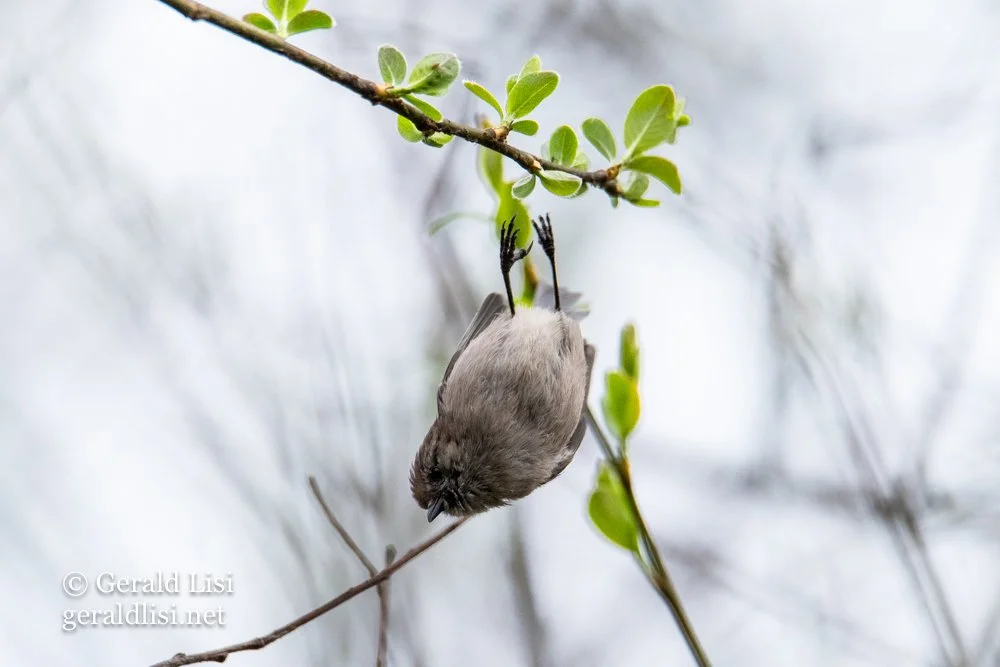
A Bushtit, Psaltriparus minimus, drops from a willow twig after gleaning it for insects and spiders. Like Anna’s Hummingbirds, Bushtits have only recently expanded their range out of the Southwest into the Pacific Northwest, but both are now common and beloved here.

A Black-capped Chickadee, Poecile atricapillus, searches a dead cottonwood leaf for spiders, insect eggs or larvae. The “deee deeee” mating song of this familiar favorite is a quintessential, and joyous, sound of spring.

The songs of Bewick’s Wrens, Thryomanes bewickii, are a delightfully prevalent sound in March. I’ve not photographed them in the act for years, but I did have the brief opportunity for this closeup a couple weeks ago. Thanks, little buddy, and good luck with the baby making!
Any self-respecting Cattail marsh, or other North American wetland, should have resident Marsh Wrens, Cistothorus palustris. These wonderful little wrens are mostly secretive, even singing their very complex songs while concealed by vegetation. But luckily the need to find mates and deter competitors does sometimes embolden the males to sing from conspicuous perches. After hearing this guy belt it out many times from afar I was thrilled to see he was on exhibition when I approached his virtuosic voice.

A Pied-billed Grebe, Podilybus podiceps, cruises Union Bay in Seattle, where so much of my early journey into birding and bird photography took place. While their breeding plumage (feathers) are the same as the rest of the year, their bill coloration changes, and gives them their common name.

Several Pied-billed grebes were present on this visit, and all were catching fish like the pros they are.

A California Scrub Jay, Aphelocoma californica, looks for action from a fence post. These Corvids are uncommon where I live, but abundant in oak woodlands of southwest Washington, Oregon, and yes, California and Baja California. Of course when I finally get a chance for some closeups of one they’re on an ugly post. Still, I’ll take it!

From the fence post into the grass, where moments after this shot our hero grabbed a fat, juicy caterpillar. I do have a picture of them with prey in bill, but it didn’t make the cut.

A Great Blue Heron, Ardea herodias, displays his magnificent plumage. When songbirds fluff their feathers they look like cute little “floofs”, but the same maneuver in a Great Blue evokes a samurai warrior in armor. It’s fitting since the yellow bill of death truly is the katana of the avian world.

After that grim reference to death by keratin I hope I can calm you with this lovely patch of Western Trillium, Trillium ovatum. The blooming of this beauty is indisputable proof that spring has sprung indeed.
That’s it for this time, my friends. Thanks for joining me. I hope you found some beauty and learned a thing or two. If you had this forwarded to you as an email, or are reading it on my website, please consider joining my mailing list yourself at https://www.geraldlisi.net/ Until next time, Take care of yourselves, of each other, and of the land you live on.

Short-eared Owls and "Friends"
Short-eared Owl, Asio flammeus.
Short-eared Owls, Asio flammeus, are a medium-sized owl found across much of the world. As denizens of grasslands and other open habitats, the heavily-forested Pacific Northwest coast long had little to offer these owls, but land conversion for agriculture has created habitat for them in the Puget Trough. Here they are considered fairly common, while in other regions of Washington they are uncommon, rare or absent (birdweb.org). The attraction of wet, grassy fields in places like the Skagit Valley is an abundance of voles. Short-eared Owls also eat mice, and some other, larger small mammals. But, here it’s all about the voles, most likely Townsend’s Voles in most cases, which are far larger than any mice I know of.
My friend and I have visited this particular spot in search of Short-eared Owls every winter for the last few years. This has yielded some distant spottings and a whole lot of nothing, but our timing was spot on this occasion. As we rounded the bend there were rows of cars parked on each side of the road, and people with long lenses, spotting scopes and binoculars standing beside them. While I have no affinity for crowd birding my distaste was quickly overrun by the excitement of seeing the owl pictured above right by the side of the road. Amazingly there was a parking space directly across the road. As soon as I parked we high fived and got our cameras out. Some pictures were taken from the car, and when we saw that the owl seemed in no rush to leave we got out for better and different views. Below are my highlights from this spectacular afternoon of birding.

Taking off to look, or more aptly listen, for voles. Their facial disk creates the flat appearance of their face in profile. This feather arrangement, which is seen in many owl species, acts as a dish that routes sounds to owls’ ears on the sides of their heads.


After a brief flight the owl settled onto another perch. A dead thistle stalk in this case. The fact that it easily supports this owl drives home how light they actually are. When we look at birds most of what we see is feathers. The ever-so-subtle “ears” in these owls’ name are somewhat apparent in this shot. In contrast, the namesake tufts on the closely related Long-eared Owl are highly conspicuous.
Before I share more owl photos with you let’s look at some of the “friends” mentioned in the title. I use quotes because Short-eared Owls don’t seem to have friends, with the possible exception of their mates and young during breeding season.

“I just flew in from the Lower Cretaceous and boy are my arms tired.” Apologies to my social media followers who already saw this caption with the frame taken right after this one. That’s a slightly sharper photo, and a more flattering picture of this Great Blue Heron, but this one highlights a fascinating bit of bird anatomy. As this heron let out their Pterodactyl gronk they revealed the jointed bones of their lower mandible. Various long-billed birds have jointed beak bones that serve them in various ways. In the case of Great Blue Herons it helps them to swallow the astonishingly enormous prey they sometimes capture. I once watched one swallow a huge catfish over the course of about five minutes. I didn’t think they would get it down, but they sure showed me.

This Great Blue Heron was here for the same reason as the Short-eared Owl: voles. While they are wading bird that hunt fish and other prey in the water it’s not uncommon to see Great Blues hunting in fields for rodents, and snakes in the warmer months. In the case of winter vole and mice hunting this makes them competitors with Short-eared Owls, but the owls seem to ignore this particular competitor.

A pair of Trumpeter Swans from a nearby grazing flock fly by. Short-eared Owls are likely indifferent to these giant vegetarians, but I was excited to see them flying low only twenty feet away.

One more Trumpeter shot. They are a major winter birding highlight here.

Can you guess what this Northern Harrier is after? Yes, it’s voles, and the overlapping ecological niches of Northern Harriers and Short-eared Owls makes them bitter enemies. Not only are they hunting the same prey in the same place at the same time, but they regularly attempt to steal that prey from each other after it’s captured. As members of the hawk family Harriers have a remarkable bit of evolutionary convergence with owls. While it’s less pronounced than in owls, they do in fact have facial disks. Because voles tunnel under fallen dead grass sound is a more reliable way of locating them than sight.

Perhaps the worst enemy of a Short-eared Owl is another member of its own species. This heavily-cropped image shows a typical attack on an interloper. While there were several Shorties present they mostly seemed to partition the field into separate hunting grounds.
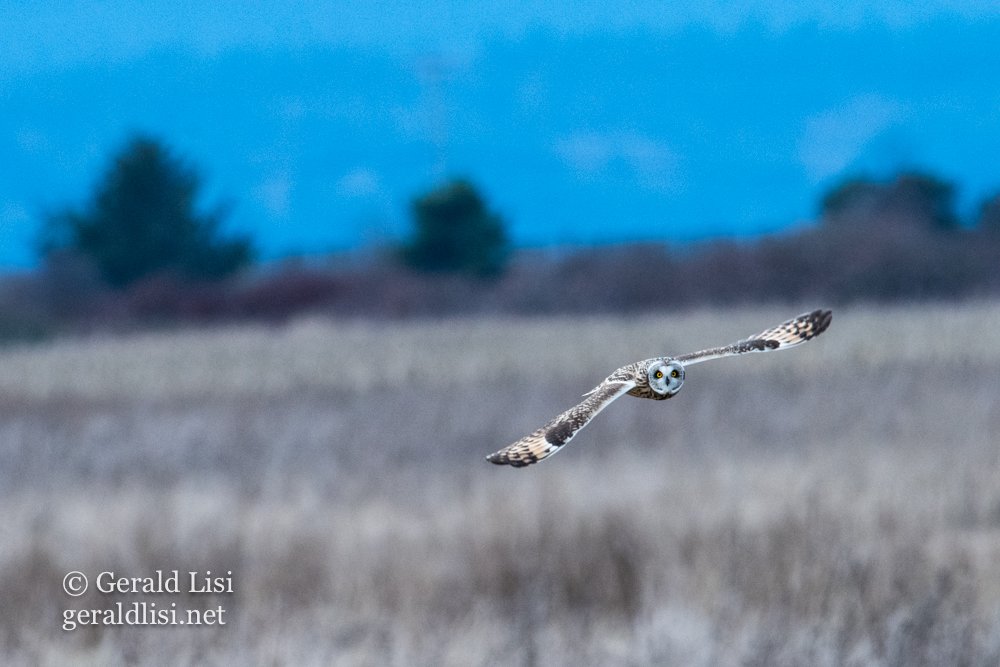
Now I leave you with a few more owl flight shots. As the grey afternoon got darker my simple kit’s capabilities were increasingly challenged, but I did get several flight shots that I like. Enjoy!



That’s it for now, folks! Thanks so much for joining me. I hope you found some beauty and inspiration in these images, and that you learned a thing or two. To receive my monthly blogs as newsletters please enter your email address at https://www.geraldlisi.net/
Until next time, take care of yourselves, each other, and the land that you live on.