
Blog

Winter's Wealth of Waterfowl

American Wigeons rest and preen on Red Alder logs. Flocks of dozens to hundreds of these handsome ducks winter on the waters and fields of the west coast.
January is not a great month for outdoor photography in western Washington. The average day is wet and gray, de-saturating the already drab colors of the winter landscape. I’m sorry to report that this January I’ve not used my camera a single time. But, in Januaries past what has often gotten me out to shoot are the many duck species that grace our waters. So, I’ve gathered some favorite duck pictures from the archives to share with you.
Most of these images were captured at Union Bay and other parts of Lake Washington in Seattle. The diversity of ducks around the lake and it’s associated marshes is very impressive. In fact, it represents most of the fresh-water duck species found across North America. This post will cover a handful of them, including both winter migrants from the north and year-round residents.
Ducks are broadly divided into two categories based on their foraging habits. There are the dabbling ducks, who gather food at or near the surface of the water, and diving ducks, who pursue prey below the water’s surface. Here I share four species of dabblers with you, and seven divers.

A pair of Green-winged Teals relaxes as the sun settles into the horizon. Catching these two in this wonderful light was a highlight of my first winter with a DSLR and a long lens, back in January of 2015! I could do better now, but I still like this image. Green-winged Teals are a favorite of mine. The namesake speculum (wing patch) is seen here on the female. The same metallic green graces the male’s head, along with a rich chestnut brown. Green-winged Teals are the smallest North American dabbling duck, at just over half the size of a Mallard.

The ubiquitous Mallard is particularly abundant here in winter, when year-round residents are joined by migrants who breed in the north. Those migrants, like all of the others in this post, come south because the northern ponds and lakes freeze. The rare snow that made for such a nice background in this picture can be a major hardship for ducks when it’s cold enough to freeze our lakes and ponds. These mallards were actually photographed recently in Duvall, where I live now. Here in the country, where there is duck hunting, they are understandably very skittish. But in the city they become more comfortable with people. That tolerance combined with their large size makes urban ducks great subjects for practicing bird photography. The rest of the images in this post are examples of me doing just that.

A male Gadwall warms his bill and breath, while his mate comments on the weather. Wet and gray of course! Female Gadwalls look similar to Mallards, but notice the white, rather than blue, speculum, and the steep forehead.

A giant Black Cottonwood log in his path gave me a rare view of this Northern Shoveler’s orange feet! The huge, top-heavy bills of these dabblers give them their name. Shovelers are filter feeders. Their specialized bills take in more water, and thus filter out more seeds and tiny plants and animals from it.

A pair of Hooded Mergansers sit in the rain between dives for fish. This is our smallest and most distinctive Merganser species.

A female Common Merganser enjoys some dry time, presumably with a belly full of fish. The “common” in the species name is belied by the elegant beauty of this distinguished lady. Her thin bill can be quickly opened and closed under water, and its edges are serrated to grip the slippery skin of fish.

The male Common Merganser is very distinct in his breeding/primary plumage, but his summer molt will leave him looking almost exactly like a female. Bald Eagles will go after about any bird on the water, but diving ducks have an advantage over dabblers in their escape. I have seen Common Mergansers disappear into the water as an eagle tried to grab them. I’ve also seen Mallards, dabblers, chased at full speed through the air by eagles. Most likely the pursuit began when the eagle tried to take the duck on the water’s surface, and flight was their only means of evasion.

Moving briefly to salt water now, to show the other North American species of Merganser. This male Red-breasted Merganser was seen on the Salish Sea, aka Puget Sound, from the downtown Seattle Waterfront. During winter they fish all of the North American coasts, but like so many ducks, geese and swans they breed across Alaska and Canada. Seen up close like this the males of this species and the Common Merganser can be distinguished pretty easily, but the females are more similar to each other. Mergansers seen on salt water are more likely Red-breasted, and those on large bodies of fresh water are more likely Common. Hooded Mergansers prefer ponds and marshes.

Ring-necked Ducks are divers who breed in boreal waters. While those waters are frozen they live in warmer parts of the US and Mexico. Notice they don’t have thin bills like mergansers. These ducks dive for mollusks and other invertebrates, as well as some plants. Females, who must be camouflaged while incubating eggs, have the earth-toned plumage.

This Lesser Scaup looks very pleased with himself. He’s about to swallow a freshwater mussel whole. His powerful gizzard will crush the shell, enabling his stomach to digest the flesh inside. Lesser Scaups are regular winter visitors, but less abundant in my area than their close relatives, the Ring-necked Ducks. Greater Scaups are seen too, but even less than the Lesser.

Here a pair of Lesser Scaups scan the sky for eagles, which is a prudent move for birds on Lake Washington. Notice that while her plumage is different than the males, the shape of the female is essentially identical.

Here we see a trio of Common Goldeneyes, with a female Bufflehead in the background. If you’re not already familiar with Goldeneyes can you guess the genders of these ones? Small groups of Common Goldeneyes are a regular sight on our lakes in winter. Occasionally a few Barrow’s Goldeneyes are seen with them. Common Goldeneyes can be sen across the lower forty-eight, but only in winter.

A Bufflehead drake (male duck) catches some rare winter sunshine as he cruises the shallows of Lake Washington for mussels and snails. They eat various invertebrates, and some plants, depending on the specific habitat and time of year, but winter lake fare is primarily mollusks. This photo, taken in January of 2017, is still one of my favorite bird pictures that I have taken. Buffleheads are quite small for ducks, and if you move towards the shore they tend to move away from it. Also, the iridescent colors seen on this drake’s head are barely visible if at all in the overcast weather that predominates here in the winter. So, when this guy swam right by me while I was enjoying the sun on a dock I was thrilled.

“I don’t follow the crowd.” Every winter a few Eurasian Wigeons end up with flocks of American Wigeons, particularly on the west coast. The females are hard to distinguish, but this Eurasian Drake’s reddish head stands out clearly next to the green eye patches of his American companions. Wigeons are dabbling ducks, but they also regularly forage like, and with geese, grazing grasses and other tender green plants.
That’s it for this edition, folks. Thanks for joining me. I hope you found some beauty here, and learned a thing or two about ducks. I have plenty more duck pictures, and could say lots more about them. If that sounds good to you please let me know in a comment below, or by responding if you’re reading this as an email. If you would like to join my mailing list you can do so here: https://www.geraldlisi.net/ Take good care of yourselves, each other, and the lands you live on. Until next time!

Spring Wildflowers of the Western Washington Lowland Forest
Don’t let the title fool you. This is not a field guide, and it is far from a complete representation of spring wildflowers of the western Washington lowland forest. It really should have been called “Select Spring Wildflowers of the Western Washington Lowland Forest”, but that would have been one too many words in an already wordy title. Insert “That I Photographed This Year” after “Forest” and my desire to be perfectly clear about the subject would be completely fulfilled, and the title would be absurdly wordy. As well as this introduction is going I think that I am going to get out while I’m ahead. Oh, wait! Please also add “Native” before “Spring” to the expanded title described above. Alright? Good. Now, without further delay I present to you, select native spring wildflowers of the western Washington lowland forest that I photographed this year.

Here we see a nice little patch of May Lily, Maianthemum dilatatum, which is known for forming patches much larger than this. Another, horrible, common name for this plant is “False Lily of the Valley.” They do resemble Lily of the Valley of course, but that hardly makes May Lily a false version of it. May is in fact the flowering time of this species. They aren’t lilies though, but members of Asparagaceae, the asparagus family.

Candy Flower, or Siberian Miner’s Lettuce, Claytonia siberica. Claytonias are found across North America, with many members of the genus known as Spring Beauties. The leaves of Claytonias do make a good salad green, and though I haven’t tried it yet you can also cook and eat their tubers.
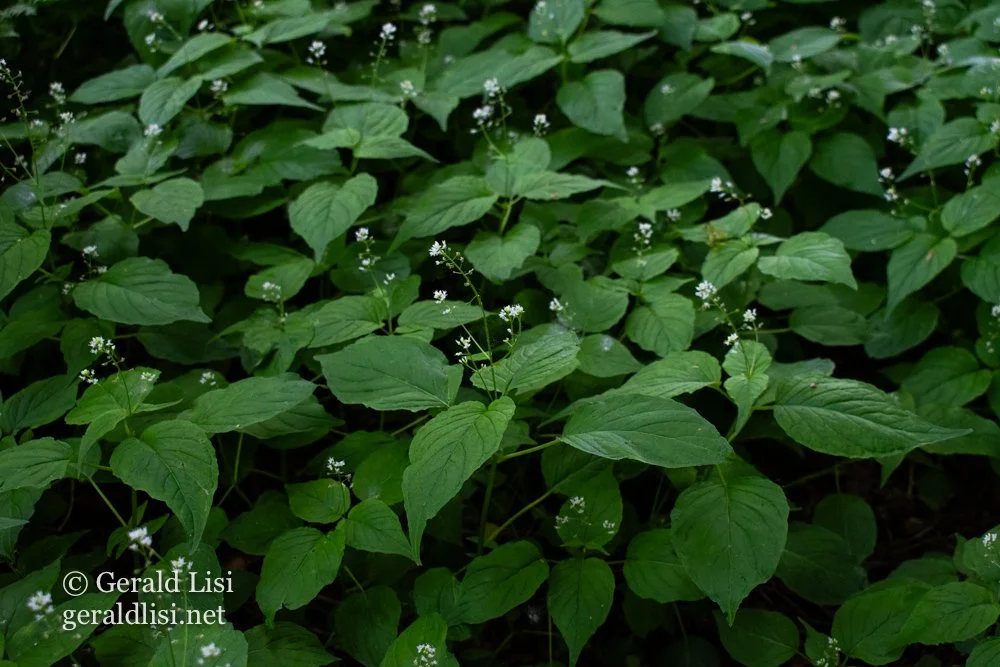
Enchanter’s Nightshade, Circea alpina is named for the Circe, the enchantress of Greek myth. The “nightshade” in the name is enigmatic however, as no one who is familiar with Solanaceae, the nightshade family, would mistake this member of Onagraceae, the evening primrose family, for a nightshade.

The delicate leaves of Pacific Bleeding Heart, Dicentra formosa, are a “sight for sore eyes” when they appear in March. In April their flowers provide an early nectar source for bees and hummingbirds. Several weeks later long, green seed pods protrude from the bottoms of the still-pink hearts.

The urn shaped flowers of Salal, Gaultheria shalon, are telltale signatures of Ericaceae, the heather family. They are buzz pollinated by bumblebees, which means that the vibration frequency of the bumblebees' wings shakes loose the pollen from the anthers inside the urn. When they stick their pollen-dusted, fuzzy little faces into the next flower to reach the nectar with their tongues some of the pollen sticks to the stigma, initiating fertilization.

The flowers of Salmonberry, Rubus spectabilis, have petals of the most exquisite magenta. This distinguishes them from most other members of genus Rubus (raspberies and blackberries), which have white flowers. Salmonberry is particularly fond of wet ground beneath Red Alder and Black Cottonwood, where they form dense thickets that can be taller than a really tall guy.

Thimbleberry, Rubus parviflorus, is a gentle bramble. In fact its completely thorn-free stems make it hardly a bramble at all. I wouldn’t describe the broad, deep red raspberries dry, but their tiny drupelets are less juicy than others. This actually has the effect of concentrating their wonderfully sweet and tart flavor.

In May Western Starflower, Lysimachia latifolia, brightens the forest floor in the western Washington lowlands. The white to pink petals of their flowers have the curious habitat of varying in number, from five to nine, but most often in my experience six, as seen here, or seven. This perennial of family Primulaceae (Primrose) emerges from a small bulb, which is edible but nobody's favorite for flavor. A beautiful flower that could save your life in a wilderness survival situation.
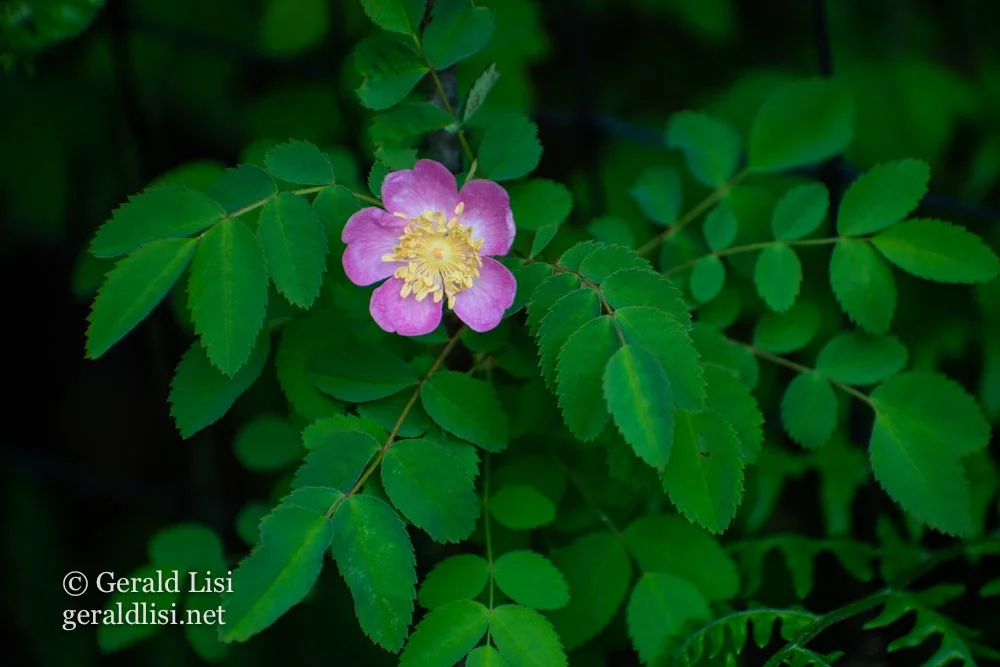
Bald-hip Rose, Rosa gymoncarpa, has flowers just a centimeter or two across. While most rose hips are adorned with the persistent sepals of the flowers from which they grew, the sepals of this species are shed as the fruit matures. This brightener of shady places has rambling stems densely covered with soft prickles.

Nootka Rose, Rosa nutkana, has much larger flowers than Bald-hip, at 1.5 to 2 inches across. Their exquisite fragrance permeates the sunny forest edges they call home. The tall smooth stems of this wild rose are punctuated with two large thorns at each node.

Pacific Ninebark, Physocarpus capitatus, is named for its shreddy bark, “Capitatus” refers to the heads of white flowers. This many-stemmed shrub can grow taller than ten feet, and is often a component of impenetrable thickets in wet woods.

The vines of Orange Trumpet Honeysuckle, Lonicera ciliosa, crawl over sunny clearings and climb deciduous trees and shrubs in search of light. The tubular flowers are hummingbird pollinated, and form translucent red berries that are eaten by Finches, Flickers and other frugivorous birds.

The flowers of American Brooklime, Veronica americana, have the distinct appearance of all Speedwells. In some other species the flowers are too small to fully appreciate with the naked eye, but it’s worth kneeling in front of American Brooklime to admire their diminutive blooms. This is a relatively large Speedwell, especially when growing in the edge of brooks where it can reach two or three feet in length.

Cooley’s Hedge Nettle, Stachys cooleyae, is not a nettle. The bilabiate flowers, square stems and opposite leaves identify it as a member of the mint family, Lamiaceae. Another common feature of this family is an abundance of aromatic oils, but nobody is making tea or seasoning food with this musky-smelling mint. As an herbaceous perennial this plant would not make a proper hedge, but its rhizomatous spreading and stems up to nine feet tall, perhaps five on average, do enable to fill a lot of space.

Twinflower, Linnaea borealis, is a circumboreal species, growing in high latitudes across the northern hemisphere. In western Washington it now grows mostly in the mountains, but it thankfully persists in mature and old-growth forests in the lowlands. This member of the honeysuckle family, Caprifoliacea, is so small that it’s hard to tell that it’s a woody plant, but it is in fact a subshrub.

Piggyback Plant, Tolmiea menziesii, is one of several woodland Saxifrages, family Saxifragaceae, in this region. Cultivars of this species are grown in gardens, and even as house plants. I suppose this reinforces my feeling that it is a very attractive plant. Every spring I have another go at photographing it, but without a macro lens it’s hard to do the delicate little flowers justice.

Another woodland Saxifrage, and a favorite of many a naturalist and woods walker, is Trefoil Foamflower, Tiarella trifoliata. The tiny white flowers are hard to see in detail, but their beauty is in numbers, and how they sparkle like stars in the dark of the forest floor.
Thanks for joining me on this virtual plant walk. I have always had a strong affinity for plants, and in the last couple of years I have been trying to strengthen my botanical photography skills. I hope that you found some beauty in the photos I shared, learned a thing or two, and most importantly were inspired to get out and pay attention to wild plants wherever you live. If you are so inclined please do leave a comment below, and use the menu at the top of my page to explore more of my work.

Winter Woods on the Cusp of Spring, Central Vermont
Technically speaking it was mud season when I arrived in Vermont on March 26th, 2022. All of the snow had melted and all of that water had made a muddy mess of dirt roads and driveways. The air was warm, in a relative, New England kind of way, and even the earliest signs of spring in the plant life were weeks away. This limbo between winter wonderland and verdant explosion of foliage would generally be considered the least picturesque time of year, but for a nemophilist there is always beauty to be found in the forest. As it turned out there was some snow while I was there, which inspired me to get into the woods with my camera. Below are a few favorite images from those walks.
I actually started this post last April when I got back to Washington, but I was so grief-stricken from the recent unexpected passing of my Mom that I barely got started before giving up on it. Right now in New England everyone has had quite enough of winter, and is eager for signs of spring. I know my Mom would be just as ready for spring as everyone else, if we were lucky enough to still have her with us, but I also know that she would appreciate the simple beauty of these photographs. Indeed, she was so good at recognizing and savoring the beauty of everyday moments, which really are the focus of most of my photography. I hope that you will find some beauty here, and more importantly on your own wanders, or just outside your door or window.

Spruces with American Beech, Paper Birch, Red Maple and Witch Hazel. Last year’s orange leaves identify the beech, the straight gray trunk of the maple is to the right of the birch and the wily Witch Hazel leans out from in front of the maple.

Paper Birch with Yellow Birch in the background.

Here the Yellow Birch is in front, with Paper Birches in the background. Golden green moss adorns the base of the Yellow birch and dark green in the background is courtesy of spruce saplings.

Eastern Hemlock and Paper Birch.

Shadows cast by Sugar Maple and Paper Birch.
Yellow Birch by a lichen-crusted outcropping.

Stream waterfall with icicles and Yellow Birch.

Tree Clubmoss. Neither tree nor moss, but more closely related to the latter. Like mosses the Club Mosses, or Lycopods, are spore plants. The strobilus seen at the top of this plant is the spore-bearing structures, the “club” in their common name.

Mature Eastern Hemlock in a stone wall by the road.

More Eastern Hemlock in the same stone wall.

The Worcester Range seen through Paper Birch and Sugar Maple.
Thanks for taking a look. If you would like to see more Vermont winter woods photos let me know in a comment below and I’ll post another series soon. Also, if you want to see and read about spring highlights in western Washington please visit my home page and sign up for my newsletter.