
Blog

Duvall Snow Days
The maritime climate of the Puget Sound lowlands makes snow a rare event here, and rarity creates treasures. Fresh snow transforms the landscape in ways that align perfectly with some elements of photographic composition. It simplifies the scenery and emphasizes shapes and patterns with the high-contrast lines of snow on substrate. But, below-freezing temperatures are so fleeting here that the treasure of snow is highly ephemeral. Of particular interest to me are snow-covered trees and shrubs. Several days into a snow event here in Duvall, Washington the rapid melting of the snow after, or even as, it fell made for very little snowy-tree time during daylight hours. I had accepted that I probably wouldn’t get a good window of snowy tree time when I went to bed on Friday, December 2nd. As it turned out a couple inches of fluffy snow fell as I slept, and the air temperature was still below freezing (barely) when I woke up shortly before dawn. A treasure was laid before me, but like life itself it was fading away by the moment. Breakfast would have to wait, as it usually does for me anyway. After savoring my large mug of strong French roast, I put on my winter clothes and boots, put my 18-55 mm lens on my Nikon D7500 and ran out the door into a cloudy dawn.

A chilly warm-up shot on the way out of my apartment’s driveway. A Beaked Hazel bowed over by the snow beneath Red Alders and a stately Bigleaf maple.

Lake Rasmussen was my first destination. This small lake is a few blocks from my place and the opposite shore of it’s public access side is a nice patch of mixed forest. This is a somewhat eastward view too, so the rising sun added some glow and color to the dissipating clouds. The barely freezing average temperature of the last couple days is seen in the partially frozen surface of the lake.
As I took pictures at the lake it began to sprinkle. This didn’t bode well for my snowy-tree window, so I rushed to the next stop. The rain was fortunately ever so brief and light. I was headed for Cherry Valley, but I saw that it was densely foggy. I love some fog in my landscape photography, but this would obscure too much. Plus all of the morning light sky action was in the other direction, so I headed towards the Snoqualmie River, passing briefly through downtown.

The Duvall Tavern on Main Street/Highway 203, with Rocking E Feeds across the street.

Crossing the street and grabbing another downtown snapshot with the morning-sunlit background.

The light was getting better by the moment, so I grabbed this shot with the Duvall-Woodinville Rd bridge on my way to the river it crosses.

I thought of Dark Tranquility’s ‘The Mundane and the Magic’ as I placed these structures and vehicles in the foreground of this snowy-trees-with-sunrise shot.

Coming up to the river I was taken by the color of this powdery lichen on the concrete. The foremost bridge support and a Bigleaf Maple frame what appears to a support from a previous bridge across the Snoqualmie River.

The old bridge support and a delightfully spreading Bigleaf Maple make the foreground for the soft shapes and colors of this morning sky.

Down the river a bit and I framed the sky with these snowy trees and shrubs.

At the river’s edge I made this reflection image.

Turning upstream I was taken by this view of the bridge and trees reflected in the river.

Zooming in on these Black Cottonwoods for another reflection shot. It’s hard not to make these kinds of pictures by a calm body of water with some nice colors in the sky. I’m not sure what kind of work was going on in the big green building, but whoever was at it was cranking ranchera music inside, and I smiled at the festive atmosphere.

Around the river’s bend I made a possible shot of the day with these snowy maples and that soft morning sky.
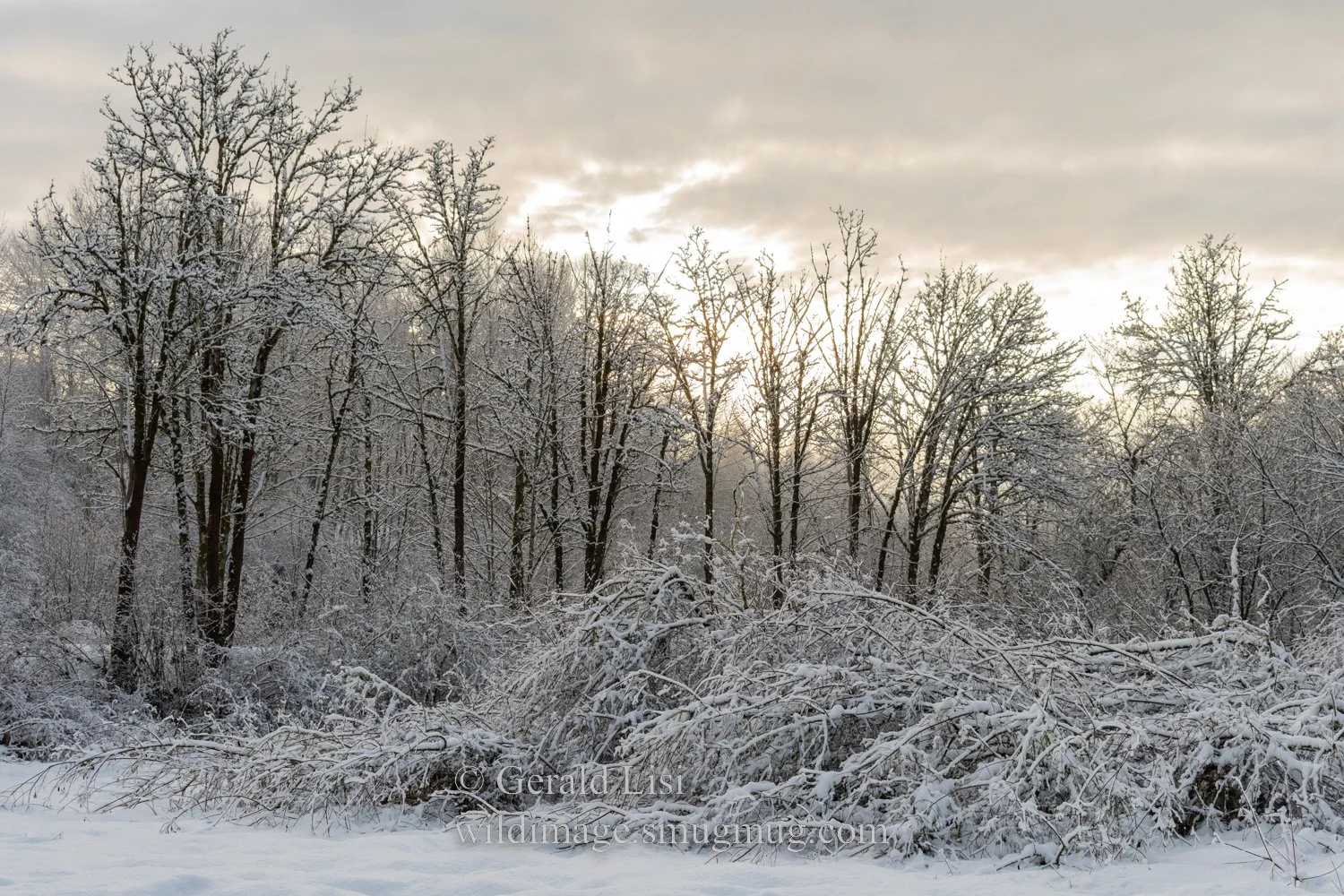
Into the shade of the foothills that Duvall is buit on I got more of the snowy trees and shrubs that were my main subjects of the morning. No choice but to overexpose the eastern sky as the sun rose higher, but I actually like to blow out the highlights on shots like these. I feel that it conveys the awesome power of the Sun, whose energy fuels all life on Earth. I also like the juxtapositions here; fire and ice, direct sun and shade.

Bigleaf Maples line the Snoqualmie Valley Trail. These are the same maples seen in the previous photo, but there I was in McCormick Park facing the trail on an eastward perpendicular line. Here we are looking south, and I like the way that the trail bisects the morning sky into the blazing sun in the east and the soft blue and clouds in the west.

Looking back across the Snoqualmie Valley Trail before heading through town to Taylor Park, which won’t be included in this post. What direction am I facing? What kind of trees are these? I hope you’ve been paying attention! ;)
With the sun rising and the clouds parting, the soft morning light was about to end abruptly, and the fluffy snow had melted into wet clumps that were now falling off of the trees. This is where my prime shooting window ended, so it is where I am ending this post. I did some more shooting in the forested Taylor Park, but conditions were fairly adverse to photography at that point. Maybe one or two of those shots will make it on to Instagram and Facebook.
Thanks for reading my blog! I hope you enjoyed these photographs and the story behind them. While you’re here please visit my store and/or portfolio! The store, which is brand spanking new, has my calendar, some matted prints and a bunch of hand-made greeting cards. As always, various kinds of prints of EVERY PICTURE IN MY PORTFOLIO are available! I hope you’ll browse it a bit whether you’re in the market for art or not, bu if you do find a photo you really love please click “buy” at the lower right of the image to open a menu. Please do leave comments below if you are so inclined. It is my intention to move towards more interaction with you here, and less on social media. Thanks again for stopping by!

Chickering Bog, june 2021
Chickering Bog Natural Area is a 222 acre property of the Nature Conservancy in Vermont. The preserve, found on the back-roads through the border of Plainfield and Calais, is comprised of the fen (“bog” is technically inaccurate) and most of its forest watershed.
A male Common Yellowthroat, Geothlypis tracheas, surveys the fen for food and threats. The vibrant green needles behind him belong to a Tamarack, aka American Larch, Larix lacrina.
Family brings me back to Vermont, where I was born and spent twenty-two of my first twenty-three years. My Mom and stepfather are always the priority people on these all-too-infrequent trips, although there are many other people there who I am very fond of. But just as the presence of my folks and old friends makes central Vermont home, the land itself permeates my history and sense of identity.
Growing up I was always a nature boy, exploring the woods around Plainfield and the Winooski River which runs through it. I felt great affinity for the plants and animals there, but only had a basic knowledge of the flora and fauna. It wasn’t until my mid thirties, over a decade into my time in Seattle that I began exploring the pursuits of a naturalist, first in botany and later with birding. So I am now in the funny position of knowing more about the flora and fauna of western Washington than of the land I grew up on. Every time I’m in Vermont I relish the opportunity catch up on the many things I didn’t learn when I lived there. While some species, such as the Common Yellowthroat seen in the photo above, can be seen in Washington as well as Vermont the flora and fauna of these distant places are very different overall. This means that returning to Vermont simultaneously provides the comfort of the familiar and the excitement of discovery.
My wildlife wish list for this trip was long, as it is for any proper naturalist excursion, but this particular story revolves around my quest for pitcher plants and orchids. After telling my Mom about my intention to visit at least one bog for that reason she did some research that yielded Chickering Bog, among other places. It was only a half an hour from my folks’ place, and lies on the edge of my hometown of Plainfield. Again, discovery amisdt the familiar.
A couple notes about this post:
Part of the purpose of having this blog is write more about the content of my photos and the adventures that yielded them, so I must apologize to those who actually want to read my writing for the brevity of the text above. The summer got away from me and with my visits to Chickering Bog now months into the past I’m not even trying to narrate those experiences. But I did manage to upload and caption the photos below, so that much of those wonderful walks can be experienced here.
Regarding the photos, I have included images taken on my phone, a Google Pixel 4a. I had my telephoto lens on my camera to be ready for wildlife encounters. Rather than changing lenses, out of pure laziness I just used my phone for landscape shots. While I am quite impressed with the quality of the images from this camera phone, they certainly don’t touch the quality of those taken on my Nikon D7500. Seeing them on my computer screen, rather than my phone screen, gave me misgivings about using these, but in order to show you more I ultimately opted to keep them here. This is more about storytelling than trying to present myself as a great photographer, which I am not. Photos without watermarks were taken on the Pixel, those with on the Nikon. Watermark or not they are still mine and may not be used without my permission. Please pardon that bit of unpleasantness and enjoy the pictures!

A sampling of floristic diversity on the forest floor. Middle, lower right and lower left are Ash, Fraxinus, Balsam Fir, Abies balsamea, and Sugar Maple, Acer rubrum. The saplings are mingling with two species of Rubus blackberry/raspberry) and one of the many New England ferns that I can’t identify.

I love the way this tree’s roots grasp the exposed bedrock.

Old stone walls are common in New England woods, and certainly lend to their charms, but finding this stone staircase was a special treat.

I can’t resist the beauty of birch bark. In life the outer layers of Paper Birch bark peel and roll into delightful scrolls as the tree grows. Here many layers are coiling together on a large section of bark shed from a dead tree.

Among the many seed plants on the forest floor can be found the vascular spore plants known as Clubmosses. Looking somewhat like tiny pine branches (“Ground Pine” is another name for them) these ancient plants are no more little trees than they are mosses. Like mosses they reproduce with spores, but they have water-transporting vasculature which mosses lack. This enables them to reach their height of eight inches, something unattainable to mosses. Seen here is Tree Clubmoss, Lycopodium obscurum.

Northern White Cedar, Thuja Occidentals. Seeing this species in the forest hinted at the proximity to the fen where I was headed. They are associated with bogs and swamps.

“Welcome to a Class I wetland designation that highlights Chickering Bog as “best in show” for wetlands in Vermont. Contrary to its name, Chickering Bog is actually a fen! Fens are fed by groundwater, carrying important nutrients from underlying bedrock, like calcium and magnesium. Bogs, on the other hand, are only fed by precipitation, creating acidic, nutrient-poor conditions. Surrounded a relatively undeveloped landscape, Chickering Bog has been a conservation priority since the mid-1970’s, with 220 acres and most of the surrounding watershed conserved by 2014.”

Northern Pitcher Plant, Sarracenia purpurea. The specialized leaves of pitcher plants give them their name, but their flowers are pretty fascinating too.

The rainwater-filled leaf of a pitcher plant is an insect trap. Insects that drown in that water are digested by enzymes secreted by the plant and by bacteria living in the water. The nutrients obtained, nitrogen in particular, compensate for the low fertility of the acidic, water-logged soils these plants grow in.

The reddish purple patterns on the surface of the pitcher attract insects. Much less obvious to us, but tantalizingly detectable to insects is the presence of nectaries at the top of the pitcher. The same sweet liquid that attracts pollinators to flowers is used here to lure prey. Insects that fall into the pitcher are prevented from crawling out by the downward-facing hairs above the opening.

Rose Pogonia, Pogonia ophioglossoides. Loss and degradation of wetlands make this and other orchids of these fragile habitats all the more precious. Collection of the plants further imperils populations of these wonderful wildflowers. If you have the good fortune of finding wild orchids please take only pictures.

Grass Pink, Calopogon pulchellus framed with Northern White Cedar foliage. At first glance I thought I was seeing more Rose Pogonia, but then I was doubly delighted to discover that there were two species of orchids flowering in the fen.

The flowers of Grass Pink are upside-down orchids. The highly modified petal known as the lip is usually at the bottom, not the top as seen here.

Larch trees, such as this Tamarack, are deciduous conifers, which shed their leaves every autumn. I remember my mind being blown as a kid when I discovered the seeming oxymoron of the deciduous conifers. I knew conifers as evergreens, and broad-leaved trees as deciduous. Of course most conifers do have leaves that live through the winters, but larches are one of several exceptions to this pattern. Similarly there are more than a few species of broad-leaved trees that don’t shed their leaves in autumn, but they are found in milder climates than New England’s.

Damselfly on Red Osier Dogwood, Cornus stolonifera. Damselflies are close relatives of the dragonflies, which can easily be guessed by looking at them. Aside from their smaller size and more delicate features (“damsel”) they can be distinguished from dragonflies by their habit of holding their wings against their sides when at rest. The wings of dragonflies remain extended outward at all times. That being said I don’t know what species of damselfly this is, or even which genus that species is placed in.

Little Wood Satyr, Megisto cymela

Green Frog, Rana clamitans

Ovenbird, Seiurus aurocapillus, with a caterpillar for their nearby fledgling.

Yellow-bellied Sapsucker, Sphyrapicus varius, female (males have red throats as well as crowns).

Pileated Woodpecker, Dryocopus pileatus, female (males have red malars or “mustaches” and the red on their crowns extends all the way to the base of their bills).

Red Squirrel, Tamiasciurus hudsonicus.

Blue Jay, Cyanocitta cristata
Thanks for joining me for this brief exploration of Chickering Bog! Links at the top of this page will take you to other posts, my social media pages, and my portfolio, where you can buy prints of my work.
Life and Death in an Urban Forest Fragment

Douglas fir stand with healthy, native understory. Yellow leaves left of center belong to a beaked hazelnut, which grows above a thick patch of salal interspersed with red huckleberry and trailing blackberry. This forest in Seattle's Lincoln Park is the setting of our story. Other trees in this exceptional patch of urban forest include western red cedar, grand fir, western hemlock, bigleaf maple and red alder. The native plant community here makes Lincoln Park an oasis of wildlife habitat. Most of the large mammals generally found in this type of forest are absent because it's in the city, but it is rich in bird life.
There was a lot on my mind as I headed to Lincoln Park last Saturday. Nothing too weighty though. As usual when I'm going to the woods I had my telephoto lens with me and was thinking of what birds I might encounter. There are a handful of species I can generally count on seeing at this time of year, and some that I usually only hope to see. This particular park has a bird that can't be seen many other places in Seattle, and I was particularly hopeful that I would see it: the raven.
The much larger cousin crows, who have achieved extraordinary numbers in the urban/suburban matrix of the greater Seattle area, ravens all but disappeared with the bears and wolves when the ancient forests were cleared. For years I actually thought there were no ravens in Seattle because I never saw one here and because I associated them with wilderness. So strong was this supposition in my mind that when I first heard a raven at Seward Park I thought to myself "that crow sounds like a raven." But after a few more quorks hit my ears I suddenly realized with delight that they did in fact come from the syrinx of an urban raven. Of course I use "urban" lightly here. Seattle is not a particularly urban city, and Seward Park is home to a small stand of old-growth trees. The neighborhood next to the park, also called Seward Park, has trees lining almost every street, like so many in the Emerald City. But still, ravens in Seattle!
Well, it turns out I was a little late to the party on this one. But that didn't diminish my excitement. There is a dry erase board at the Seattle Audubon Society's Nature Center near the entrance to the park where people report wildlife sightings. After having the good fortune of visually confirming my ID of the raven, and discovering that there was actually a pair, I checked the dry erase board and there it was: "two ravens." After reporting my "discovery" to a group of fellow bird nerds I learned that while they are uncommon, if not rare, here they are present. I believe at least one of them told me about ravens in Lincoln Park. Regardless, I did soon see ravens there, and as with Seward Park, I'm always hoping to see them when I go there.

The first raven I saw in Seattle, at Seward Park. This is not a character in our story, but since I mentioned it, and have this photo, why not? "What's that in it's bill?" you say. "It's a mole" I reply. Like crows ravens are omnivores, but a much larger percentage of their diet is made up of animals.
So ravens are definitely on my mind when I get to Lincoln Park, but I don't see or hear them as I walk the forest trails. I can hear chickadees and golden-crowned kinglets up in the trees, but they're hidden by branches. The light level is not great for photography anyways. Cloudy weather and the shade of tall conifers don't give one much to work with, at least not for the fast exposures generally required for wildlife photography. Of I course if I let low light stop me I would only shoot for half of the year, and that's not an option. But at the moment I want to get out into the open. The lower part of the park is Puget Sound shoreline, so I head down to the beach.
When I was at this beach last winter I saw harlequin ducks on the water, and managed to get some decent shots of them. I'm pleased to discover that they're here again, but they're too far away from the beach to photograph. Orcas pass by here, and as always I'm hoping to see them. As usual I don't though. Across the sound is the Olympic Peninsula, and I admire the jagged, snowy peaks of the Olympic Mountains for a few minutes. It's a great view and a lovely day to be by the water, but my avian amigos are calling to me from the forest. I take a couple pictures of the Olympics and head back up.

The Olympic Mountains seen from the beach at Lincoln Park.
It wasn't that overcast at this point, as seen in the picture above, so I find a south-facing forest edge to take advantage of the light. There's plenty of activity with the little feathered ones there, and a sciurid from back east.

This Hutton's vireo was sallying from various branches in a thicket, and is seen here hiding behind an orange honeysuckle vine in order to thwart my efforts at a clean shot. It's their nature and I don't hold it against her.

While every little bird on the face of the planet is a lousy model, city-dwelling eastern gray squirrels are total hams. I don't particularly want to photograph an eastern gray squirrel, but he basically gives me no choice.

A female house finch snags an orange honeysuckle berry. Like most birds she can't hover, and there's no perches for her to access the fruits from, so she was doing flybys from a tree branch below.

And here she is enjoying the fruit of her efforts (which is also the fruit of the orange honeysuckle plant). Girl, you better wash up when you're done. You're bill is a mess.

A song sparrow forages on a Pacific madrona log. More orange honeysuckle to her left. Pretty background colors are courtesy of the invasive small-leaved cotoneaster, which I kill when given the opportunity.
I'm on a bit of a roll at this point, but my time at the edge of the woods is about to end. I hear raven calling, and he's calling loudly. No quorks this time. More like a deeper, harsher version of the kaw of a crow. The calls are coming from above and away, and with a little moving around I manage to get a clear view of him at the tip of a tree.

Raven calling to his mate, and inadvertently summoning a wildlife photographer.
Now that raven has spoken I'm headed back into the woods. The shot above was taken at about 150 feet away, and I'd love to get closer to this mystical forest being. I'm not likely to get a clear view of him up in the trees, but I change my camera settings in hopes that I do. Time to crank up the ISO's, open the aperture all the way and significantly slow my shutter speed down. I walk toward the Douglas fir he's been calling from then follow as he flies into a thick stand nearby. I lose sight of him but his continued calling leads me his way. I spot him again through many branches. Then I'm made aware of his mate's presence thirty feet above me by her rustling in the branches.
Soon they both take off, and again I follow. Walking briskly but calmly I move in the general direction of their departure. Suddenly I am aware of the angry voices of dozens of crows. I consider that they may be yelling at the ravens, who they often rightly see as a threat (at least in nesting season). "But maybe they're yelling at a hawk or an owl" I think to myself as I walk towards the racket. Moments later a large owl sweeps silently over the path and into the trees with three noisy crows on its tail. The chorus of alarmed crows extends up into the trees, following the owl's path. I creep through the forest scanning every branch for the beleaguered raptor. The loud swishing of raven wings overhead interrupts my search. The crows' massive cousins are in the middle of the fray. Stalking below the corvid mob I have no expectations of actually finding the owl, but as I round the straight trunk of a large grand fir I see it only thirty feet away. I immediately freeze, then slowly lay down on the forest floor. This barred owl doesn't seem threatened by me though. It gives me a good look then turns it's attention back to the corvid vigilantes.

A crow-beleaguered barred owl assesses the person lying on the ground with a long lens pointed at it and rightly determine that it's not a threat.

Her attention returns to the crows incessantly announcing her presence from the trees above.

"Sigh... they know exactly where I am. Gotta find a better hiding place. I seriously just want to go back to sleep."
And so she makes a bee line through thick low branches, and I hope that I'm the only one who sees the dark perch she squeezes into. I'm thankful to have had this encounter, and to even get some pictures of this owl. And now I wish her good day and good luck.
Through the cries of the crows I hear the the ravens' long wings again. Intrigued by their presence in the middle of the crows I head their way for a look. I spot them up in the trees surrounded by crows, but they swoop down to a lower branch by the trail. This gives me a chance to get a better view. One moves out of sight, but amazingly I get a clear view of the other, and even get a couple quick photos.

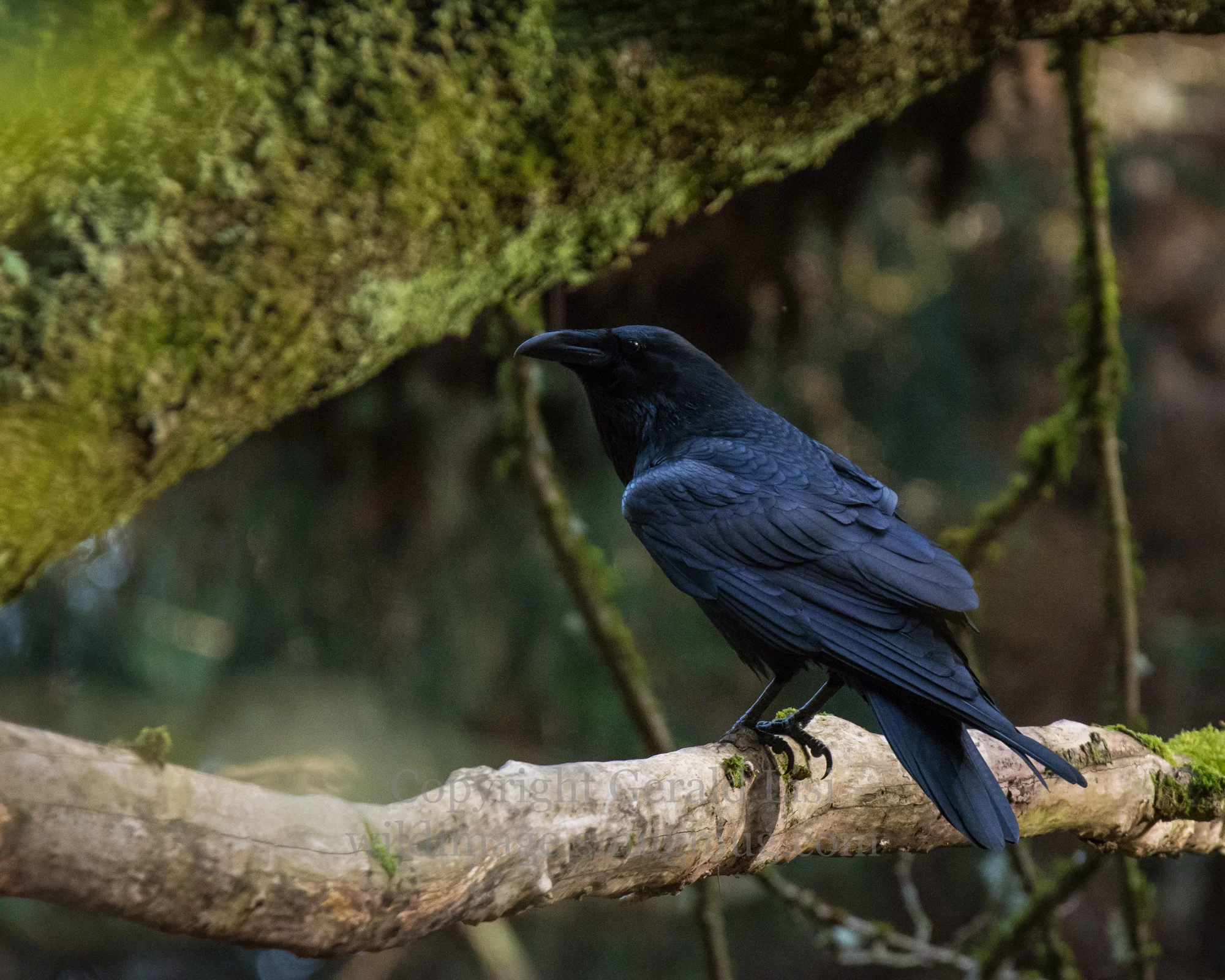
Raven in all of his glory. The blue sheen on his black feathers is striking, and his eyes hint at the mysteries of wildness.
Exhilarated by raven's presence I follow him yet again as he arcs up into the air then back into the trees beneath the yelling crows. Through many branches I am able to see him land in a snag not twenty feet tall. He's picking vigorously at some moss at his feet. I manage to get a better view through the trees and begin to photograph him again.

Raven found something. Something he wasn't meant to find by it's owner. At first I didn't know what he was standing on or why he was pulling it apart. But when I realized that it was a nest it all made sense. I don't know for sure, but this appears to be the nest a barred owl. The barred owl I just showed you.

And this of course is what he was after. Eggs are very nutritious, and there aren't many animals out there that won't eat them if the chance arises. Some specialize on exploiting this valuable resource, such as ravens.
My blood and mind racing from all that I've seen I make my way through a narrow trail behind the raided nest. What a terrible day that barred owl had: mobbed by crows, and a raven took advantage of the situation by raiding her nest. I feel for the owl, but I don't judge the crows or ravens. Everything in nature is struggling to survive. And in our modern lives humans have forgotten what that feels like. That's not to say we don't struggle, but the life-and-death struggles that pervade every moment outside of the man-made world are at best an abstraction to most. If we had predators that would eat us we would certainly mob them to prevent that from happening. And if we had no farms, money or grocery stores we would certainly raid nests to stay alive. Stepping over a fallen tree I see the signs of one bird's struggles ended to sustain those of another.

The feathers of blood of what appears to have been a red-breasted nuthatch. It was most likely killed and eaten by a Cooper's or sharp-shinned hawk.
Moving on I am drawn towards the enchanting little voices of golden-crowned kinglets. A flock is working over a thick stand of trees and shrubs for the insects and spiders on their branches. I watch through my lens, honing in on one who is only fifteen feet away from me. I mostly just enjoy the beauty of her plumage and the incredible grace and speed she employs in her furious foraging. So rarely do they hold still long enough to take a shot or two, let alone do so without branches between them and your lens. But after following her repeated relocation for a few minutes I find myself with a clear view of this incredible creature. So tiny in form, but as fierce as any large predator you can imagine. And she's lovely. Just so astoundingly beautiful.

Golden-crowned kinglet. This one's a lady. The fellas have a red/orange stripe through their golden crowns.
After being gifted this photo opportunity I slowly walk out of the park feeling grateful. Grateful for the native trees plants that comprise this urban forest fragment, and all of the wildlife they give home and sustenance to. Grateful for Hutton's vireos, house finches, song sparrows and crows. Grateful for ravens and barred owls. And what the hell, even grateful for eastern gray squirrels.
Thanks for reading my blog! Please use the links at the top of this page to check out my portfolio and social media pages.