
Blog
The Northern Hummingbird
Anna's hummingbirds don't actually have the northern-most range of any hummingbird species. That distinction goes to the rufous hummingbird, who is found as far north as southern Alaska in the summer time. And the summer range of ruby-throated hummingbirds beats that of Anna's hummingbirds by a few degrees of latitude. But during the winter Anna's hummingbirds live hundreds of miles farther north than any of North America's other eighteen species. This species, a year-round resident of the west coast, has significantly expanded its range since 1950 when they weren't found north of southern California and northern Baja California. Now they have spread east into Arizona and north through Oregon and Washington up into British Columbia.

Anna's Hummingbird, Calypte anna, female at red-flowering currant.

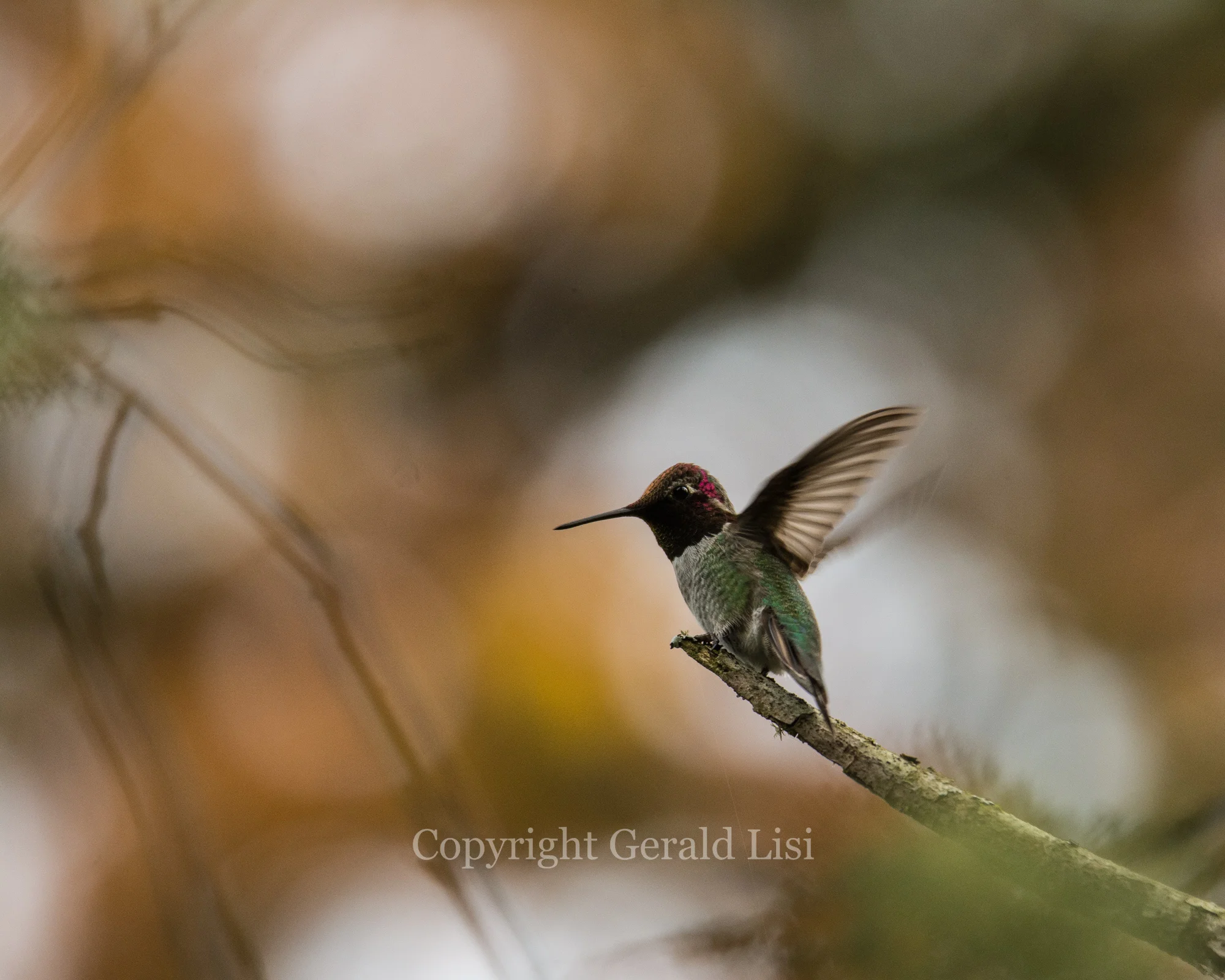
Anna's hummingbird male.
The range expansion of Anna's hummingbirds is generally attributed to the nectar provided by exotic garden and landscape plants that flower during naturally flowerless months, and to the ever-increasing popularity of hummingbird feeders. They are also known to take advantage of another food resource that certainly could have aided their dispersal, and is not provided by humans. Sapsuckers are woodpeckers that cut small holes through tree bark causing the leakage of sap. Like the makers of these sap wells Anna's, and migrating rufous, hummingbirds drink the sap and eat the insects it attracts.
People sometimes seem surprised to learn that hummingbirds eat insects. But all animals need protein, regardless of where they get it. In fact a great many bird species eat insects at certain times in their lives, especially as rapidly-growing chicks. No bird can live on sugary nectar, or sugar water from hummingbird feeders, alone. But hummingbirds sure can burn up the sugar. Fast metabolisms are characteristic of small, endothermic ("warm-blooded") animals. Small bodies have high surface area to volume ratios which cause them to loose large amounts of heat to their environments. Add to this bit of physics the blur of wing beats that enables hummingbirds to hover and zip about in a blur and you get a high energy budget indeed. Anna's are apparently low on the hummingbird wing-beat spectrum, at a mere fifty beats per second. That's three thousand wing beats per minute.

Drinking the nectar of orange trumpet honeysuckle, a native flowering vine of Pacific Northwest forests. These long, tubular flowers are characteristic of hummingbird pollinated species. Hummingbirds' bills conceal even longer tongues which are used to access the nectaries deep inside such flowers.
This furious flapping is associated with a blazing body temperature of one hundred seven degrees Fahrenheit. Maintaining such a temperature at rest poses a severe challenge to such a small creature on cold nights. Hummingbirds avoid this potentially fatal energy expenditure by going into torpor when necessary. Torpor is a state of reduced metabolic activity that enables many endothermic animals to conserve precious calories during cold weather. Breathing and heart rate are reduced while sleeping, significantly lowering an animal's body temperature. In the case of Anna's hummingbirds body temperature can get as low as forty-eight degrees Fahrenheit, less than half of their active temperature. This physiology has surely been essential to Anna's hummingbirds' northward range expansion.
Having these amazing little creatures around all year really is a treat, and in Seattle there is a very healthy population of them. Hummingbirds are a favorite subject of many wildlife photographers, and that certainly includes me. When i started trying to photograph them a couple years back it was a struggle to get any decent images. They're so tiny, and so fast. But as I got to know them better, and got better with my camera I slowly started accumulating images of these captivating critters. The two main things that have helped me get pictures of Anna's hummingbirds are knowing their voices so I can find them perched and knowing which flowers they prefer to feed at. Below I have collected some favorite images of Anna's hummingbirds perched and feeding on flower nectar. I hope you enjoy them!

"You there! I said, NO PICTURES!"

There's a nice symmetry to this one. It's also at least a little suggestive of a heart, which is appropriate for an image of such a lovable bird.

Enjoying the early-spring nectar of flowering currants.

Little buddy on little buds. Notice the white pollen on the tip of his bill, which came from the white currant flowers in the previous photo.

Resting in an ossoberry (aka Indian plum) bush. The fresh green leaves and dangling white flowers flowers of this native shrub light up deciduous forests in the Pacific Northwest in February or March. A most welcome appearance of life and color at this drab, gray time of year, especially when further adorned by the feathered jewel that is a male Anna's hummingbird.

A sub-adult male declares his territorial claim. Hummingbirds are very vocal. I frequently use their calls to locate them, but have a hard time describing those calls. In "The Sibley Guide to the Birds" David Allen Sibley impressively writes them out phonetically. "Chase call a rapid, dry chatter zrrr jika jika jika jika. Song from perch scratchy, thin, and dry sturee sturee sturee, sccrrrr, zveeee, street street." So, yeah, what he said.

Anna's hummingbirds do not frequent dance clubs, but some are known to shake it from time to time.
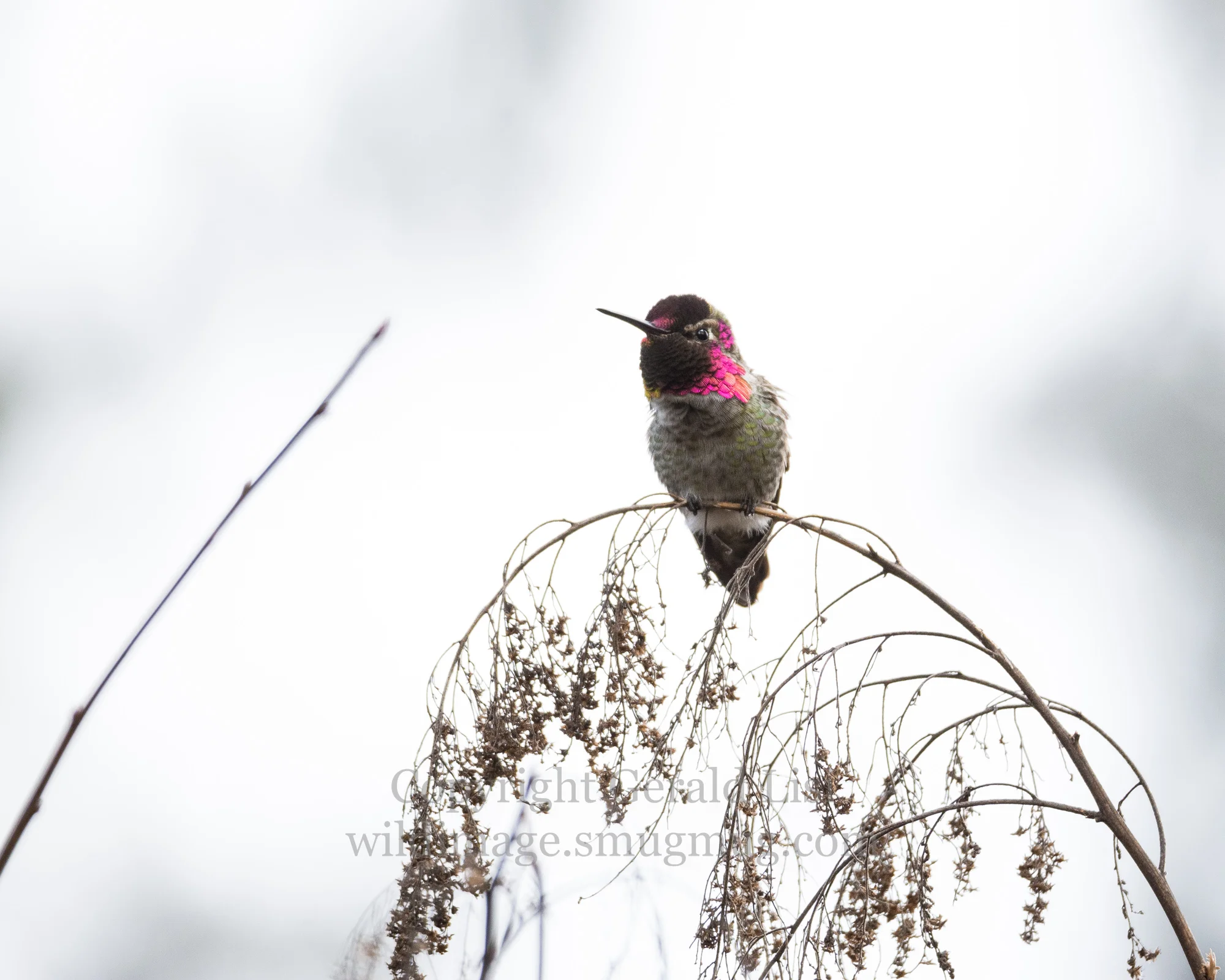
Male hummingbirds really are fierce little critters. Look at that face!

Nice helmet, dude.

This red flowering currant bush is sideways, but that's no problem for this little lady.
Thanks for reading my blog! If you're particularly fond of any of these images you can get inexpensive prints of them at my portfolio website. Find that link, and links to my Facebook and Instagram at the top of this page.
Winter Camping at Deception Pass, Day Three
My strategy for the second 24-degree night worked out pretty well. Knowing that my sleeping bag would be less than warm and cozy I kept the fire going, and sat by it until I could barely keep my eyes open. I had brought a little reading light and was revisiting "Ravens in Winter" by Bernd Heinrich. I had a flask of brandy, which I heated so it would warm me in two ways. I'm mostly a beer guy, and when I do drink liquor it's usually not brandy. It had seemed like a good pick for the cold weather though, and it turned out that it was indeed. I comfortably sipped my warm flask and turned the pages, scarcely aware of the cold and darkness that surrounded me. At one point I thought that it must be pretty late, so I checked the time on my phone. Ten o'clock, and it wouldn't be light 'til 8 AM. I needed to stay up a couple more hours, and was happy to do so. When I finally got into my tent and zipped my cold sleeping bag up around myself I was nicely buzzed and definitely sleepy.
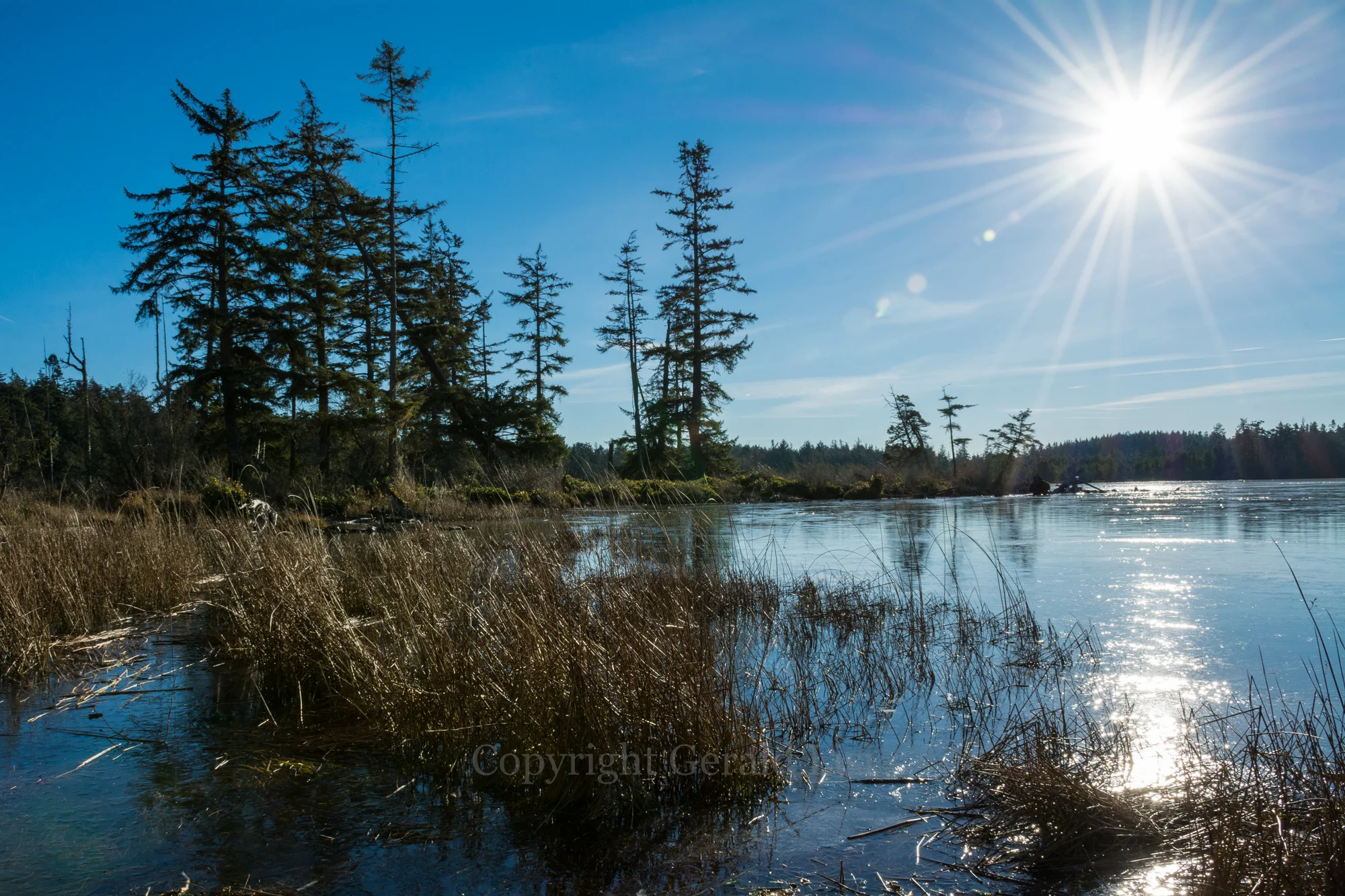
I slept much better than the first night, but the cold still woke me several times. First thing in the morning I enthusiastically built a fire. After a couple cups of strong coffee with sugar and instant milk I broke camp. This was my last day here. With my backpack full of camping gear I headed back to Cranberry Lake where I spent my first afternoon. It was cold with clear skies, just as it had been the last couple days. I was looking forward to the southern exposure at the north end of the lake. The walk through tall conifers was pleasant, and my heavy pack was not a burden but a welcome generator of body heat. The tiny, musical voices of busy chickadees and kinglets rained down from unseen places in the trees. When I reached the sunny opening at the north shore I sat to eat some trail mix. I had skipped the instant oatmeal this morning, and now I was more than peckish. As I poured large handfuls of nuts, dried fruit and chocolate chips into my mouth I heard a soft tapping on the small Pacific crab-apple tree beside me. It was a female downy woodpecker who was very busy finding her own breakfast, one little bite at a time. I pulled out my camera and attached my long lens as she went about her business. She rapidly pecked at the lichen crusted bark as she made her way up and around each branch. Occasionally she found something, probably the eggs or larvae of insects, and paused for a split second to eat it. She was almost always obscured by twigs or facing away from me, but I snapped away at every brief interval of decent visibility.

After dozens of shots that weren't likely to be usable this female downy woodpecker finally reached a clear, open spot. Unfortunately she was in the shade, but when she stopped for half a second to look at me I got my first decent shot of the day. Luckily she decided that I wouldn't eat her, or that I could't catch her if I wanted to, and she continued searching the branches for food.
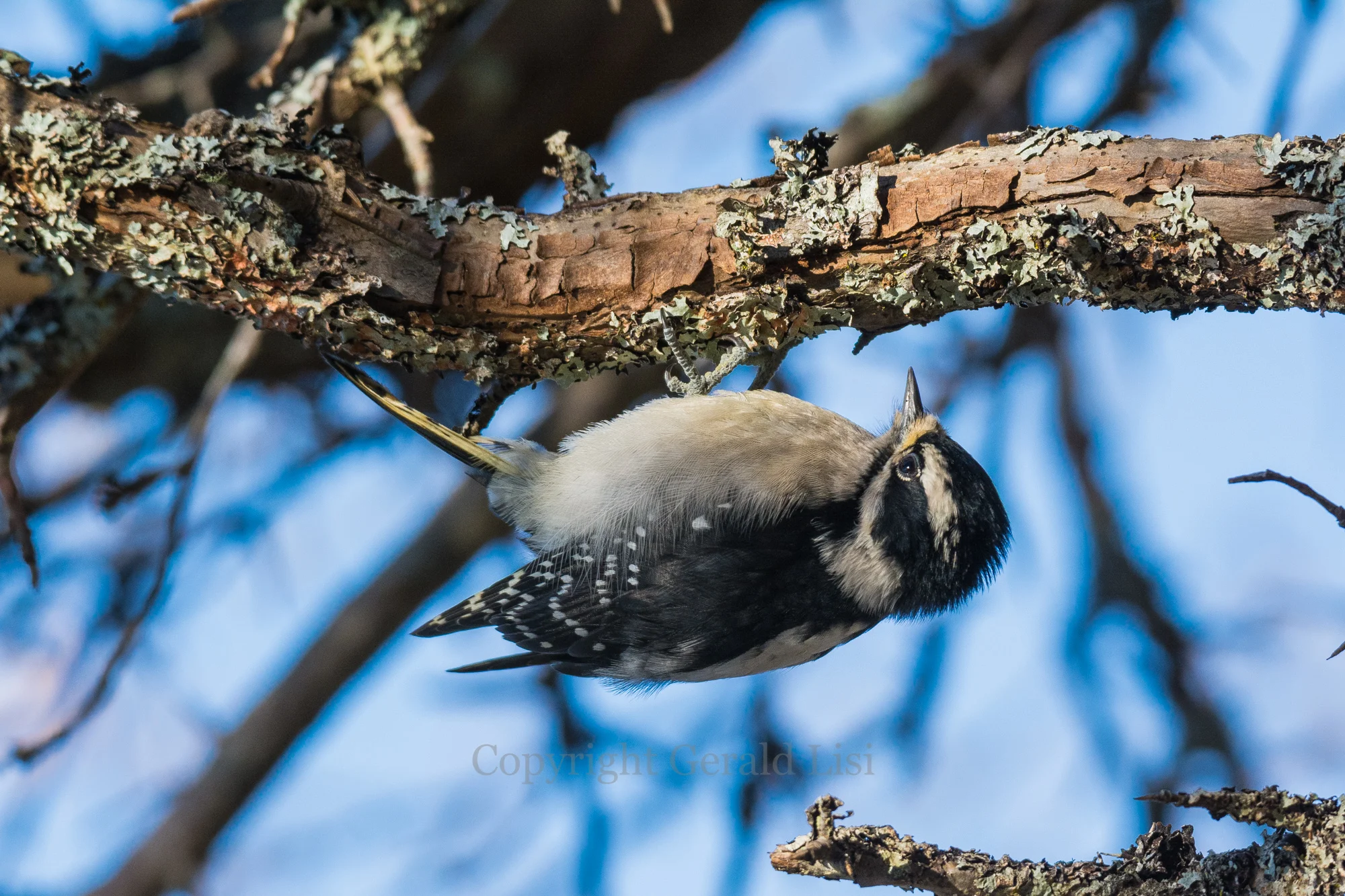
Here I finally caught a good view of her with in some decent light. Downy woodpeckers, Picoides pubescens, are North America's smallest woodpeckers at 6.75 inches long. That's three inches shorter than their close relative the hairy woodpecker, Picoides villosus. Hairy woodpeckers have a much longer bill which lacks the conspicuous tuft at its base. They are associated with mature forests where they forage on the trunks and larger branches of trees. Downy woodpeckers on the other hand prefer riparian habitats where they forage on small branches, just as this one was doing.

Hermit thrush, Catharus guttatus. A short walk away from my downy woodpecker encounter I spotted this one hopping around at the forest edge. Hermit thrushes are distinguished from the other four members of their genus by their reddish tails and unbroken eye rings. They are also the only one that is regularly seen in North America during the winter. This hardy thrush forages for invertebrates on the ground, and is often hidden by the brushy understory of its forest habitats.

After seeing the thrush an hour or so passed without any photo-worthy wildlife spottings. So I switched my long lens for my 18-140 mm to take some landscape shots. I mostly came up with a bunch of crap, but I do like this one.

Nootka rose hip, Rosa nutkana, with madrona bark, Arbutus menziesii. Even in winter Nootka rose is easily distinguished from our other wild roses by having two large thorns at its leaf bases with otherwise smooth stems.

Pacific wren, Triglodytes pacificus. I didn't have my long lens on when this little beauty popped out of the bushes by the trail, so I couldn't zoom in much. It hasn't been long since ornithologists split what was formerly just know as the winter wren, Troglodytes hiemalis, into the Pacific wren of the greater Pacific coastal region and the winter wren east of the Rocky Mountains. So you still often hear people referring to Pacific wrens as winter wrens. Both live in wet, shady areas. This makes them uncommon across their ranges. However, in much of the Pacific Northwest, including western Washington, Pacific wrens are common thanks to our mature and old-growth forests. At just four inches long this really is a tiny bird. But their song is far from that, and it can even be enjoyed outside of the breeding season. Hence the name "winter wren" for the original, lumped species designation.

Mere moments after my wren friend returned to the undergrowth I heard the soft tapping of beak on wood that led my eyes to this lovely male downy woodpecker. He was near, but not close enough to photograph with my shorter lens. Fortunately he stuck around while I changed lenses, and for several minutes afterwards. The red patch on the back of the male downy woodpecker's head is the only thing that distinguishes him from the female.
This was definitely the best photo opportunity of the day, and one of the best of the whole trip. The woodpecker was in direct light, there were no distracting branches blocking or crowding my view of him, and there was enough empty space behind him to render the background into smooth colors with little distracting detail (bokeh).

Here the shading of the woodpecker's face sacrifices an essential element of most effective portraits: a good look at the subject's eye(s). But I still think he looks handsome, and there's a lot of natural history in this shot. Three essential aspects of woodpecker morphology are on display; stiff tail feathers that help steady their bodies while foraging on trees, the orientation of their toes, with two in front and two in back, that facilitates their tree climbing, and last but not least their long, sticky tongue. Here we only see the base of that tongue, but the part that is now probing the tunnels of tree beetles or carpenter ants is coated with tiny barbs. These grab ants and beetle larvae on impact, enabling them to be drawn into the woodpecker's mouth.
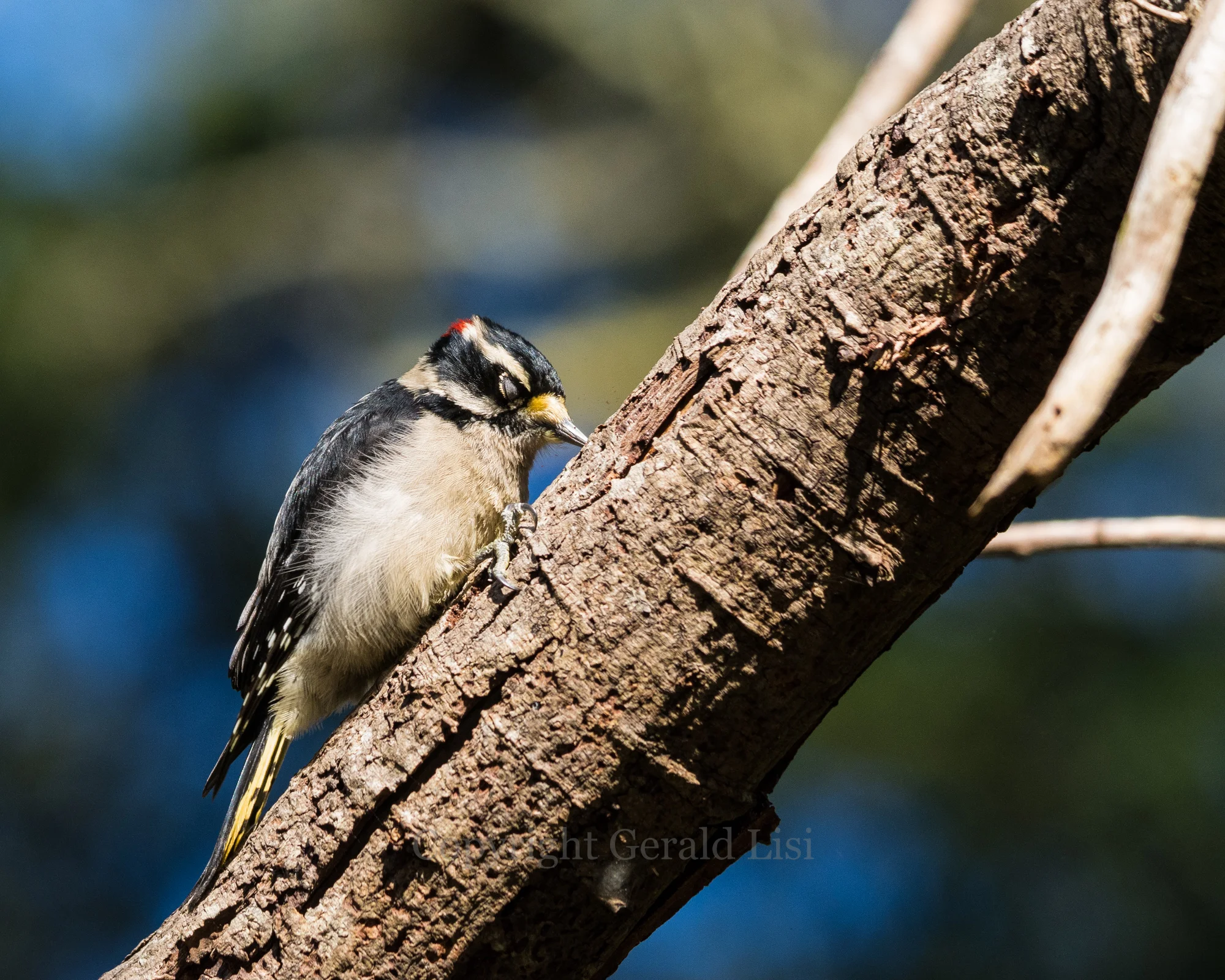
When you take a bite that's so damn tasty you just have to close your eyes and savor it.
Actually this is the moment right after the bill's impact, and you can barely see the tiniest specks of flying debris above it. Woodpeckers close their eyes when pecking to protect them from chips.
When I ran into the male downy woodpecker it was well into the afternoon and I was slowly moving towards the highway to catch my bus. The encounter was a fitting way to cap off a day of shooting that had started with a female downy woodpecker. It was also a most welcome chance to get a few good shots before wrapping up a day that hadn't been particularly productive.
That's the nature of wildlife photography though. Sometimes you you hit the jackpot, sometimes you get mostly crap, but still end up with a few usable images, and sometimes you end up with nothing. So ending up with more than nothing can reasonably be seen as a success. Even ending up with nothing isn't so bad, as long as you're not on assignment. A day spent in wild places is a day well spent.

As always I kept my camera out until the last minute, and on my way to bus stop I enjoyed the company of several chestnut-backed chickadees, Poecile rufescens. While I didn't have the benefit of good lighting I couldn't resist photographing this little charmer when he briefly perched nearby. Although my subject is poorly lit I like the atmosphere of this image. There are many ways of creating a good photograph. The one thing they all have in common is making the best of the circumstances.
Thanks for reading my blog. I really do appreciate it. Please use the links at at the top of this page to see more of my work, on social media and on my website. You can follow the "portfolio/shop" link to see high-resolution images and order prints. Paper prints start at just $5 for a 5x7. I also offer ready-to-hang wall art, including wrapped canvases and mounted prints, at very reasonably prices. I can assure you that any purchases from my website will help a struggling artist. Thanks again, and I hope you'll check back periodically to see more of my posts.
Winter Camping at Deception Pass, Day Two
During my first afternoon at the park temperatures were in the mid thirties, Fahrenheit. A night-time low of twenty-four was expected. My sleeping bag is rated for twenty-five degrees though, so I figured I would be fine. As it turned out that rating just means that one will not get hypothermia and die at that temperature. The cold woke me twenty times over the course of the night, making me anxious to get up and go long before it was a reasonable option. As soon as the black sky gave way to the faintest blue glow I sat up, still in my sleeping bag, and unzipped my tent door. I placed my tiny camp stove on the frozen ground and put on a little water for instant hot cocoa. The cocoa warmed me enough to get me out of my bag and into my cold boots. Then I stepped out to tend to a more important preparation; coffee.
Coffee was delicious, but it was a race to drink it before the twenty-eight degree air drained its precious heat. The warm liquid in my stomach overcame the night's chill as the caffeine stoked my mind's excitement for the day ahead. After a second cup and some oatmeal I was eager to hit the trail. The sun had risen at this point, but its rays had not yet hit the forest where I was camped. Nearly jogging to warm my extremities I rushed towards the nearest hiking trails, which were at Goose Rock. I chose the perimeter trail, rather than the summit. I wanted to be by the water, but especially wanted to be in the sunshine that now warmed and illuminated the forest edge that trail followed. Ahead of me I heard a flock of American robins gregariously fluting their calls at each other. I suspected that they were having breakfast in the Pacific madrona trees that grow from the rocky shoreline and hillside. This was soon confirmed as I approached several madrona trees whose upper branches were laden with small red fruits and shaking with the comings and goings of hungry robins.

I couldn't get any good shots of the robins in the tree tops, but this male alighted on a shrub near me where I had a clear view of him. At first he was looking away from me, which doesn't make for much of a photo, but when he looked over his shoulder at me I got this rather comical shot. His apparent plumpness is largely a result of him fluffing out his feathers for insulation from the cold.

This fox sparrow perched briefly about thirty-five feet away from me to assess the scene. While they are common around Puget Sound during the winter I never see fox sparrows in Seattle. Those large feet and long claws are used for scratching in the duff for seeds and invertebrates. Like many of their relatives fox sparrows use a technique of jumping up while kicking backwards with both feet. The prevalence of this foraging method surely speaks to its effectiveness, but I have to say that it looks kind of silly.

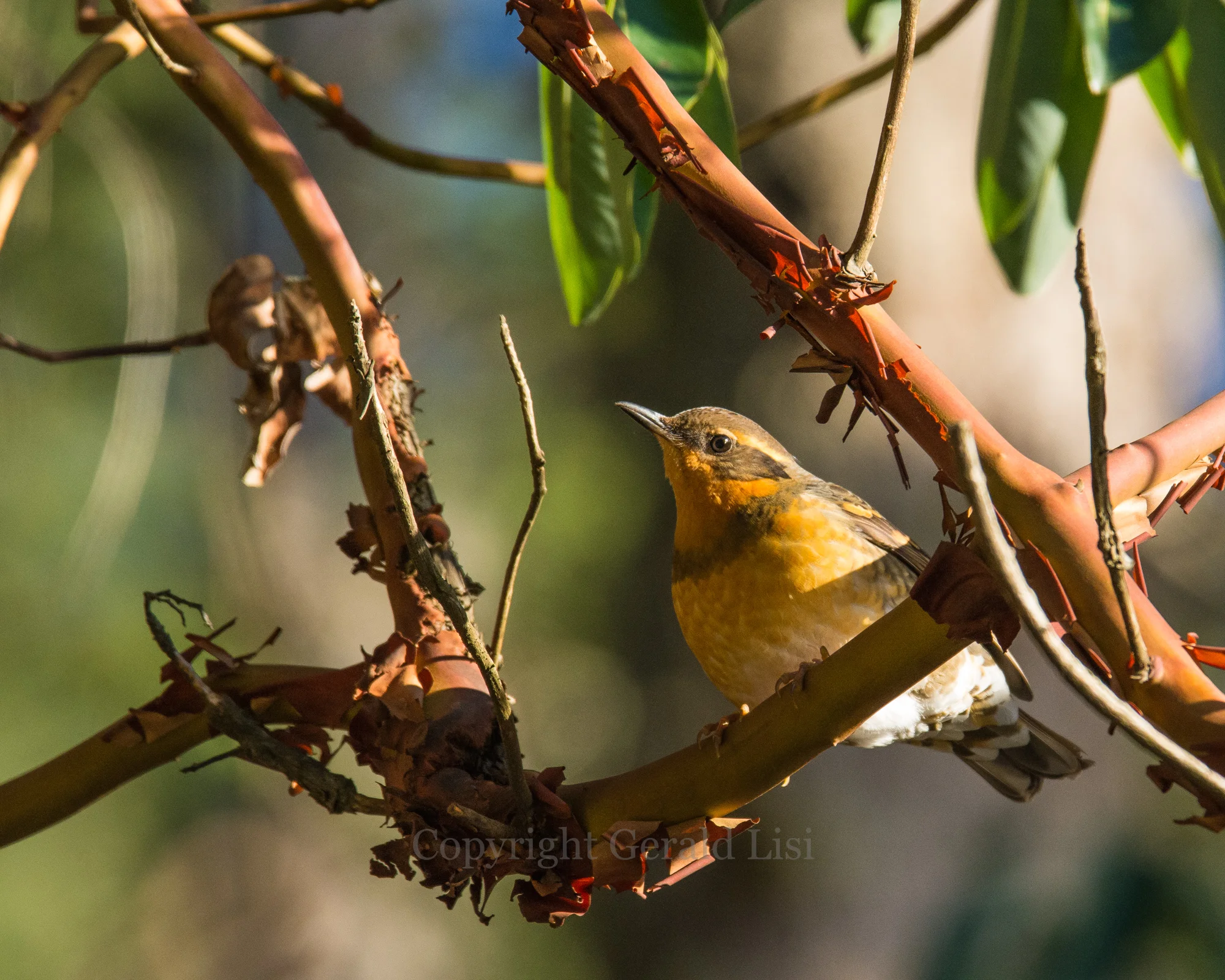
This varied thrush female perched in a lower branch of a madrona after feeding in its canopy. Varied thrushes are close relatives of robins, and have the same fruit-heavy winter diet. But while robins form winter flocks varied thrushes fly solo. At a glance It's easy to miss this species among its cousins, but it's worth scrutinizing your local robin flock to get a look at a varied thrush.

After the trail wound from the east to the north side of Goose Rock I found myself in the shade. This dimmed the prospects for bird photography in that area, but I was afforded this sweet view of Mt Baker.
From Goose Rock I crossed the bridge over the pass. While it wasn't particularly busy at the time, traffic and sight seers broke the peaceful mood of my morning up until that point. After crossing the 1,487 foot bridge I scanned the west side of the road for a trail head. Spotting one a couple hundred feet up the road I jogged back into the forest with relief. A steep, winding trail led me down to Lottie Bay. Along with the small peninsula that separates it from Bowman Bay, this has always been a favorite part of the park for me. The trail ran through mature Douglas fir, Sitka spruce and western red cedar. Emerging from their shadows I found the smooth pebble beach of Lottie Bay enjoying the full sun of its southern exposure. Without even a slight breeze the air here was probably twenty degrees warmer than in the shade of the forest. Just moments after I stepped into the sunshine a pair of great blue herons flew over the bay. One carried on towards the pass while the other broke off sharply and alighted in a tall Sitka spruce by the beach. It was maybe forty feet up, but standing where I could see it from a good angle put me at least seventy-five feet away. A bit of along shot, but fortunately it's a big bird and I had a clear view of its perch.

A great blue heron soaks up the mid-day sun, surrounded by the recently opened cones of the Sitka spruce in which it's perched.

This killdeer blends in well with the beach pebbles. The double breast band of this species distinguishes it from other similar looking plovers.

Shortly after entering the woods of the peninsula by the bay I spotted this Douglas squirrel, who retrieved an unidentified food cache from the duff and ate it on the spot.

After photographing the Douglas squirrel, and some failed shots of a golden-crowned kinglet, I found lighthouse point sunny but uneventful. I watched a belted kingfisher and a pelagic cormorant from there for a bit but both were too far off for good photos. So I walked on around the other side of the peninsula. There I changed lenses to get this shot of a little fjord off of Bowman Bay.

Having changed lenses I decided to do some close-up botanical shots. Ever since I first saw a Pacific madrona tree I have though the colors and smooth texture of their bark were exquisite. Since taking up photography I have repeatedly attempted to capture that beauty, and until this trip I failed consistently. In this close-up I finally have a madrona photo for my portfolio. I want to have a large canvas of this image made for the next time I show my work.

When I saw this eagle soaring towards me I changed lenses and settings as quickly as I could, just managing to get this shot before it passed out of range. This is a second year bird. It takes bald eagles three years to develop the familiar and iconic appearance of adult birds.

Back into the forest, and back to my wide angle lens, for this one. The two trees in the center of the frame are a Douglas fir on the left and a western red cedar to its right. Also present in this forest are the other conifers that characterize low-elevation forests in western Washington; western hemlock, grand fir, Sitka spruce, shore pine and Pacific yew. I'm thinking that this image is another candidate for printing.

Back out on Lottie Bay the sinking sun was casting a warm, soft light on this thick growth of moss and lichen that adorned an old driftwood trunk. I played around with some wide angle shots that included trees and sky in the background, but ended up liking the simplicity of this close-up better. I've always loved moss and lichen. The Pacific Northwest abounds with both, and back in my point-and-shoot days I took countless crappy photos of them.

The textures and colors of lichen-crusted wood fill out this this composition since it's subject, this dark-eyed junco, was so far away from me. But he and his rustic throne were nicely lit by the fading sunlight, and both were brought into relief by the dark forest background.
This was my last shot of the day. I needed to get back to camp and get plenty of firewood before it got dark. After the long, cold previous night in my sleeping bag I intended on spending more of this one up by the fire. I had a pretty good day of shooting, but was glad that there was another one ahead of me. That last day will be the subject of my next post.
Thanks for reading my blog! I hope you enjoyed it. Please use the links at the top of this page to check out my portfolio website, and to see my Instagram and Facebook pages.