
Blog
Winter Camping at Deception Pass, Day One
Winter in western Washington is a tough time for outdoor photography. Rain and drizzle can last for weeks at a time. Even when it's not raining it tends to be overcast, producing low, gloomy light that is less than inspiring. So when I saw that the first week of January would have a spell of clear days I decided to take full advantage of it. I was overdue for a camping trip, so I looked at my options. Seattle is surrounded by some of the best hiking and camping areas in the country, but as I don't have a car right now most of that incredible menu was not available.
Nonetheless, with a little online research I was pleased to discover that I could get to Deception Pass State Park by public transportation. It would take five buses and a ferry, but it was doable and I was excited. Nineteen years ago when I was new to Seattle and Washington Deception Pass was one of my first hiking destinations. The pass itself is a narrow, but navigable, passage between the Pacific Ocean waters of the Strait of Juan De Fuca and Puget Sound. The park includes old-growth forests and rocky shorelines at the northern tip of Whidbey Island and the southern tip of Fidalgo Island.

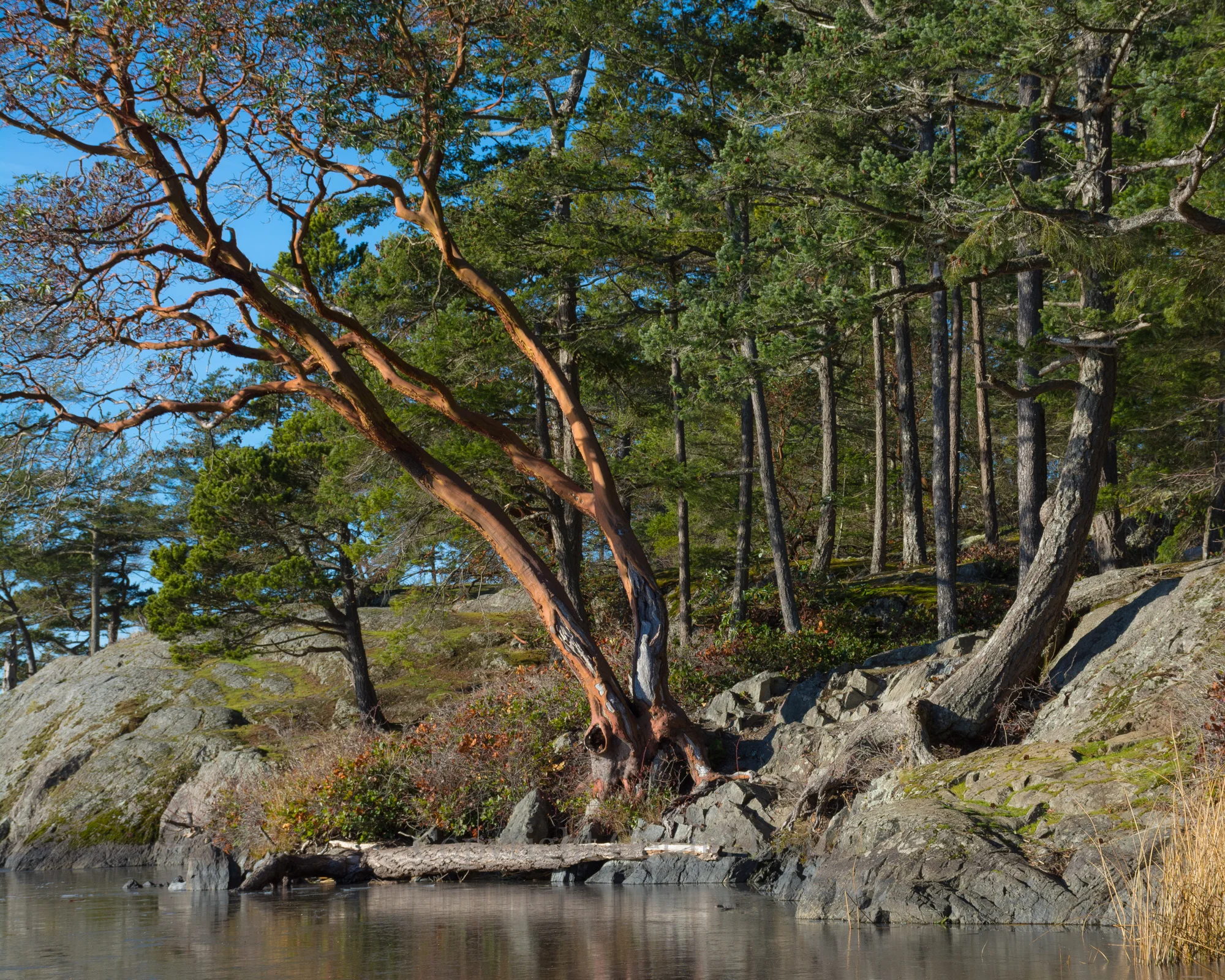
Pacific Madrona and Conifers by Cranberry Lake
This broad-leaf evergreen tree is a favorite of mine for its smooth, peeling bark. It is also loved by American robins, varied thrushes, northern flickers and other birds for its small red fruits.
I booked a camp site for two nights and set my alarm for two hours before sunrise. I wanted to have a few hours of the short winter day left when I got there. After the five-hour trip I arrived at about noon. I found my camp site in the cold shade of tall conifers and put up my tent as quickly as I could. The daylight was already more than half over. I had seen on the map that Cranberry Lake was nearby. I had never seen that part of the park so I headed that way. Ten minutes later I approached the lake shore through old-growth Douglas firs.
This is a wild lake, although it's just a couple hundred feet from Route 20, which bisects the park. It was so refreshing to see the undeveloped shoreline studded with stunted, wind-gnarled trees. Still, a simple fishing dock in full sunlight was a welcome sight. I sat down on the dock, put my long lens on my camera and surveyed the area for birds. The lake was frozen from the shore to well past the dock. Over a hundred feet away was an unfrozen area where I could see a group of mergansers, hooded and common. I wanted to photograph them, especially the hooded mergansers because I don't have any good pictures of them, but they were too far away.

While waiting in vain for birds to come within photographing range this detail on the lake caught my eye. The low angle of the winter sun brought these dead reeds to life with golden light. And the contrasting colors of the cobalt sky and dark, shaded conifers reflected through the ice brought them into sharp relief.
Clear winter weather here is generally colder than average. Without the usual blanket of low clouds the mild winter conditions in the Puget Sound lowlands sometimes give way to freezing temperatures. This was one of those times. In fact we were a couple days into a record cold spell at this point. Although I was in full sun, sitting still was a chilly affair. At the opposite, northwest, end of the lake I saw two very large, white birds. Even though I couldn't get a very good look at them from that distance they could only be trumpeter swans. Cranberry Lake has good southern exposure, so I decided to explore the sunny northern shore and see if I could get a better look at the swans.
After a short walk on a forest trail I discovered that there is a road off the northern shore. It is a park road though, and on a cold January day there is very little traffic. I walked west along the road, scanning the lake, ground and trees for wildlife. But aside from ducks that were too far away to photograph there wasn't a critter in sight. As I continued towards the area where the trumpeter swans had been I peered at the lake through little alders. I had to do a quick double take to confirm that there was a river otter sunning itself behind the trees.
After doing what I could to get a picture of the otter I continued west. The unfrozen part of the lake where I had spotted the trumpeter swans earlier was empty now. I could see that top of the lake wrapped around a thinly-treed rocky outcropping. A narrow trail meandered a short way through the trees. Following it revealed the shaded, fully-frozen tip of the lake. Out on the ice were the two trumpeter swans. They were maybe two hundred feet away, but approaching very slowly so as to not alarm them I managed to make the distance closer to one hundred feet. That's definitely further than I would prefer, but they're quite large so they actually filled up a decent amount of the frame. If I could just manage to get a sharp image without a tripod at this distance a little cropping could make the photo work.

A river otter catches some rays by Cranberry Lake. Positioning myself so that I could see it's face through the trees was the best I could do under the circumstances. Not much of a shot, but it's better than none at all. It's always a pleasure to see an otter.

"Didn't we fly south to find lakes that AREN'T frozen?" Trumpeter swans on Cranberry Lake.

After photographing the swans I found a sunny spot on the shore to watch for birds. This bald eagle was also scanning the water, but not a fish, duck, gull or coot presented itself to be eaten. Before long we both gave up and moved on.
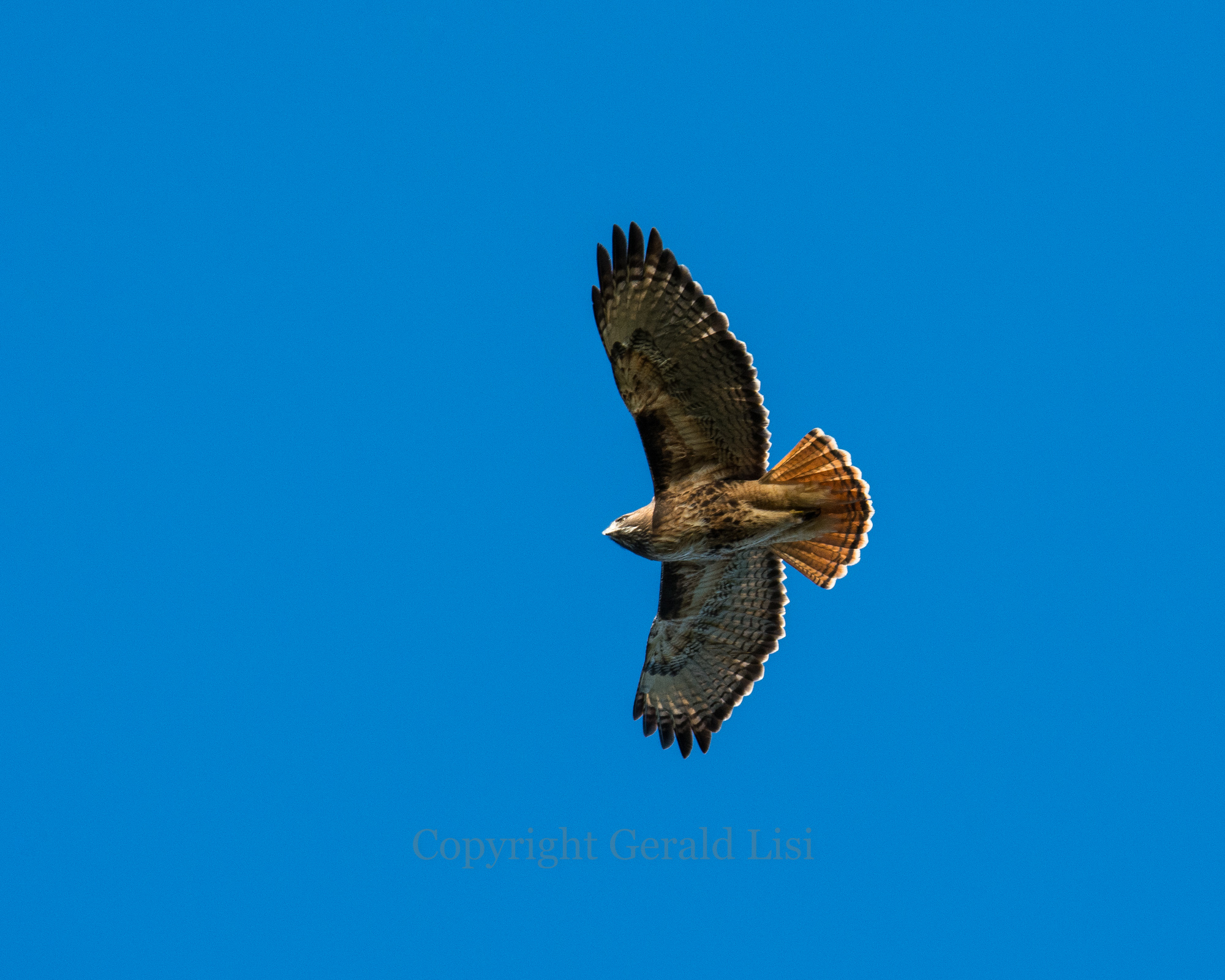
This red-tailed hawk circled over the lakeside forest briefly. They seem small when you've been watching eagles. This picture is nothing special, but I like the way the red tail feathers are illuminated.
Walking towards the marshy northeast edge of the lake I could see mergansers again. They were less than a hundred feet from the shore, but were back-lit by the bright sunshine reflecting off of the lake. This meant that to get a decent exposure of the birds I would have to blow out the highlights in the background. The "high-key" images produced that way can look cool though, so I set my camera accordingly. That eagle must have made it's way towards them too though because suddenly the sound of dozens of duck wings hitting the water shattered the silence. Most of them were flying away but a couple female common mergansers flew roughly towards me. They were on a course to pass me at about fifty feet away. I held down the shutter button as they made their pass and managed a couple shots before they flew out of range.

Common merganser females fly over frozen Cranberry Lake.

After slowly making it to the other side of the marsh I was watching chestnut-backed chickadees up in the trees when more splashing turned my head towards the water. A couple hundred feet out I spotted the commotion. This eagle rose up from the water's surface with empty talons as several ducks scattered across the lake. Having already outed itself the eagle flew to the top of the nearest tall tree, probably hoping that some other ducks would come along before dark and not notice it up there.

With an hour of daylight left I needed to make my way back to camp and build a fire before it got dark. Along the way my old friend the song sparrow perched in the golden light, with salal leaves glowing in the background.
I barely got four hours of shooting in on my first day due to my late arrival. I wasn't sure if I had even gotten any good photographs, but it was a lovely afternoon and I was looking forward to a full day of hiking and shooting. I have to admit that I wasn't looking froward to the 24 degree night in my tent before that, but I was definitely glad to be at Deception Pass.
Thanks for reading. I've got two more posts about this trip on the way, and they'll both include some images I'm excited to share with you. There are links at the top of this page to my portfolio, and to my Facebook and Instagram pages.
"That Dinosaur Bird"
"That dinosaur bird." That's how a friend of mine who didn't know or couldn't remember what great blue herons are called referred to them once. Of course we now know that all birds are descended from dinosaurs, but it's more apparent in some than others. If you've seen a great blue heron fly overhead without being reminded of a pterodactyl then you must not know what a pterodactyl is. If that's the case you should look it up, sometime after reading this blog.

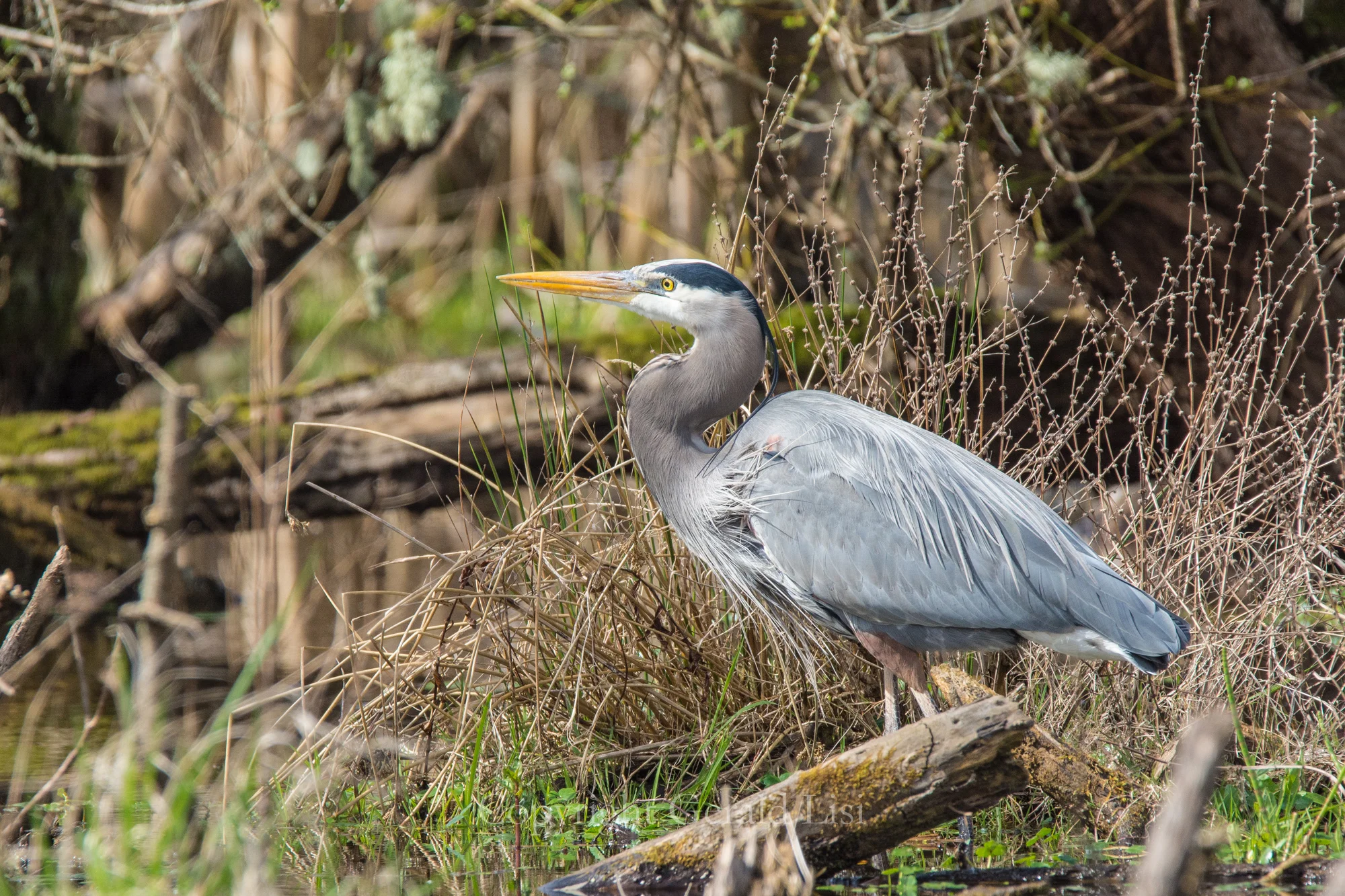
Great Blue Heron, Ardea herodias. The long, sharp bill and even longer neck are essential to this bird's hunting methods.
At four and a half feet tall with a six-foot wing span the great blue heron is the largest member of its family in North America. It can be found, at least seasonally, from the south of Mexico up through the bottom half of Canada. Here in Washington state they are found year round, as is the case in more than half of the contiguous United States. Great blue herons are common in Seattle where I live, so as a naturalist and wildlife photographer I have taken an interest in them. All but one of the pictures in this post were taken around Union Bay, but I have seen great blue herons at various other parts of Lake Washington, around Lake Union and at the edges of Puget Sound.

I watched this heron stalking behind the cattails for a few minutes before its long body rose into clear view while stepping over a dead tree.
Great blue herons are generally seen in shallow water, fresh or salt, where they feed on fish, frogs and anything else within the reach of their long necks and bills. They are capable of standing perfectly still for long periods of time, waiting for prey to swim by. These diligent hunters are also known to take prey on land such as rodents, snakes and small birds. Their catches are swallowed whole as birds have no teeth and herons don't have the hooked bills that raptors use to tear their victims into bite-sized pieces. Later bones and scales, feathers or hair are coughed up.

Waiting for some food to swim by.
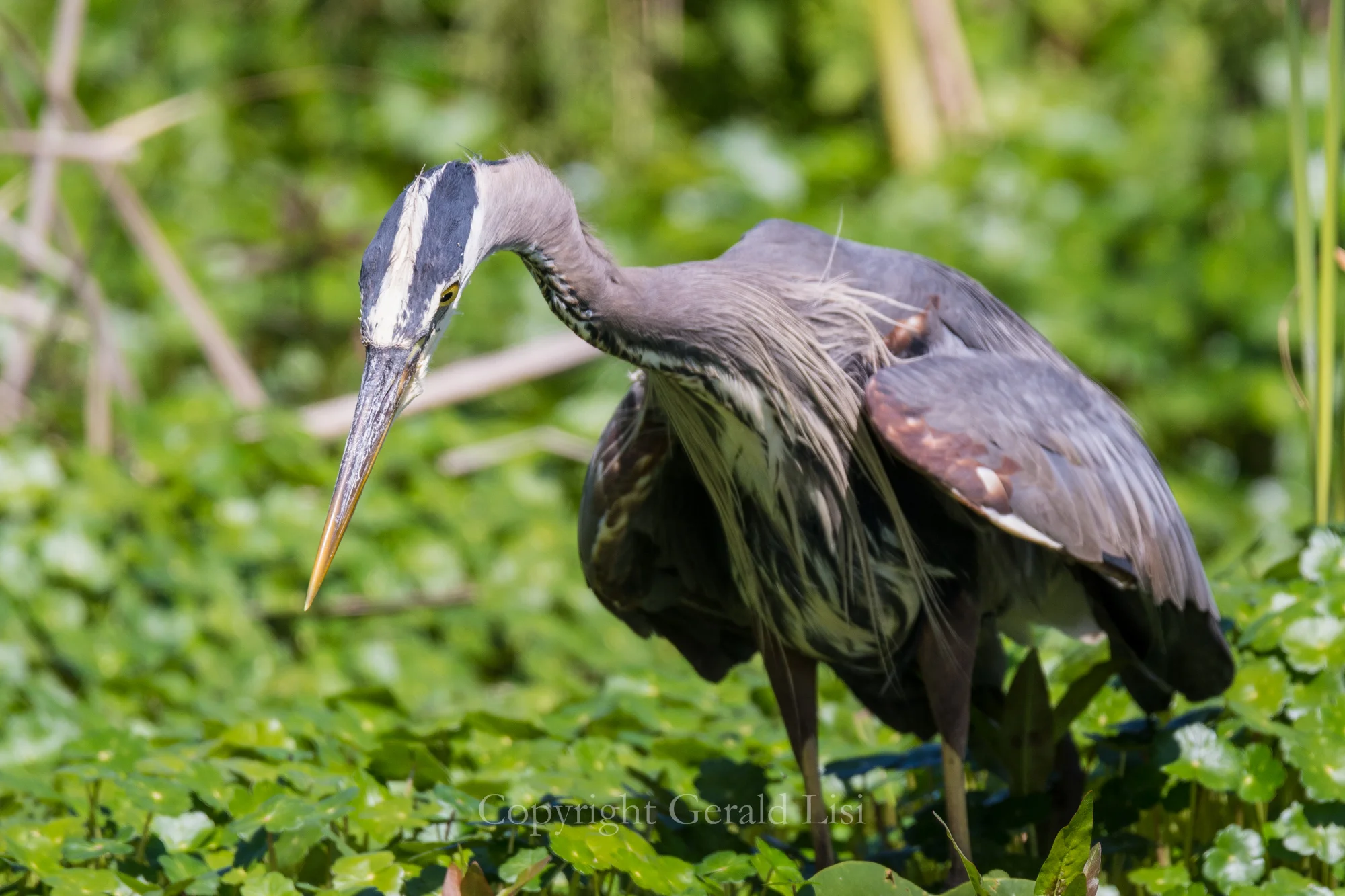
Closing in on a potential victim.

This heron was at least a hundred feet away from me and the light was low for photography. But I was glad that I took pictures anyways when it struck and came up with this big catfish.

This other heron caught an even bigger catfish. It was too big to swallow whole, but the bird managed to behead it with its sharp bill. Then it swallowed the head without much apparent difficulty.

After the head it still had the huge body to eat. It took several minutes, and I thought it might choke, but it finally got it down! I don't think this heron needed to do anymore hunting that day.

The satiated heron found a nice spot to digest and I went on my way. I don't know for sure but I'm guessing it stayed there in a food coma for a long time.
Great blue herons show incredible patience when using their wait-and-ambush fishing method. They're definitely more patient than me. There have been numerous occasions when I watched and waited for a heron to catch something but eventually gave up and left. The birds needed to eat to survive. I wanted pictures of them with fish in their bills, but I didn't need them.
These large, striking birds are popular with wildlife photographers. Their hunting method affords ample opportunities to get shots of them in interesting poses, and their large size makes it relatively easy to fill a large portion of the frame with them without needing to get super close. Many of my subjects are birds that are only four to eight inches long, so even with a 600 millimeter lens I need to be less than twenty-five feet from them to get a good photo. Their size and habits make it relatively easy to photograph great blue herons, but that doesn't mean it's easy to get good photos of them. After amassing a collection of similar images I pretty much stopped photographing them while they were stone still waiting for prey. But I can't resist stopping to watch them. I meter the exposure, adjust my settings and wait for them do something different. Sometimes it's the same old statue routine. So it ends up being some down time by the water, watching an amazing creature in the struggle to survive, which is fine with me. But other times they reward me with cool behaviors and photo opportunities.

Alighting in a willow. Something alarmed this heron and it flew up to this branch for safety. Great blue herons actually spend a lot of time in trees. They roost in them every night and nest in them every spring when it's time to produce the next generation.

"Don't talk to me until I've had my coffee."

Ruffled. Birds fluff up their feathers to increase their insulation value, while they are preening, and to appear larger to rivals. But it wasn't cold when I took this, the heron did not proceed to preen and there were no other herons in sight. So I don't know why this heron ruffled its feathers briefly but it made for a cool photo.

Creeping. By moving along this dead tree branch the heron is avoiding detection by its quarry in the water. While I most often observe these birds using the wait-and-ambush hunting method it's not uncommon to see them actively stalking prey. Oh, and speaking of "dinosaur birds", look at those feet!

The Best Spot on the Pond
This heron was at rest, as is indicated by its neck being curled up, but that didn't mean it couldn't keep an eye on the water for potential snacks.
Thanks for reading my blog. I hope you learned a little bit about great blue herons and that you enjoyed my photos. Please follow the "Portfolio/Shop" link at the top of this page to see more photography and buy inexpensive prints. There are also links to my Facebook and Instagram pages for those of you who are into that sort of thing.
An Exotic Native
One of my top photographic muses is the wood duck. I first saw them here in Seattle, on Union Bay. At that point I was familiar with several species of dabbling ducks that live on that stretch of Lake Washington. There are plenty of mallards of course, but gadwalls, northern shovelers and green-winged teals are regular sights as well, not to mention diving ducks like common and hooded mergansers. But the first time I saw a wood duck swim out from behind the cattails I was stunned. It was so striking, and clearly from a different taxa than all of the other ducks. It looked so exotic to me.

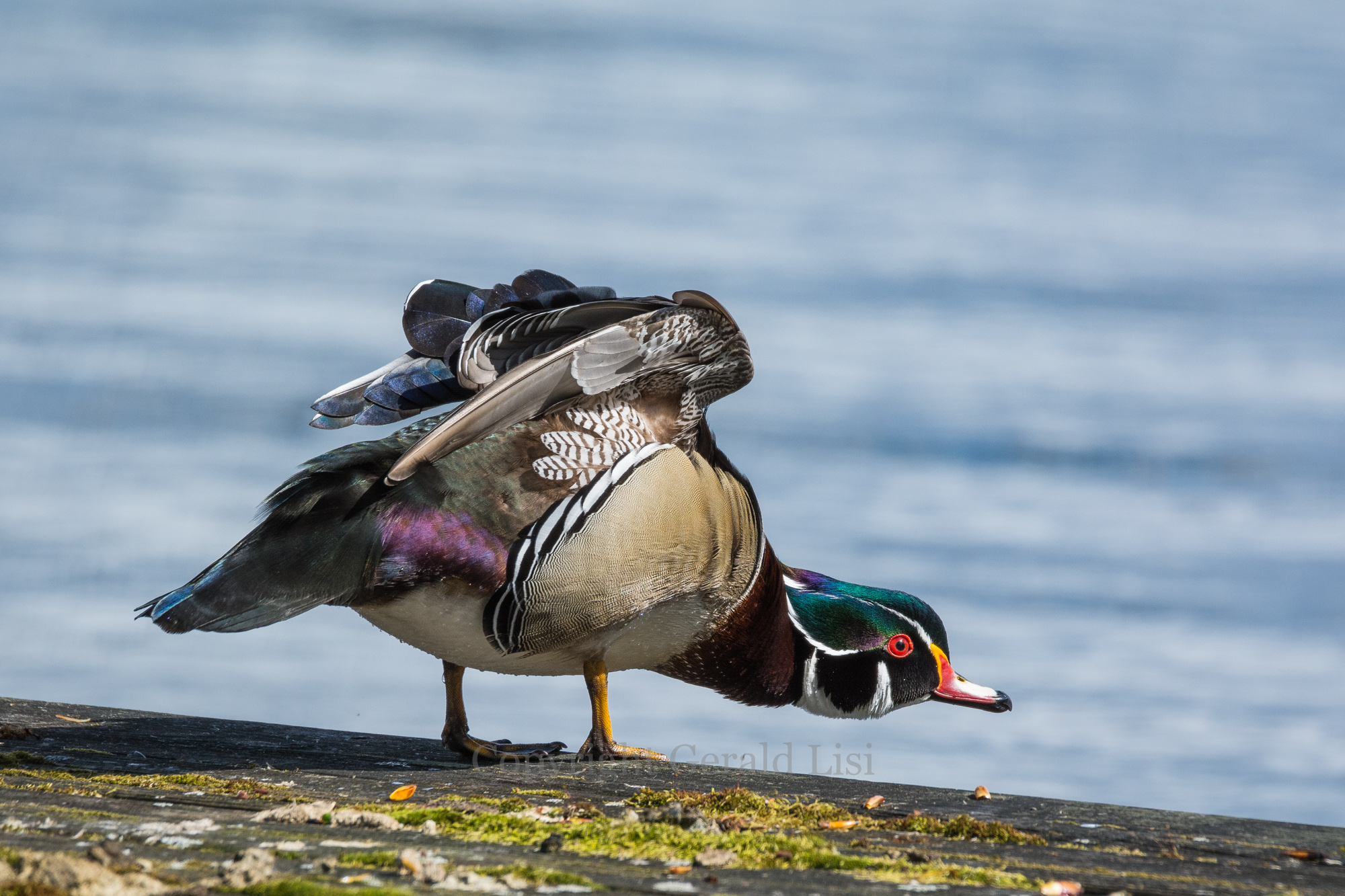
'Wood Drake Yoga'
Indeed, the wood duck is the only member of it's genus, Aix, in North America. It's closest relative is the equally striking mandarin duck of Asia. Meanwhile genus Anas, which includes the ubiquitous mallards, totals eleven North American species. While wood ducks look exotic next to all of those species they are in fact native.

Wood ducks share habitat and feeding habits with mallards, but the fact that they're from a separate evolutionary lineage is easily inferred by their radically different appearance.

A wood duck pair "fords" a fallen tree.
Like their neighbors in genus Anas wood ducks are dabblers. That means use their bills to gather food at or near the surface of the water. Seattle Audubon reports that that food is primarily the seeds of aquatic plants, but also includes insects and other invertebrates as well as plenty of acorns when and where they're available. (http://washington.www.birdweb.org/Birdweb/bird/wood_duck) I have noticed that they also seem fond of the rhizomes of cattails and other aquatic plants.
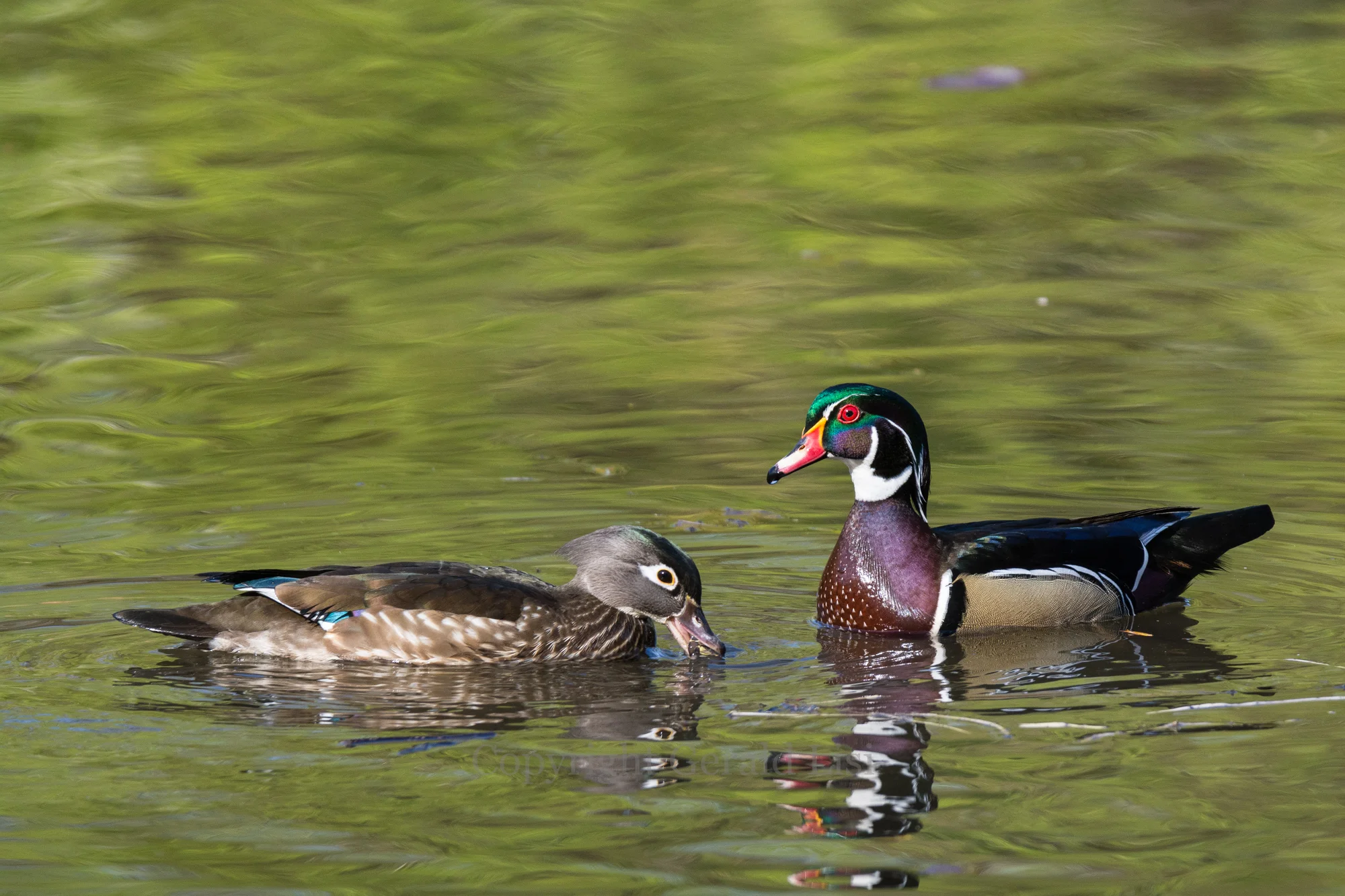
The hen is eating some kind of rhizome. They were swimming along looking for food, her in front, when the drake pulled the rhizome out of the water. He got her attention and when she turned around and approached him he dropped it in the water for her to pick up. What a gent!

The features that make wood drakes so beautiful also make them somewhat difficult to photograph. It's a balance between not underexposing the black feathers and not overexposing the highly reflective white stripes and red eyes and bill.

Wood drake hens are as lovely as the drakes are handsome. While less colorful than their mates they are more colorful than females of any of the Anas species. Unlike those species, who generally nest on the ground, wood duck hens nest in tree cavities. Since they are hidden inside their trees they don't require the camouflage while nesting that ground nesters do.
While the feeding habits of wood ducks are the same as those of mallards the fact that they nest in tree cavities clearly sets them apart. It also limits the areas they can live in. As their name implies, and their nesting habits show, wood ducks require wooded habitat. And not just any woods will do. There must be snags (dead trees) large enough to accommodate a wood duck hen and her eggs. But also, where do these nest cavities come from? Wood duck cannot excavate their own nest sites. Frequently they are the former nest cavities of the very large pileated woodpeckers, who conveniently tend to create new cavities for themselves each year.
This evolutionary relationship between mature forests, plieated woodpeckers and wood ducks goes back many millennia. But in just a few centuries extensive deforestation across North America has severely reduced populations of wood ducks, pileated woodpeckers and so many other species. For this reason it is amazing to me that the city of Seattle is home to wood ducks and the pileated woodpeckers that provide them with nest sites. It goes to show how valuable remnant patches of habitat are, and hints at the future biological promise of secondary forests if we manage them with the needs of wildlife in mind.
Some people must be given credit for helping wood ducks recover from historical population lows that other people caused. Duck-loving conservationists have done this through the simple act of building nest boxes and installing them on trees by ponds and marshes. But it is my great hope that we as a society will move towards protecting the mature forests that remain and facilitating the regeneration of as many of those that have been cleared as possible. This would be for the ultimate good, not just of wood ducks, pileated woodpeckers and myriad other species, but for human beings as well. As the negative effects of climate change accelerate alarmingly around the globe the immense value of carbon sequestration by the world's forests is driven home. Forests also recharge local stores of fresh water, a dangerously dwindling resource in more and more parts of the world.
I deeply hope that everyone that reads this (and more importantly the many, many more that don't) will give the issue of forest protection and restoration serious thought and intention. But I don't want to end this on a heavy note. So let's look at some more pictures of one of the many great reasons to love and protect our forests: Aix sponsa, the wood duck.

'Dazzled Drake'
Yeah, buddy. She's gorgeous. Don't screw it up.

These drakes are competing for the attention of nearby hens.

Two different drakes at a different time and place. One appeared to be mated to a hen he was traveling with. When the other showed up they chased each other around for a while, but the aggression seemed ceremonial and before long the bachelor went on his way.

These two obviously like each other. Once they pair up he won't leave her side until she hits the nest. But alas that is where the romance ends. She's on her own to incubate the eggs and teach the chicks how to be wood ducks after they hatch.
Thanks for reading my blog. Please use the links at the top of the page to check out my portfolio and follow me on Facebook and Instagram.