
Blog

Back in June
Greetings and salutations! I am still here, and do have some things to share with you. I actually selected images for a June post, but didn’t get past that step. So, one month later I offer you these photographic highlights of my late-spring/early-summer naturalist explorations. Enjoy!

It was actually back in May, the 31st, when I had the pleasure of watching this Scarlet Tanager for a few minutes. He was in the deep shade of the forest early on an overcast morning, so the light was not in my favor for photography. But this is undoubtedly one of Vermont’s most striking breeding birds, so I was clicking away with great enthusiasm. Here I managed to get a clear view of him through a window framed with Beech leaves.
Here he is perched on the boughs of an Eastern Hemlock, whose still-developing new leaves reveal the season of the shot.

Speaking of fresh spring growth I encountered this Cinnamon Fern at the perfect time to appreciate the namesake fertile fronds. Many species of ferns produce sori, their spore-bearing structures, on the undersides of their leaves, but Cinamon Fern is among those who produce separate sterile and fertile fronds.

Here we see a favorite of the forest floor. Bunchberry, aka Dwarf Dogwood, bears an inflorescence of small white flowers subtended by showy, white bracts. Said bracts are often misinterpreted as the petals of a single flower, but the bunch of berries that follow, one from each flower, reveal the actual arrangement. Here they are already developing into berries. This plant is nestled amongst Bead Lilies.

I was orchid hunting when I took the last two pictures. Specifically I was trying to find Pink Lady Slippers in flower. This is a photo of what turned out to be the first of dozens. This individual, well over a foot tall, was growing in a particularly photogenic spot.

The forest of the last three photos surrounds a fen where I encountered another botanical delight; Pitcher Plants. There were no clear views of the modified, insect-trapping, leaves that give these plants their name through the sedges they grew amongst, but their maroon flowers were opening. I was additionally delighted to see and photograph the tiny bee that was on one of this flower’s sepals. I suspect this is some species of solitary bee, but my bee knowledge is limited, unfortunately.

Thanks to the Vermont Atlas of Life on the Vermont Center for Ecostudies I was able to identify these mating dragonflies as Crimson-ringed Whitefaces.

Stunted White Cedar and Tamarack manage to grow in the saturated soils of the fen. Here a Bluejay hunts for food from a branch of the former.
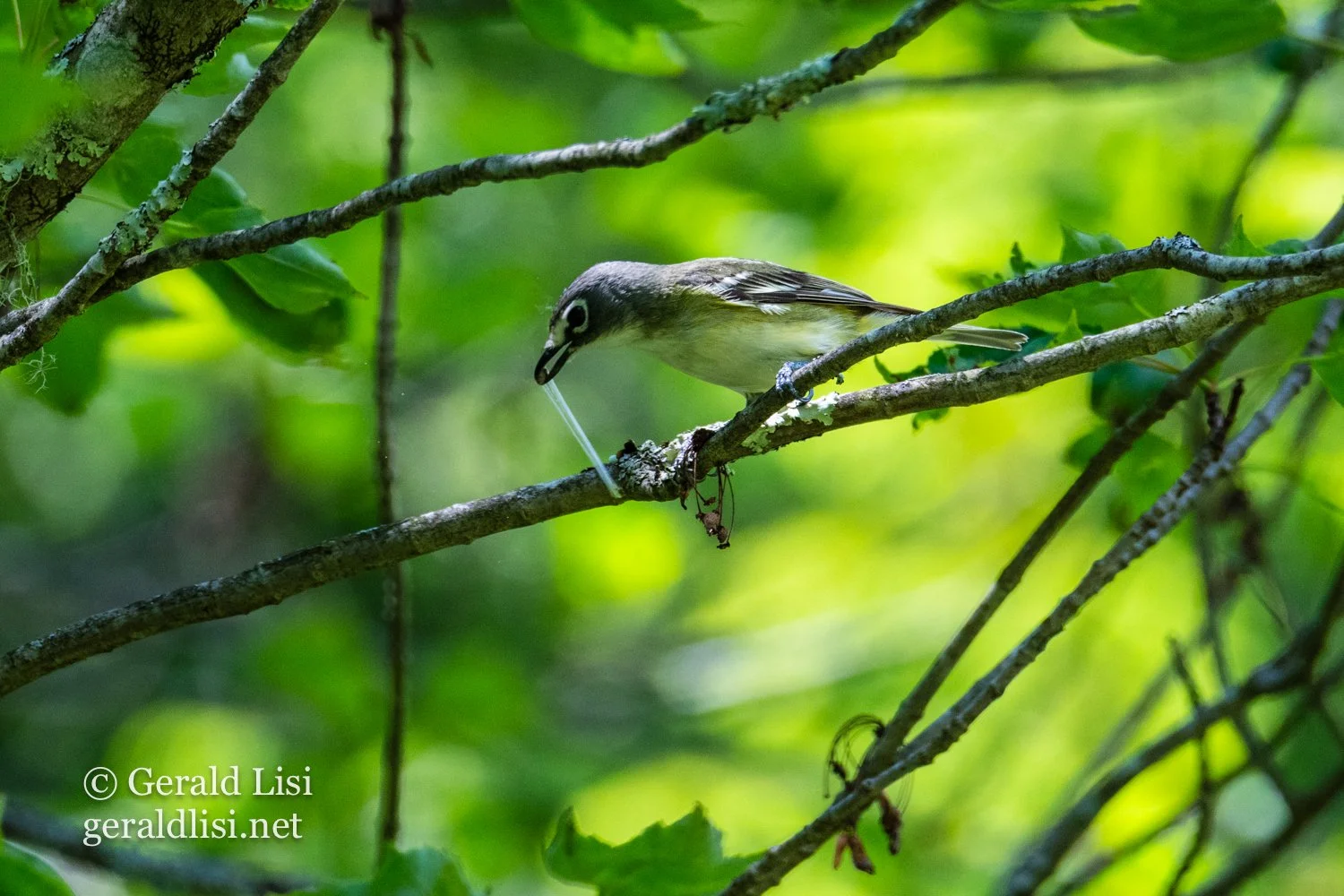
Another day, while birding at home, I had the pleasure of seeing this Blue-headed Vireo pulling what was probably a larval moth of some sort from its silken pupation tent. Many a caterpillar never metamorphoses due to the appetites and foraging skills of birds.

I was fortunate this spring to hear a lot of female American Redstart songs, and even get clear views of this little lady belting it out. The songs of most songbirds in the northern hemisphere are performed by males, but in a few species females sing their own songs as well. Both sexes are strongly territorial during nesting season and this image captures that behavior in this female Redstart.

One day a particularly loud and rapid exchange of Tufted Titmouse calls led my eyes to a whole family of these delightful birds. This juvenile and her siblings were still getting fed by their parents, but were probably quite close to fending for themselves at that point. Here we see adult plumage fully developed, but the fleshy gape at the base of baby birds’ bills is still apparent.
That’s it for this time, folks! Thanks for joining me. If you are reading this on my website or if a friend forwarded this email to you, you can subscribe to my somewhat-monthly newsletters at https://www.geraldlisi.net/ Wishing you inspiring encounters with the wild world until I next share some of mine with you.

It's (Almost) All About the Birds
After a solid year of monthly posts I fell off in April. Working long hours every week has relegated my photography to weekend hobby status. The long-awaited spring greening of the landscape is an absolute favorite event of mine. But, it’s May’s dramatic influx of migratory birds that has most drawn my lens this spring. So it’s these captivating creatures that will dominate this post, after I kick it off with another kind of delightful vertebrate.

This tiny Red Eft was a most welcome preview of the mass movement of these juvenile Eastern Newts that takes place every summer in the Northern Forest.

One dark morning early this month was brightened for me by the realization that Black-throated Blue Warblers had returned.

The throat of males is also part of the namesake for Black-throated Green Warblers. After chasing this guys songs through the canopy for more than a few minutes I lucked out when he alighted in a Sumac just ten feet away from me.

Also presenting himself in the late-to-leaf-out Staghorn Sumac was this Myrtle (Yellow-rumped) Warbler.

The Warbler game mostly involves craning one’s neck to scan the canopy from which a male’s song is emanating. Frequently one must settle for audio identification, but the relative lack of foliage in early May and this Black and White Warbler’s choice of singing perch enabled me to catch him in the act.

Pine Warblers do live up to their names, and I generally fail to spot the songster high in a White Pine. But foraging for insects brings many of the upper-canopy-singing warblers closer to the ground. I was very pleased to get this Pine Warbler shot in a flowering and leafing-out Paper Birch. Catkins of male flowers dangle below him and the remnants of last year’s seed “cones” are at his head level. Note also that if this tree was done leafing out this warbler would not be visible. The first couple weeks of warbler season affords the best views.

The biggest float in my spring warbler parade was presented by Northern Parulas. I was hearing, and even seeing, them so much earlier this month. Here a male sings in a Speckled Alder. The catkins behind him belong to a Willow.
So strong was my Northern Parula mojo that I even got a good look at this female, without the benefit of song to point me in the right direction. Although it was almost certainly the song of the guy in the previous picture that drew this little beauty to an Aspen branch in the same thicket. The plumage of female warblers is a less-colorful variation on that of the males, with that of some species having little or no bright colors at all, but the lady Northern Parulas are nearly as colorful as the males.

Closing of the warbler section of this post with an Ovenbird singing the ubiquitous “teacher teacher TEAcher TEACHER” of spring and summer in deciduous and mixed forests of the northeastern United States. Ovenbirds are one of a few outlier species in the Wood Warbler family that have thrush like appearances and habits.

For actual thrushes today i have for you this Veery, who granted me my closest yet looks at this often-heard denizen of Vermont woods.

Less often heard and rarely seen is the Wood Thrush. This guy’s truly enchanting song drew me like the piping of Pan, but I held little hope of beholding the feathered minstrel. The Spirits of the Forest smiled on me this day though, and I am very happy to share my first look at a Wood Thrush with you.

While I am indeed a woodsling, I am hardly allergic to the rivers, ponds and streams that so beautifully punctuate the forested landscape. The water draws me just as it does birds who are not at home in the deep shade of the forest. As strict pescivores Osprey bound to the bodies of water that feed them. I barely managed to get a couple pictures of my first Osprey of the year (they also migrate north to breed). But what a way to kick off Osprey season. She had just pulled this beautiful trout out of the Waterbury Reservoir.

Almost immediately after being dazzled by the Osprey I spotted the distinct silhouette of my first Loon of the year 10 yards across the water. A mate was soon revealed too, and both thankfully made their way closer to me between dives.
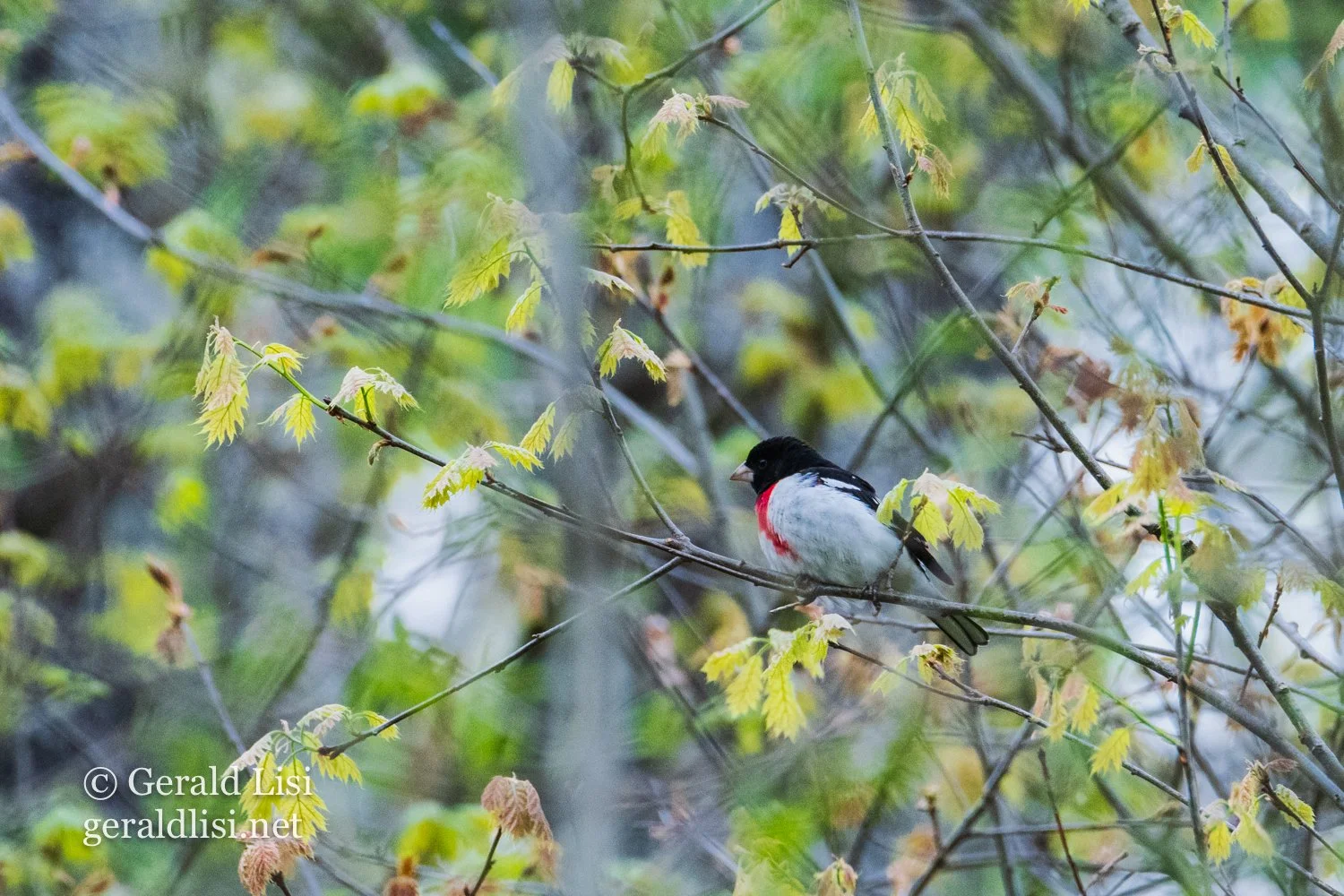
Back to the woods we go, with yet another first of year in then form of this male Rose-breasted Grosbeak in a Red Oak. He was o good ways off, but much closer than the only other one I have managed to photograph.

Well ahead of the mostly May arrivals of the birds above was that of the Eastern Phoebe, our most familiar flycatcher in the northeast, but for added color I share this one in the early-May flowering and leaf-out of a Gray Birch.

And now I close this set of images with the stunning beauty of a Common Grackle in a Quaking Aspen. The high-key exposure required to get feather details on an overcast day revealed her shimmering blue hood.
Thanks for joining me, my friends. If these birds gave you just a touch of the joy they did me then It was well worth the time (mine and yours). A bit of related news before I go: on Global Big Day, May 10th 2025, the announcement of said day on the Cornell Lab of Ornithology’s Merlin app prompted me to have my first go at a Big Day. I was going to be birding anyway, so I decided to see how many species I could identify in one day. Better birders than myself have much bigger Big Days than my first, but after a long and thoroughly enjoyable day of birding I had seen and/or heard forty-four species. For those interested I will list them below. Until next time, I wish you many encounters with wild others, and glimpses of wild self they grant.
Black-capped Chickadee, Hairy Woodpecker, Hermit Thrush, Ovenbird, American Crow, Ruby-crowned Kinglet, Eastern Phoebe, Blue-headed Vireo, Pine Warbler, Northern Parula, Common Yellowthroat, Chestnut-sided Warbler, Gray Catbird, Red-eyed Vireo, Yellow-rumped (Myrtle) Warbler, Red-breasted Nuthatch, Common Grackle, Red-winged Blackbird, American Robin, European Starling, Mallard, Turkey Vulture, Song Sparrow, Yellow Warbler, Bluejay, Common Merganser, Osprey, Spotted Sandpiper, Common Loon, Yellow-bellied Sapsucker, Ruffed Grouse, Downy Woodpecker, Chipping Sparrow, Canada Goose, Veery, American Redstart, Rose-breasted Grosbeak, Pileated Woodpecker, Black-throated Green Warbler, Brown Creeper, Wood Duck, Northern Flicker, Louisiana Waterthrush, and Wood Thrush!

Not Spring, Not Winter
According to the calendar spring started on March 20th. I’ve always felt that was completely arbitrary. Spring involves many delightful events, but to me the ones that officially kick it off are the emergence of shoots from herbaceous perennials and the leafing out of deciduous trees and shrubs. As I write on the 30th of March these long-anticipated botanical activities have not yet unfurled spring’s myriad green flags, but that’s not to say that spring is not in the air.
A better way to say it is that spring is on the wing (high fives self for stumbling into this rhyme). Warmer temperatures and especially increasing day length have activated the mating instinct in every bird I see or hear. Testosterone can hardly be contained within their little bodies and its results are being released in frequent calls, songs and woodpecker drumming, as well as driving courtship chases and mate-competition altercations. These particular signs of spring were in fact manifesting by the 20th, but have amplified significantly in the last few days. Yesterday all of this excitement was juxtaposed with half a foot of fresh snow. Does this mean it’s still winter? I can’t say that I am of that opinion, but it’s certainly not spring either.
One thing that I love about the change of seasons is how some elements of the one that’s ending overlap with those of the one that’s beginning. Nature is complex and defies our efforts to neatly divide it’s parts into categories. I’ve always been enthralled by ecotones, where one natural community type transitions to another. Now I’m thinking of the change of seasons as a temporal metaphor for this spatial phenomenon. This niche analogy only goes so far, but I think it’s worth exploring since it draws from the wonder that the more than human world provides. Meanwhile the only wonder I’ve been getting from the human world is wondering what the hell is wrong with people. Present company excluded, of course. The obvious point of all of this is birds. Let’s look at some birds.

This Song Sparrow is a new arrival in my yard. While some of these ground-foraging birds somehow manage to overwinter in Vermont most arrive from southern vacation spots around now.
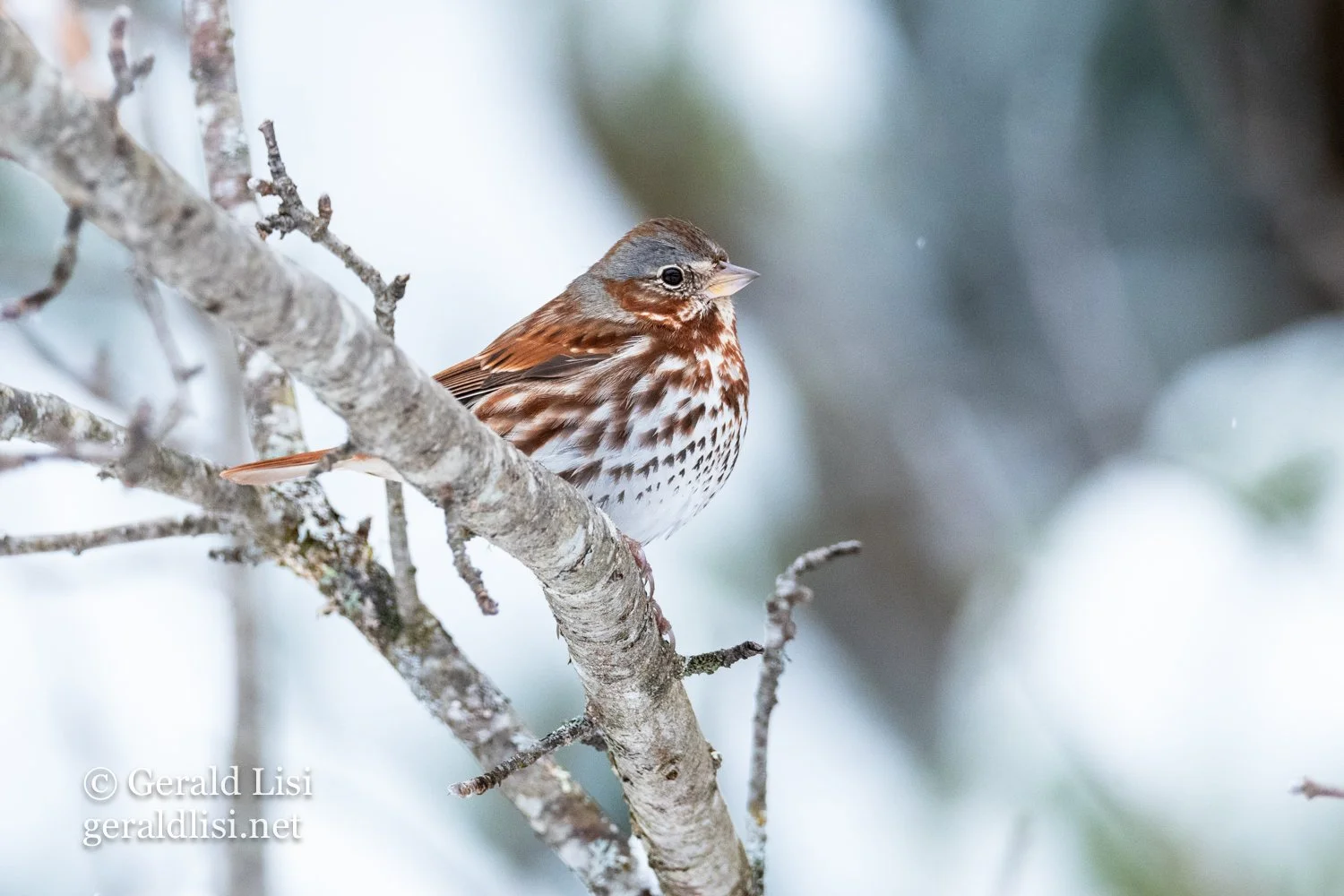
Fox Sparrows pass through Vermont on leisurely migrations too and from their northern breeding grounds.

Slate-colored Dark-eyed Junco females are light gray above with varying amounts of light brown on their sides and backs. I’ve had a handful of Juncos around the house all winter, but on the morning of the 30th I counted 28. They have contributed more tha their share to soundscape of the changing season.

Here we see that the male Slate-colored Dark-eyed Juncos are much darker with no brown. Note the pink bill in both sexes. Males in this flock greatly outnumber females, which is common across species.
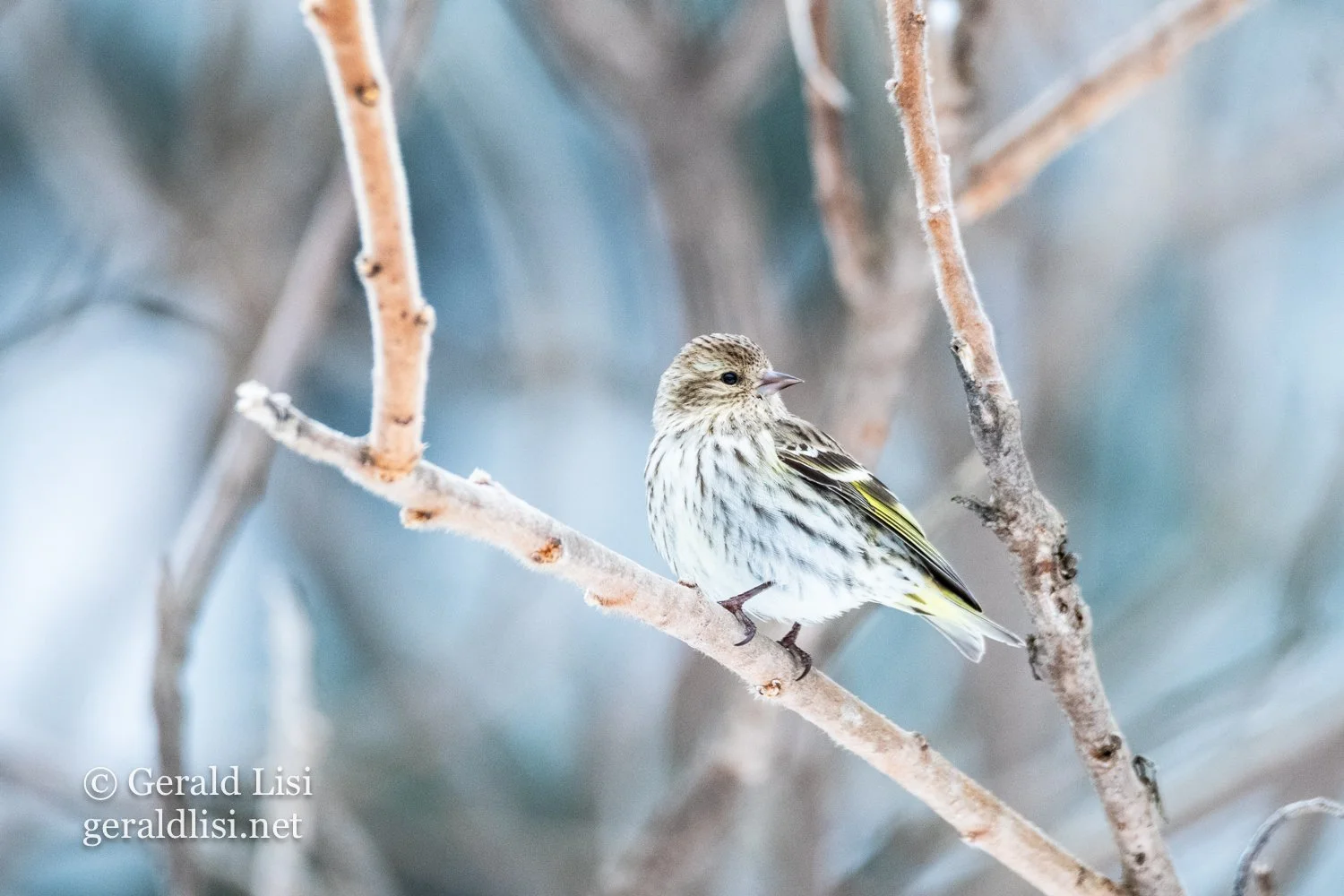
Pine Siskin in Staghorn Sumac. I had very little Siskin action this winter, but am pleased to report that a flock arrived recently. Flocks of these little finches follow the cone crops of conifers, birches and alders, and like other finches they visit bird feeders.
American Robin male finishing off a cluster of Staghorn Sumac berries. Most Robins head south for the winter. Fruiting trees provide winter fare for the early arriving males, who are establishing nesting territories, and the few who overwinter. As soon as the ground is bare they switch to worms, of course, and other ground-dwelling invertebrates.

Once his belly was full this guy perched for quite a while on this birch branch.

Hairy Woodpecker males are distinguished by the red spots on the backs of their heads. Downy Woodpeckers have the same plumage patterns, but are smaller with shorter bills, and they tend to forage on the branches rather than trunks of trees. This guy was chasing around his lady love, squeaking with amorous delight as he did so. I’ve heard similar courtship vocalizations from Flickers and Sapsuckers, but this was my first time seeing this species doing it.
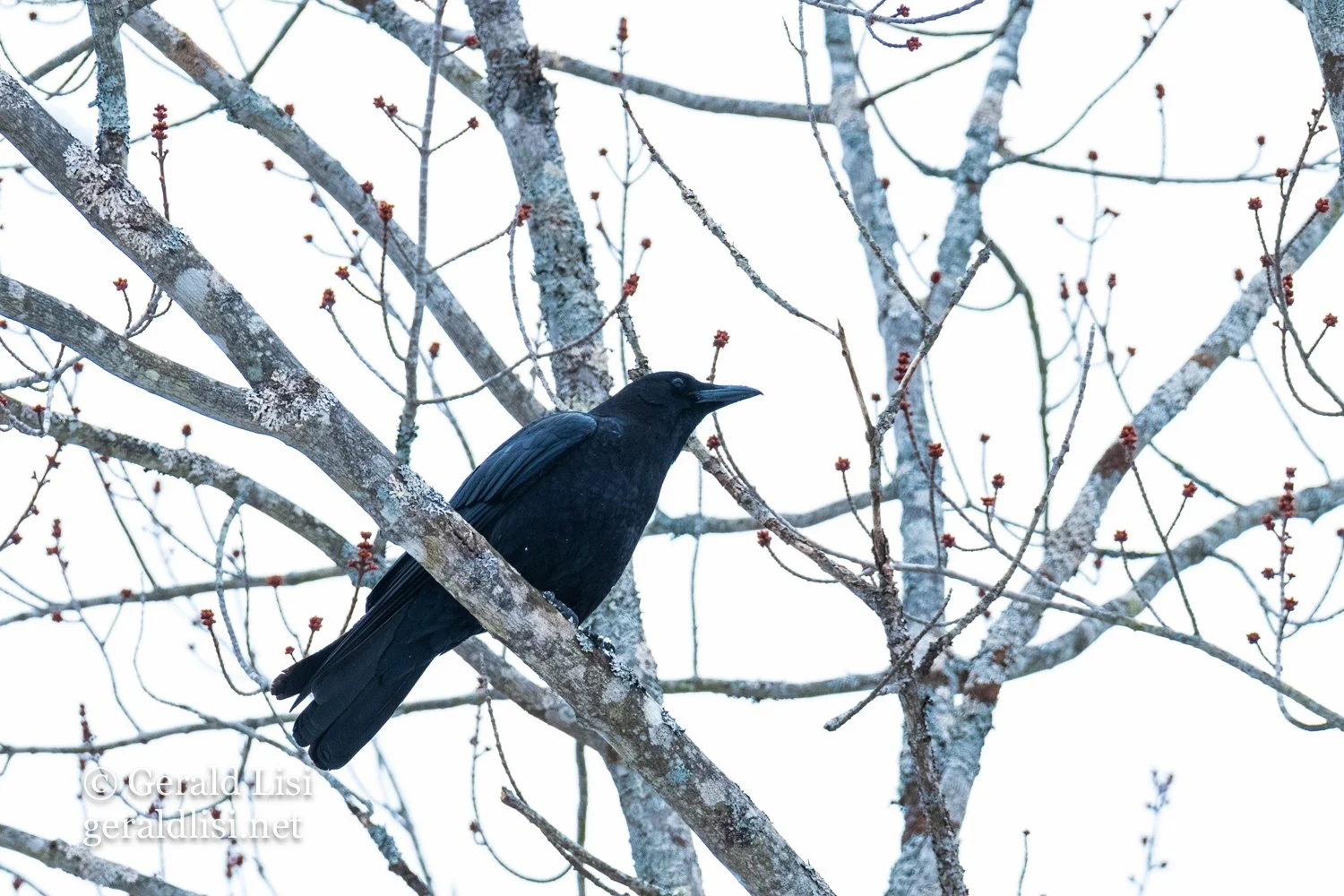
This Crow is one of four who spend some time here. They are most likely a mated pair and the young from last year.

The other Corvids that visit my yard are Bluejays, and are similarly likely to be a mated pair and last year’s young. Their is a Ravn family in the area too, who sometimes visit my woods, but not the yard.
So there’s a few of the birds whose company I enjoyed at home on the 29th. My full species list for the day was as follows.
Slate-colored Dark-eyed Junco, Song Sparrow, Fox Sparrow. Black-capped Chickadee, Tufted Titmouse, Red-breasted Nuthatch, White-breasted Nuthatch, Brown Creeper, American Goldfinch, Pine Siskin, American Robin, Downy Woodpecker, Hairy Woodpecker, Pileated Woodpecker, American Crow, Bluejay, Mourning Dove
That’s eighteen species, which is more than I’ve had here since October. Spring is indeed on the wing!

Surprise! Birds aren’t the only charismatic vertebrates I have to share with you. Imagine my delight when this Long-tailed Weasel zipped across my porch. I was sure he would be gone when I rushed out the with my camera, but fortune and the bold/curious behavior of these weasels was on my side.

Here he peeks from under the steps outside my bedroom. After his inspection I suspect any rodents around the house have been converted to weasel flesh. Just a couple nights before I had a five hundred pound Black Bear out there, certainly a male. He stole a fresh block of suet from my feeder, but was good enough to leave the feeder itself. No pictures as this was the middle of the night. As much as I would like to see him in daylight a fed bear is a dead bear, so I had to scare him off. A simple rapping on the window sufficed to have him swiftly loping off into the woods.
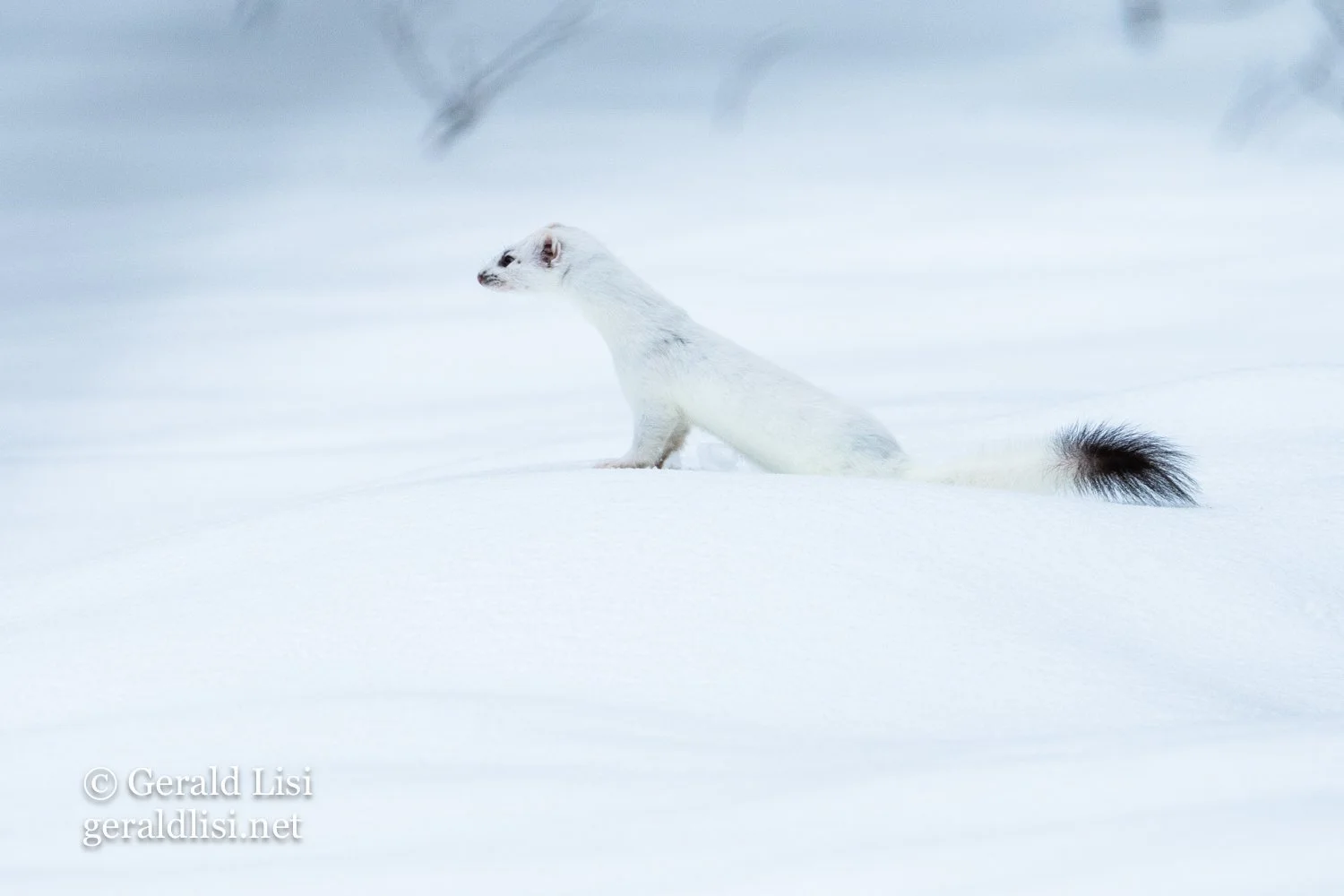
I’ve never gotten good Long-tailed Weasel photos before, and this was my first time seeing them in their north-country winter coats. The white pelage seen here will sooj be replaced with a shorter coat of browns, with a bit of a dark mask. Seeing a photographing this guy was a real treat. It helps to be in the woods of Vermont, but wherever you are there’s wildlife that will surprise you right outside your door. Pay attention and you will be rewarded!
That’s it for this month, my friends. Thanks for taking the time for this. If you’re reading this in an email please consider forwarding it to someone who might enjoy it. If you’re reading it on my website or in a forwarded email please consider visiting my home page to subscribe, https://www.geraldlisi.net/ . Thanks and take good care!