
Blog

Winter Woods on the Cusp of Spring, Central Vermont
Technically speaking it was mud season when I arrived in Vermont on March 26th, 2022. All of the snow had melted and all of that water had made a muddy mess of dirt roads and driveways. The air was warm, in a relative, New England kind of way, and even the earliest signs of spring in the plant life were weeks away. This limbo between winter wonderland and verdant explosion of foliage would generally be considered the least picturesque time of year, but for a nemophilist there is always beauty to be found in the forest. As it turned out there was some snow while I was there, which inspired me to get into the woods with my camera. Below are a few favorite images from those walks.
I actually started this post last April when I got back to Washington, but I was so grief-stricken from the recent unexpected passing of my Mom that I barely got started before giving up on it. Right now in New England everyone has had quite enough of winter, and is eager for signs of spring. I know my Mom would be just as ready for spring as everyone else, if we were lucky enough to still have her with us, but I also know that she would appreciate the simple beauty of these photographs. Indeed, she was so good at recognizing and savoring the beauty of everyday moments, which really are the focus of most of my photography. I hope that you will find some beauty here, and more importantly on your own wanders, or just outside your door or window.

Spruces with American Beech, Paper Birch, Red Maple and Witch Hazel. Last year’s orange leaves identify the beech, the straight gray trunk of the maple is to the right of the birch and the wily Witch Hazel leans out from in front of the maple.

Paper Birch with Yellow Birch in the background.

Here the Yellow Birch is in front, with Paper Birches in the background. Golden green moss adorns the base of the Yellow birch and dark green in the background is courtesy of spruce saplings.

Eastern Hemlock and Paper Birch.

Shadows cast by Sugar Maple and Paper Birch.
Yellow Birch by a lichen-crusted outcropping.

Stream waterfall with icicles and Yellow Birch.

Tree Clubmoss. Neither tree nor moss, but more closely related to the latter. Like mosses the Club Mosses, or Lycopods, are spore plants. The strobilus seen at the top of this plant is the spore-bearing structures, the “club” in their common name.

Mature Eastern Hemlock in a stone wall by the road.

More Eastern Hemlock in the same stone wall.

The Worcester Range seen through Paper Birch and Sugar Maple.
Thanks for taking a look. If you would like to see more Vermont winter woods photos let me know in a comment below and I’ll post another series soon. Also, if you want to see and read about spring highlights in western Washington please visit my home page and sign up for my newsletter.

Duvall Snow Days
The maritime climate of the Puget Sound lowlands makes snow a rare event here, and rarity creates treasures. Fresh snow transforms the landscape in ways that align perfectly with some elements of photographic composition. It simplifies the scenery and emphasizes shapes and patterns with the high-contrast lines of snow on substrate. But, below-freezing temperatures are so fleeting here that the treasure of snow is highly ephemeral. Of particular interest to me are snow-covered trees and shrubs. Several days into a snow event here in Duvall, Washington the rapid melting of the snow after, or even as, it fell made for very little snowy-tree time during daylight hours. I had accepted that I probably wouldn’t get a good window of snowy tree time when I went to bed on Friday, December 2nd. As it turned out a couple inches of fluffy snow fell as I slept, and the air temperature was still below freezing (barely) when I woke up shortly before dawn. A treasure was laid before me, but like life itself it was fading away by the moment. Breakfast would have to wait, as it usually does for me anyway. After savoring my large mug of strong French roast, I put on my winter clothes and boots, put my 18-55 mm lens on my Nikon D7500 and ran out the door into a cloudy dawn.

A chilly warm-up shot on the way out of my apartment’s driveway. A Beaked Hazel bowed over by the snow beneath Red Alders and a stately Bigleaf maple.

Lake Rasmussen was my first destination. This small lake is a few blocks from my place and the opposite shore of it’s public access side is a nice patch of mixed forest. This is a somewhat eastward view too, so the rising sun added some glow and color to the dissipating clouds. The barely freezing average temperature of the last couple days is seen in the partially frozen surface of the lake.
As I took pictures at the lake it began to sprinkle. This didn’t bode well for my snowy-tree window, so I rushed to the next stop. The rain was fortunately ever so brief and light. I was headed for Cherry Valley, but I saw that it was densely foggy. I love some fog in my landscape photography, but this would obscure too much. Plus all of the morning light sky action was in the other direction, so I headed towards the Snoqualmie River, passing briefly through downtown.

The Duvall Tavern on Main Street/Highway 203, with Rocking E Feeds across the street.

Crossing the street and grabbing another downtown snapshot with the morning-sunlit background.

The light was getting better by the moment, so I grabbed this shot with the Duvall-Woodinville Rd bridge on my way to the river it crosses.

I thought of Dark Tranquility’s ‘The Mundane and the Magic’ as I placed these structures and vehicles in the foreground of this snowy-trees-with-sunrise shot.

Coming up to the river I was taken by the color of this powdery lichen on the concrete. The foremost bridge support and a Bigleaf Maple frame what appears to a support from a previous bridge across the Snoqualmie River.

The old bridge support and a delightfully spreading Bigleaf Maple make the foreground for the soft shapes and colors of this morning sky.

Down the river a bit and I framed the sky with these snowy trees and shrubs.

At the river’s edge I made this reflection image.

Turning upstream I was taken by this view of the bridge and trees reflected in the river.

Zooming in on these Black Cottonwoods for another reflection shot. It’s hard not to make these kinds of pictures by a calm body of water with some nice colors in the sky. I’m not sure what kind of work was going on in the big green building, but whoever was at it was cranking ranchera music inside, and I smiled at the festive atmosphere.

Around the river’s bend I made a possible shot of the day with these snowy maples and that soft morning sky.
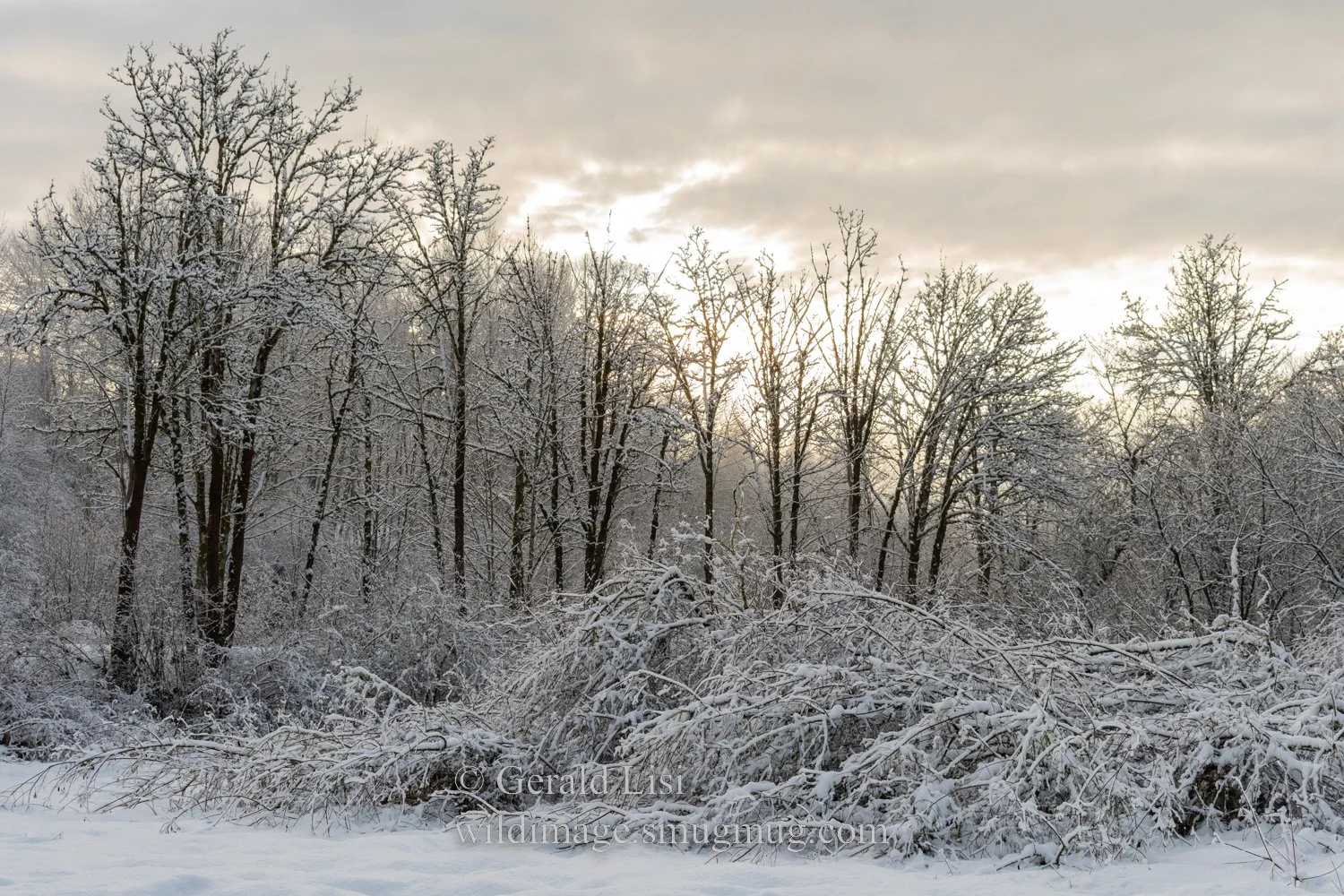
Into the shade of the foothills that Duvall is buit on I got more of the snowy trees and shrubs that were my main subjects of the morning. No choice but to overexpose the eastern sky as the sun rose higher, but I actually like to blow out the highlights on shots like these. I feel that it conveys the awesome power of the Sun, whose energy fuels all life on Earth. I also like the juxtapositions here; fire and ice, direct sun and shade.

Bigleaf Maples line the Snoqualmie Valley Trail. These are the same maples seen in the previous photo, but there I was in McCormick Park facing the trail on an eastward perpendicular line. Here we are looking south, and I like the way that the trail bisects the morning sky into the blazing sun in the east and the soft blue and clouds in the west.

Looking back across the Snoqualmie Valley Trail before heading through town to Taylor Park, which won’t be included in this post. What direction am I facing? What kind of trees are these? I hope you’ve been paying attention! ;)
With the sun rising and the clouds parting, the soft morning light was about to end abruptly, and the fluffy snow had melted into wet clumps that were now falling off of the trees. This is where my prime shooting window ended, so it is where I am ending this post. I did some more shooting in the forested Taylor Park, but conditions were fairly adverse to photography at that point. Maybe one or two of those shots will make it on to Instagram and Facebook.
Thanks for reading my blog! I hope you enjoyed these photographs and the story behind them. While you’re here please visit my store and/or portfolio! The store, which is brand spanking new, has my calendar, some matted prints and a bunch of hand-made greeting cards. As always, various kinds of prints of EVERY PICTURE IN MY PORTFOLIO are available! I hope you’ll browse it a bit whether you’re in the market for art or not, bu if you do find a photo you really love please click “buy” at the lower right of the image to open a menu. Please do leave comments below if you are so inclined. It is my intention to move towards more interaction with you here, and less on social media. Thanks again for stopping by!

Chickering Bog, june 2021
Chickering Bog Natural Area is a 222 acre property of the Nature Conservancy in Vermont. The preserve, found on the back-roads through the border of Plainfield and Calais, is comprised of the fen (“bog” is technically inaccurate) and most of its forest watershed.
A male Common Yellowthroat, Geothlypis tracheas, surveys the fen for food and threats. The vibrant green needles behind him belong to a Tamarack, aka American Larch, Larix lacrina.
Family brings me back to Vermont, where I was born and spent twenty-two of my first twenty-three years. My Mom and stepfather are always the priority people on these all-too-infrequent trips, although there are many other people there who I am very fond of. But just as the presence of my folks and old friends makes central Vermont home, the land itself permeates my history and sense of identity.
Growing up I was always a nature boy, exploring the woods around Plainfield and the Winooski River which runs through it. I felt great affinity for the plants and animals there, but only had a basic knowledge of the flora and fauna. It wasn’t until my mid thirties, over a decade into my time in Seattle that I began exploring the pursuits of a naturalist, first in botany and later with birding. So I am now in the funny position of knowing more about the flora and fauna of western Washington than of the land I grew up on. Every time I’m in Vermont I relish the opportunity catch up on the many things I didn’t learn when I lived there. While some species, such as the Common Yellowthroat seen in the photo above, can be seen in Washington as well as Vermont the flora and fauna of these distant places are very different overall. This means that returning to Vermont simultaneously provides the comfort of the familiar and the excitement of discovery.
My wildlife wish list for this trip was long, as it is for any proper naturalist excursion, but this particular story revolves around my quest for pitcher plants and orchids. After telling my Mom about my intention to visit at least one bog for that reason she did some research that yielded Chickering Bog, among other places. It was only a half an hour from my folks’ place, and lies on the edge of my hometown of Plainfield. Again, discovery amisdt the familiar.
A couple notes about this post:
Part of the purpose of having this blog is write more about the content of my photos and the adventures that yielded them, so I must apologize to those who actually want to read my writing for the brevity of the text above. The summer got away from me and with my visits to Chickering Bog now months into the past I’m not even trying to narrate those experiences. But I did manage to upload and caption the photos below, so that much of those wonderful walks can be experienced here.
Regarding the photos, I have included images taken on my phone, a Google Pixel 4a. I had my telephoto lens on my camera to be ready for wildlife encounters. Rather than changing lenses, out of pure laziness I just used my phone for landscape shots. While I am quite impressed with the quality of the images from this camera phone, they certainly don’t touch the quality of those taken on my Nikon D7500. Seeing them on my computer screen, rather than my phone screen, gave me misgivings about using these, but in order to show you more I ultimately opted to keep them here. This is more about storytelling than trying to present myself as a great photographer, which I am not. Photos without watermarks were taken on the Pixel, those with on the Nikon. Watermark or not they are still mine and may not be used without my permission. Please pardon that bit of unpleasantness and enjoy the pictures!

A sampling of floristic diversity on the forest floor. Middle, lower right and lower left are Ash, Fraxinus, Balsam Fir, Abies balsamea, and Sugar Maple, Acer rubrum. The saplings are mingling with two species of Rubus blackberry/raspberry) and one of the many New England ferns that I can’t identify.

I love the way this tree’s roots grasp the exposed bedrock.

Old stone walls are common in New England woods, and certainly lend to their charms, but finding this stone staircase was a special treat.

I can’t resist the beauty of birch bark. In life the outer layers of Paper Birch bark peel and roll into delightful scrolls as the tree grows. Here many layers are coiling together on a large section of bark shed from a dead tree.

Among the many seed plants on the forest floor can be found the vascular spore plants known as Clubmosses. Looking somewhat like tiny pine branches (“Ground Pine” is another name for them) these ancient plants are no more little trees than they are mosses. Like mosses they reproduce with spores, but they have water-transporting vasculature which mosses lack. This enables them to reach their height of eight inches, something unattainable to mosses. Seen here is Tree Clubmoss, Lycopodium obscurum.

Northern White Cedar, Thuja Occidentals. Seeing this species in the forest hinted at the proximity to the fen where I was headed. They are associated with bogs and swamps.

“Welcome to a Class I wetland designation that highlights Chickering Bog as “best in show” for wetlands in Vermont. Contrary to its name, Chickering Bog is actually a fen! Fens are fed by groundwater, carrying important nutrients from underlying bedrock, like calcium and magnesium. Bogs, on the other hand, are only fed by precipitation, creating acidic, nutrient-poor conditions. Surrounded a relatively undeveloped landscape, Chickering Bog has been a conservation priority since the mid-1970’s, with 220 acres and most of the surrounding watershed conserved by 2014.”

Northern Pitcher Plant, Sarracenia purpurea. The specialized leaves of pitcher plants give them their name, but their flowers are pretty fascinating too.

The rainwater-filled leaf of a pitcher plant is an insect trap. Insects that drown in that water are digested by enzymes secreted by the plant and by bacteria living in the water. The nutrients obtained, nitrogen in particular, compensate for the low fertility of the acidic, water-logged soils these plants grow in.

The reddish purple patterns on the surface of the pitcher attract insects. Much less obvious to us, but tantalizingly detectable to insects is the presence of nectaries at the top of the pitcher. The same sweet liquid that attracts pollinators to flowers is used here to lure prey. Insects that fall into the pitcher are prevented from crawling out by the downward-facing hairs above the opening.

Rose Pogonia, Pogonia ophioglossoides. Loss and degradation of wetlands make this and other orchids of these fragile habitats all the more precious. Collection of the plants further imperils populations of these wonderful wildflowers. If you have the good fortune of finding wild orchids please take only pictures.

Grass Pink, Calopogon pulchellus framed with Northern White Cedar foliage. At first glance I thought I was seeing more Rose Pogonia, but then I was doubly delighted to discover that there were two species of orchids flowering in the fen.

The flowers of Grass Pink are upside-down orchids. The highly modified petal known as the lip is usually at the bottom, not the top as seen here.

Larch trees, such as this Tamarack, are deciduous conifers, which shed their leaves every autumn. I remember my mind being blown as a kid when I discovered the seeming oxymoron of the deciduous conifers. I knew conifers as evergreens, and broad-leaved trees as deciduous. Of course most conifers do have leaves that live through the winters, but larches are one of several exceptions to this pattern. Similarly there are more than a few species of broad-leaved trees that don’t shed their leaves in autumn, but they are found in milder climates than New England’s.

Damselfly on Red Osier Dogwood, Cornus stolonifera. Damselflies are close relatives of the dragonflies, which can easily be guessed by looking at them. Aside from their smaller size and more delicate features (“damsel”) they can be distinguished from dragonflies by their habit of holding their wings against their sides when at rest. The wings of dragonflies remain extended outward at all times. That being said I don’t know what species of damselfly this is, or even which genus that species is placed in.

Little Wood Satyr, Megisto cymela

Green Frog, Rana clamitans

Ovenbird, Seiurus aurocapillus, with a caterpillar for their nearby fledgling.

Yellow-bellied Sapsucker, Sphyrapicus varius, female (males have red throats as well as crowns).

Pileated Woodpecker, Dryocopus pileatus, female (males have red malars or “mustaches” and the red on their crowns extends all the way to the base of their bills).

Red Squirrel, Tamiasciurus hudsonicus.

Blue Jay, Cyanocitta cristata
Thanks for joining me for this brief exploration of Chickering Bog! Links at the top of this page will take you to other posts, my social media pages, and my portfolio, where you can buy prints of my work.
Life and Death in an Urban Forest Fragment

Douglas fir stand with healthy, native understory. Yellow leaves left of center belong to a beaked hazelnut, which grows above a thick patch of salal interspersed with red huckleberry and trailing blackberry. This forest in Seattle's Lincoln Park is the setting of our story. Other trees in this exceptional patch of urban forest include western red cedar, grand fir, western hemlock, bigleaf maple and red alder. The native plant community here makes Lincoln Park an oasis of wildlife habitat. Most of the large mammals generally found in this type of forest are absent because it's in the city, but it is rich in bird life.
There was a lot on my mind as I headed to Lincoln Park last Saturday. Nothing too weighty though. As usual when I'm going to the woods I had my telephoto lens with me and was thinking of what birds I might encounter. There are a handful of species I can generally count on seeing at this time of year, and some that I usually only hope to see. This particular park has a bird that can't be seen many other places in Seattle, and I was particularly hopeful that I would see it: the raven.
The much larger cousin crows, who have achieved extraordinary numbers in the urban/suburban matrix of the greater Seattle area, ravens all but disappeared with the bears and wolves when the ancient forests were cleared. For years I actually thought there were no ravens in Seattle because I never saw one here and because I associated them with wilderness. So strong was this supposition in my mind that when I first heard a raven at Seward Park I thought to myself "that crow sounds like a raven." But after a few more quorks hit my ears I suddenly realized with delight that they did in fact come from the syrinx of an urban raven. Of course I use "urban" lightly here. Seattle is not a particularly urban city, and Seward Park is home to a small stand of old-growth trees. The neighborhood next to the park, also called Seward Park, has trees lining almost every street, like so many in the Emerald City. But still, ravens in Seattle!
Well, it turns out I was a little late to the party on this one. But that didn't diminish my excitement. There is a dry erase board at the Seattle Audubon Society's Nature Center near the entrance to the park where people report wildlife sightings. After having the good fortune of visually confirming my ID of the raven, and discovering that there was actually a pair, I checked the dry erase board and there it was: "two ravens." After reporting my "discovery" to a group of fellow bird nerds I learned that while they are uncommon, if not rare, here they are present. I believe at least one of them told me about ravens in Lincoln Park. Regardless, I did soon see ravens there, and as with Seward Park, I'm always hoping to see them when I go there.

The first raven I saw in Seattle, at Seward Park. This is not a character in our story, but since I mentioned it, and have this photo, why not? "What's that in it's bill?" you say. "It's a mole" I reply. Like crows ravens are omnivores, but a much larger percentage of their diet is made up of animals.
So ravens are definitely on my mind when I get to Lincoln Park, but I don't see or hear them as I walk the forest trails. I can hear chickadees and golden-crowned kinglets up in the trees, but they're hidden by branches. The light level is not great for photography anyways. Cloudy weather and the shade of tall conifers don't give one much to work with, at least not for the fast exposures generally required for wildlife photography. Of I course if I let low light stop me I would only shoot for half of the year, and that's not an option. But at the moment I want to get out into the open. The lower part of the park is Puget Sound shoreline, so I head down to the beach.
When I was at this beach last winter I saw harlequin ducks on the water, and managed to get some decent shots of them. I'm pleased to discover that they're here again, but they're too far away from the beach to photograph. Orcas pass by here, and as always I'm hoping to see them. As usual I don't though. Across the sound is the Olympic Peninsula, and I admire the jagged, snowy peaks of the Olympic Mountains for a few minutes. It's a great view and a lovely day to be by the water, but my avian amigos are calling to me from the forest. I take a couple pictures of the Olympics and head back up.

The Olympic Mountains seen from the beach at Lincoln Park.
It wasn't that overcast at this point, as seen in the picture above, so I find a south-facing forest edge to take advantage of the light. There's plenty of activity with the little feathered ones there, and a sciurid from back east.

This Hutton's vireo was sallying from various branches in a thicket, and is seen here hiding behind an orange honeysuckle vine in order to thwart my efforts at a clean shot. It's their nature and I don't hold it against her.

While every little bird on the face of the planet is a lousy model, city-dwelling eastern gray squirrels are total hams. I don't particularly want to photograph an eastern gray squirrel, but he basically gives me no choice.

A female house finch snags an orange honeysuckle berry. Like most birds she can't hover, and there's no perches for her to access the fruits from, so she was doing flybys from a tree branch below.

And here she is enjoying the fruit of her efforts (which is also the fruit of the orange honeysuckle plant). Girl, you better wash up when you're done. You're bill is a mess.

A song sparrow forages on a Pacific madrona log. More orange honeysuckle to her left. Pretty background colors are courtesy of the invasive small-leaved cotoneaster, which I kill when given the opportunity.
I'm on a bit of a roll at this point, but my time at the edge of the woods is about to end. I hear raven calling, and he's calling loudly. No quorks this time. More like a deeper, harsher version of the kaw of a crow. The calls are coming from above and away, and with a little moving around I manage to get a clear view of him at the tip of a tree.

Raven calling to his mate, and inadvertently summoning a wildlife photographer.
Now that raven has spoken I'm headed back into the woods. The shot above was taken at about 150 feet away, and I'd love to get closer to this mystical forest being. I'm not likely to get a clear view of him up in the trees, but I change my camera settings in hopes that I do. Time to crank up the ISO's, open the aperture all the way and significantly slow my shutter speed down. I walk toward the Douglas fir he's been calling from then follow as he flies into a thick stand nearby. I lose sight of him but his continued calling leads me his way. I spot him again through many branches. Then I'm made aware of his mate's presence thirty feet above me by her rustling in the branches.
Soon they both take off, and again I follow. Walking briskly but calmly I move in the general direction of their departure. Suddenly I am aware of the angry voices of dozens of crows. I consider that they may be yelling at the ravens, who they often rightly see as a threat (at least in nesting season). "But maybe they're yelling at a hawk or an owl" I think to myself as I walk towards the racket. Moments later a large owl sweeps silently over the path and into the trees with three noisy crows on its tail. The chorus of alarmed crows extends up into the trees, following the owl's path. I creep through the forest scanning every branch for the beleaguered raptor. The loud swishing of raven wings overhead interrupts my search. The crows' massive cousins are in the middle of the fray. Stalking below the corvid mob I have no expectations of actually finding the owl, but as I round the straight trunk of a large grand fir I see it only thirty feet away. I immediately freeze, then slowly lay down on the forest floor. This barred owl doesn't seem threatened by me though. It gives me a good look then turns it's attention back to the corvid vigilantes.

A crow-beleaguered barred owl assesses the person lying on the ground with a long lens pointed at it and rightly determine that it's not a threat.

Her attention returns to the crows incessantly announcing her presence from the trees above.

"Sigh... they know exactly where I am. Gotta find a better hiding place. I seriously just want to go back to sleep."
And so she makes a bee line through thick low branches, and I hope that I'm the only one who sees the dark perch she squeezes into. I'm thankful to have had this encounter, and to even get some pictures of this owl. And now I wish her good day and good luck.
Through the cries of the crows I hear the the ravens' long wings again. Intrigued by their presence in the middle of the crows I head their way for a look. I spot them up in the trees surrounded by crows, but they swoop down to a lower branch by the trail. This gives me a chance to get a better view. One moves out of sight, but amazingly I get a clear view of the other, and even get a couple quick photos.

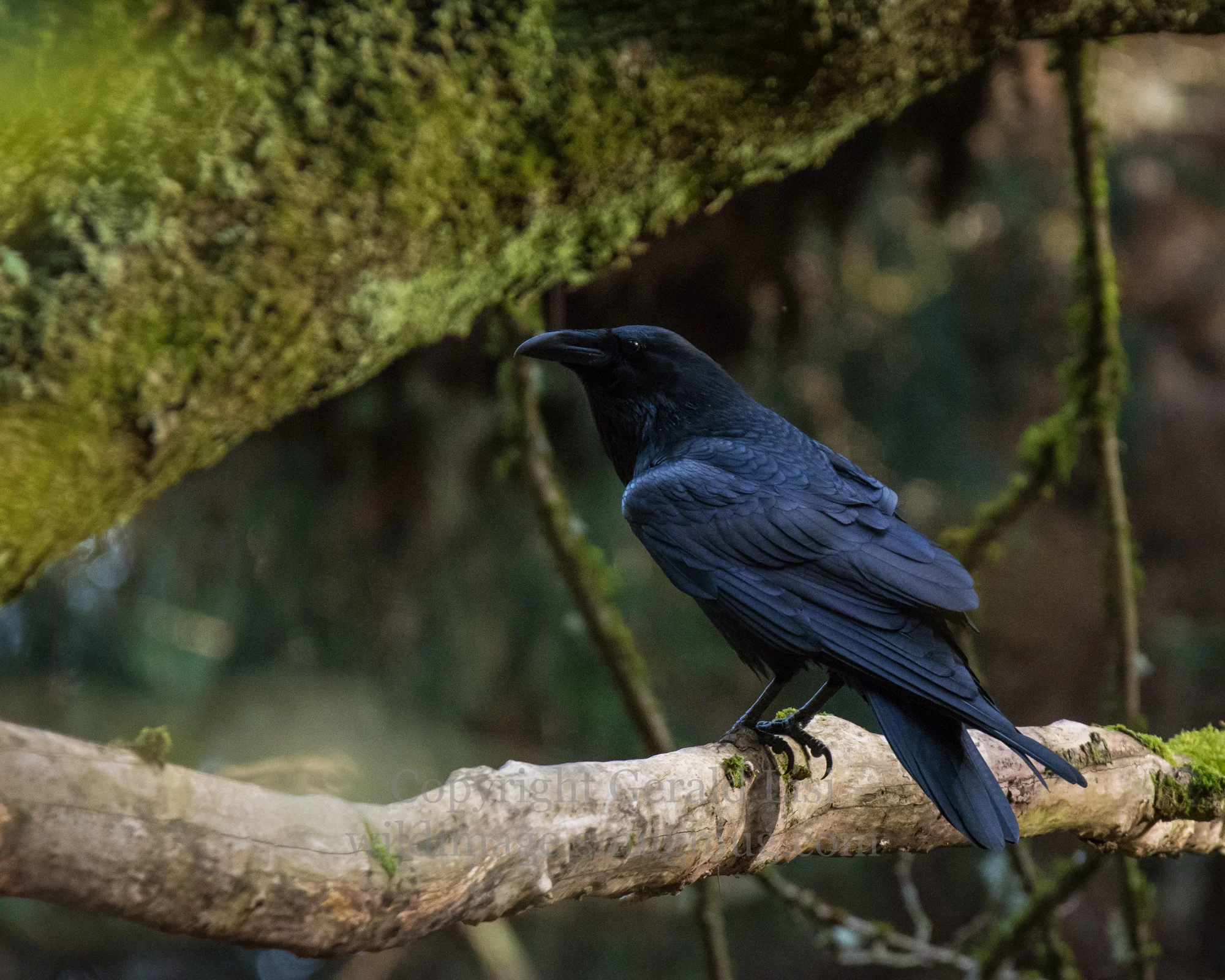
Raven in all of his glory. The blue sheen on his black feathers is striking, and his eyes hint at the mysteries of wildness.
Exhilarated by raven's presence I follow him yet again as he arcs up into the air then back into the trees beneath the yelling crows. Through many branches I am able to see him land in a snag not twenty feet tall. He's picking vigorously at some moss at his feet. I manage to get a better view through the trees and begin to photograph him again.

Raven found something. Something he wasn't meant to find by it's owner. At first I didn't know what he was standing on or why he was pulling it apart. But when I realized that it was a nest it all made sense. I don't know for sure, but this appears to be the nest a barred owl. The barred owl I just showed you.

And this of course is what he was after. Eggs are very nutritious, and there aren't many animals out there that won't eat them if the chance arises. Some specialize on exploiting this valuable resource, such as ravens.
My blood and mind racing from all that I've seen I make my way through a narrow trail behind the raided nest. What a terrible day that barred owl had: mobbed by crows, and a raven took advantage of the situation by raiding her nest. I feel for the owl, but I don't judge the crows or ravens. Everything in nature is struggling to survive. And in our modern lives humans have forgotten what that feels like. That's not to say we don't struggle, but the life-and-death struggles that pervade every moment outside of the man-made world are at best an abstraction to most. If we had predators that would eat us we would certainly mob them to prevent that from happening. And if we had no farms, money or grocery stores we would certainly raid nests to stay alive. Stepping over a fallen tree I see the signs of one bird's struggles ended to sustain those of another.

The feathers of blood of what appears to have been a red-breasted nuthatch. It was most likely killed and eaten by a Cooper's or sharp-shinned hawk.
Moving on I am drawn towards the enchanting little voices of golden-crowned kinglets. A flock is working over a thick stand of trees and shrubs for the insects and spiders on their branches. I watch through my lens, honing in on one who is only fifteen feet away from me. I mostly just enjoy the beauty of her plumage and the incredible grace and speed she employs in her furious foraging. So rarely do they hold still long enough to take a shot or two, let alone do so without branches between them and your lens. But after following her repeated relocation for a few minutes I find myself with a clear view of this incredible creature. So tiny in form, but as fierce as any large predator you can imagine. And she's lovely. Just so astoundingly beautiful.

Golden-crowned kinglet. This one's a lady. The fellas have a red/orange stripe through their golden crowns.
After being gifted this photo opportunity I slowly walk out of the park feeling grateful. Grateful for the native trees plants that comprise this urban forest fragment, and all of the wildlife they give home and sustenance to. Grateful for Hutton's vireos, house finches, song sparrows and crows. Grateful for ravens and barred owls. And what the hell, even grateful for eastern gray squirrels.
Thanks for reading my blog! Please use the links at the top of this page to check out my portfolio and social media pages.
The Northern Hummingbird
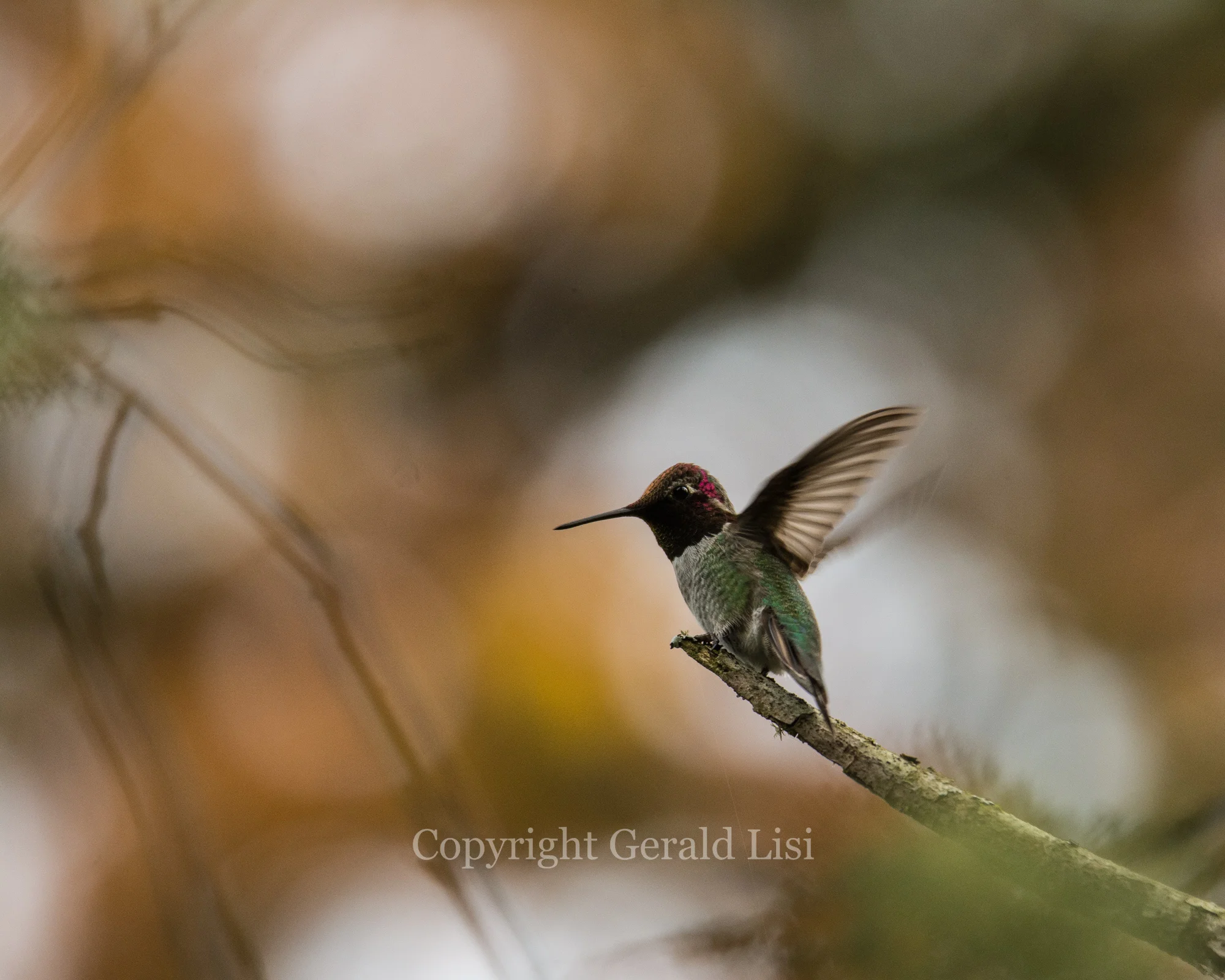
Anna's hummingbirds don't actually have the northern-most range of any hummingbird species. That distinction goes to the rufous hummingbird, who is found as far north as southern Alaska in the summer time. And the summer range of ruby-throated hummingbirds beats that of Anna's hummingbirds by a few degrees of latitude. But during the winter Anna's hummingbirds live hundreds of miles farther north than any of North America's other eighteen species. This species, a year-round resident of the west coast, has significantly expanded its range since 1950 when they weren't found north of southern California and northern Baja California. Now they have spread east into Arizona and north through Oregon and Washington up into British Columbia.

Anna's Hummingbird, Calypte anna, female at red-flowering currant.

Anna's hummingbird male.
The range expansion of Anna's hummingbirds is generally attributed to the nectar provided by exotic garden and landscape plants that flower during naturally flowerless months, and to the ever-increasing popularity of hummingbird feeders. They are also known to take advantage of another food resource that certainly could have aided their dispersal, and is not provided by humans. Sapsuckers are woodpeckers that cut small holes through tree bark causing the leakage of sap. Like the makers of these sap wells Anna's, and migrating rufous, hummingbirds drink the sap and eat the insects it attracts.
People sometimes seem surprised to learn that hummingbirds eat insects. But all animals need protein, regardless of where they get it. In fact a great many bird species eat insects at certain times in their lives, especially as rapidly-growing chicks. No bird can live on sugary nectar, or sugar water from hummingbird feeders, alone. But hummingbirds sure can burn up the sugar. Fast metabolisms are characteristic of small, endothermic ("warm-blooded") animals. Small bodies have high surface area to volume ratios which cause them to loose large amounts of heat to their environments. Add to this bit of physics the blur of wing beats that enables hummingbirds to hover and zip about in a blur and you get a high energy budget indeed. Anna's are apparently low on the hummingbird wing-beat spectrum, at a mere fifty beats per second. That's three thousand wing beats per minute.

Drinking the nectar of orange trumpet honeysuckle, a native flowering vine of Pacific Northwest forests. These long, tubular flowers are characteristic of hummingbird pollinated species. Hummingbirds' bills conceal even longer tongues which are used to access the nectaries deep inside such flowers.
This furious flapping is associated with a blazing body temperature of one hundred seven degrees Fahrenheit. Maintaining such a temperature at rest poses a severe challenge to such a small creature on cold nights. Hummingbirds avoid this potentially fatal energy expenditure by going into torpor when necessary. Torpor is a state of reduced metabolic activity that enables many endothermic animals to conserve precious calories during cold weather. Breathing and heart rate are reduced while sleeping, significantly lowering an animal's body temperature. In the case of Anna's hummingbirds body temperature can get as low as forty-eight degrees Fahrenheit, less than half of their active temperature. This physiology has surely been essential to Anna's hummingbirds' northward range expansion.
Having these amazing little creatures around all year really is a treat, and in Seattle there is a very healthy population of them. Hummingbirds are a favorite subject of many wildlife photographers, and that certainly includes me. When i started trying to photograph them a couple years back it was a struggle to get any decent images. They're so tiny, and so fast. But as I got to know them better, and got better with my camera I slowly started accumulating images of these captivating critters. The two main things that have helped me get pictures of Anna's hummingbirds are knowing their voices so I can find them perched and knowing which flowers they prefer to feed at. Below I have collected some favorite images of Anna's hummingbirds perched and feeding on flower nectar. I hope you enjoy them!

"You there! I said, NO PICTURES!"

There's a nice symmetry to this one. It's also at least a little suggestive of a heart, which is appropriate for an image of such a lovable bird.

Enjoying the early-spring nectar of flowering currants.

Little buddy on little buds. Notice the white pollen on the tip of his bill, which came from the white currant flowers in the previous photo.

Resting in an ossoberry (aka Indian plum) bush. The fresh green leaves and dangling white flowers flowers of this native shrub light up deciduous forests in the Pacific Northwest in February or March. A most welcome appearance of life and color at this drab, gray time of year, especially when further adorned by the feathered jewel that is a male Anna's hummingbird.

A sub-adult male declares his territorial claim. Hummingbirds are very vocal. I frequently use their calls to locate them, but have a hard time describing those calls. In "The Sibley Guide to the Birds" David Allen Sibley impressively writes them out phonetically. "Chase call a rapid, dry chatter zrrr jika jika jika jika. Song from perch scratchy, thin, and dry sturee sturee sturee, sccrrrr, zveeee, street street." So, yeah, what he said.

Anna's hummingbirds do not frequent dance clubs, but some are known to shake it from time to time.
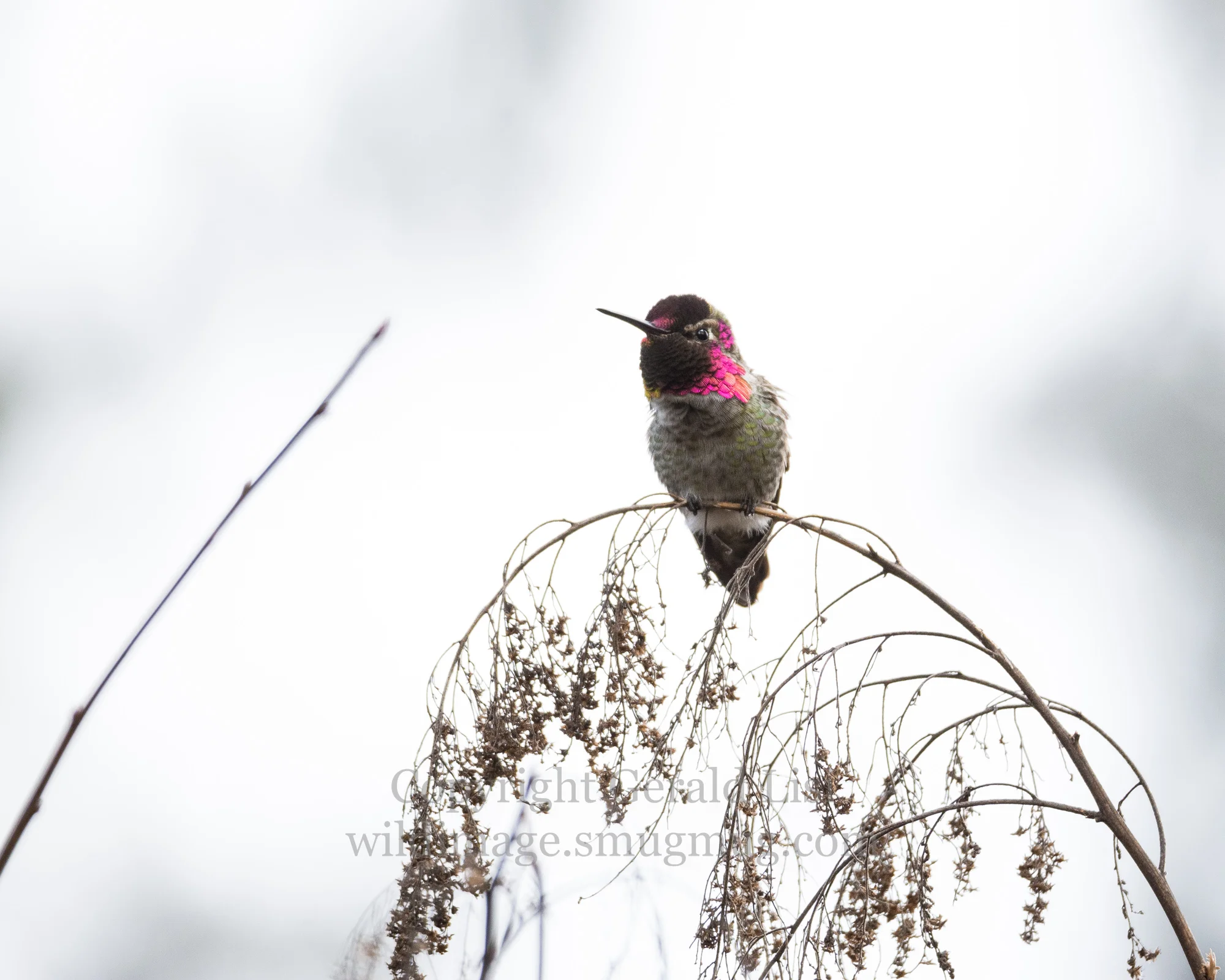
Male hummingbirds really are fierce little critters. Look at that face!

Nice helmet, dude.

This red flowering currant bush is sideways, but that's no problem for this little lady.
Thanks for reading my blog! If you're particularly fond of any of these images you can get inexpensive prints of them at my portfolio website. Find that link, and links to my Facebook and Instagram at the top of this page.
Winter Camping at Deception Pass, Day Three
My strategy for the second 24-degree night worked out pretty well. Knowing that my sleeping bag would be less than warm and cozy I kept the fire going, and sat by it until I could barely keep my eyes open. I had brought a little reading light and was revisiting "Ravens in Winter" by Bernd Heinrich. I had a flask of brandy, which I heated so it would warm me in two ways. I'm mostly a beer guy, and when I do drink liquor it's usually not brandy. It had seemed like a good pick for the cold weather though, and it turned out that it was indeed. I comfortably sipped my warm flask and turned the pages, scarcely aware of the cold and darkness that surrounded me. At one point I thought that it must be pretty late, so I checked the time on my phone. Ten o'clock, and it wouldn't be light 'til 8 AM. I needed to stay up a couple more hours, and was happy to do so. When I finally got into my tent and zipped my cold sleeping bag up around myself I was nicely buzzed and definitely sleepy.
I slept much better than the first night, but the cold still woke me several times. First thing in the morning I enthusiastically built a fire. After a couple cups of strong coffee with sugar and instant milk I broke camp. This was my last day here. With my backpack full of camping gear I headed back to Cranberry Lake where I spent my first afternoon. It was cold with clear skies, just as it had been the last couple days. I was looking forward to the southern exposure at the north end of the lake. The walk through tall conifers was pleasant, and my heavy pack was not a burden but a welcome generator of body heat. The tiny, musical voices of busy chickadees and kinglets rained down from unseen places in the trees. When I reached the sunny opening at the north shore I sat to eat some trail mix. I had skipped the instant oatmeal this morning, and now I was more than peckish. As I poured large handfuls of nuts, dried fruit and chocolate chips into my mouth I heard a soft tapping on the small Pacific crab-apple tree beside me. It was a female downy woodpecker who was very busy finding her own breakfast, one little bite at a time. I pulled out my camera and attached my long lens as she went about her business. She rapidly pecked at the lichen crusted bark as she made her way up and around each branch. Occasionally she found something, probably the eggs or larvae of insects, and paused for a split second to eat it. She was almost always obscured by twigs or facing away from me, but I snapped away at every brief interval of decent visibility.

After dozens of shots that weren't likely to be usable this female downy woodpecker finally reached a clear, open spot. Unfortunately she was in the shade, but when she stopped for half a second to look at me I got my first decent shot of the day. Luckily she decided that I wouldn't eat her, or that I could't catch her if I wanted to, and she continued searching the branches for food.
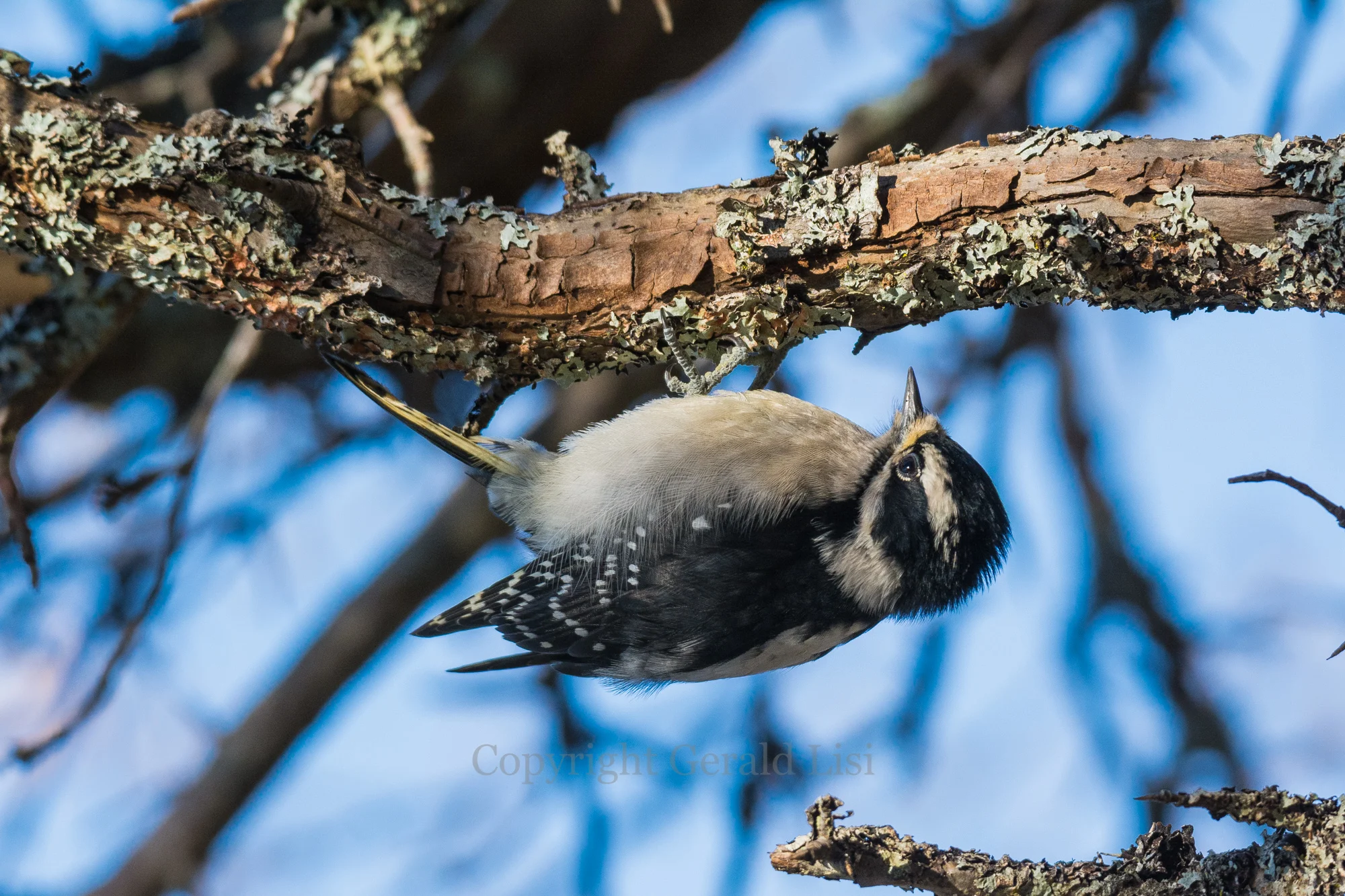
Here I finally caught a good view of her with in some decent light. Downy woodpeckers, Picoides pubescens, are North America's smallest woodpeckers at 6.75 inches long. That's three inches shorter than their close relative the hairy woodpecker, Picoides villosus. Hairy woodpeckers have a much longer bill which lacks the conspicuous tuft at its base. They are associated with mature forests where they forage on the trunks and larger branches of trees. Downy woodpeckers on the other hand prefer riparian habitats where they forage on small branches, just as this one was doing.

Hermit thrush, Catharus guttatus. A short walk away from my downy woodpecker encounter I spotted this one hopping around at the forest edge. Hermit thrushes are distinguished from the other four members of their genus by their reddish tails and unbroken eye rings. They are also the only one that is regularly seen in North America during the winter. This hardy thrush forages for invertebrates on the ground, and is often hidden by the brushy understory of its forest habitats.

After seeing the thrush an hour or so passed without any photo-worthy wildlife spottings. So I switched my long lens for my 18-140 mm to take some landscape shots. I mostly came up with a bunch of crap, but I do like this one.

Nootka rose hip, Rosa nutkana, with madrona bark, Arbutus menziesii. Even in winter Nootka rose is easily distinguished from our other wild roses by having two large thorns at its leaf bases with otherwise smooth stems.

Pacific wren, Triglodytes pacificus. I didn't have my long lens on when this little beauty popped out of the bushes by the trail, so I couldn't zoom in much. It hasn't been long since ornithologists split what was formerly just know as the winter wren, Troglodytes hiemalis, into the Pacific wren of the greater Pacific coastal region and the winter wren east of the Rocky Mountains. So you still often hear people referring to Pacific wrens as winter wrens. Both live in wet, shady areas. This makes them uncommon across their ranges. However, in much of the Pacific Northwest, including western Washington, Pacific wrens are common thanks to our mature and old-growth forests. At just four inches long this really is a tiny bird. But their song is far from that, and it can even be enjoyed outside of the breeding season. Hence the name "winter wren" for the original, lumped species designation.

Mere moments after my wren friend returned to the undergrowth I heard the soft tapping of beak on wood that led my eyes to this lovely male downy woodpecker. He was near, but not close enough to photograph with my shorter lens. Fortunately he stuck around while I changed lenses, and for several minutes afterwards. The red patch on the back of the male downy woodpecker's head is the only thing that distinguishes him from the female.
This was definitely the best photo opportunity of the day, and one of the best of the whole trip. The woodpecker was in direct light, there were no distracting branches blocking or crowding my view of him, and there was enough empty space behind him to render the background into smooth colors with little distracting detail (bokeh).

Here the shading of the woodpecker's face sacrifices an essential element of most effective portraits: a good look at the subject's eye(s). But I still think he looks handsome, and there's a lot of natural history in this shot. Three essential aspects of woodpecker morphology are on display; stiff tail feathers that help steady their bodies while foraging on trees, the orientation of their toes, with two in front and two in back, that facilitates their tree climbing, and last but not least their long, sticky tongue. Here we only see the base of that tongue, but the part that is now probing the tunnels of tree beetles or carpenter ants is coated with tiny barbs. These grab ants and beetle larvae on impact, enabling them to be drawn into the woodpecker's mouth.
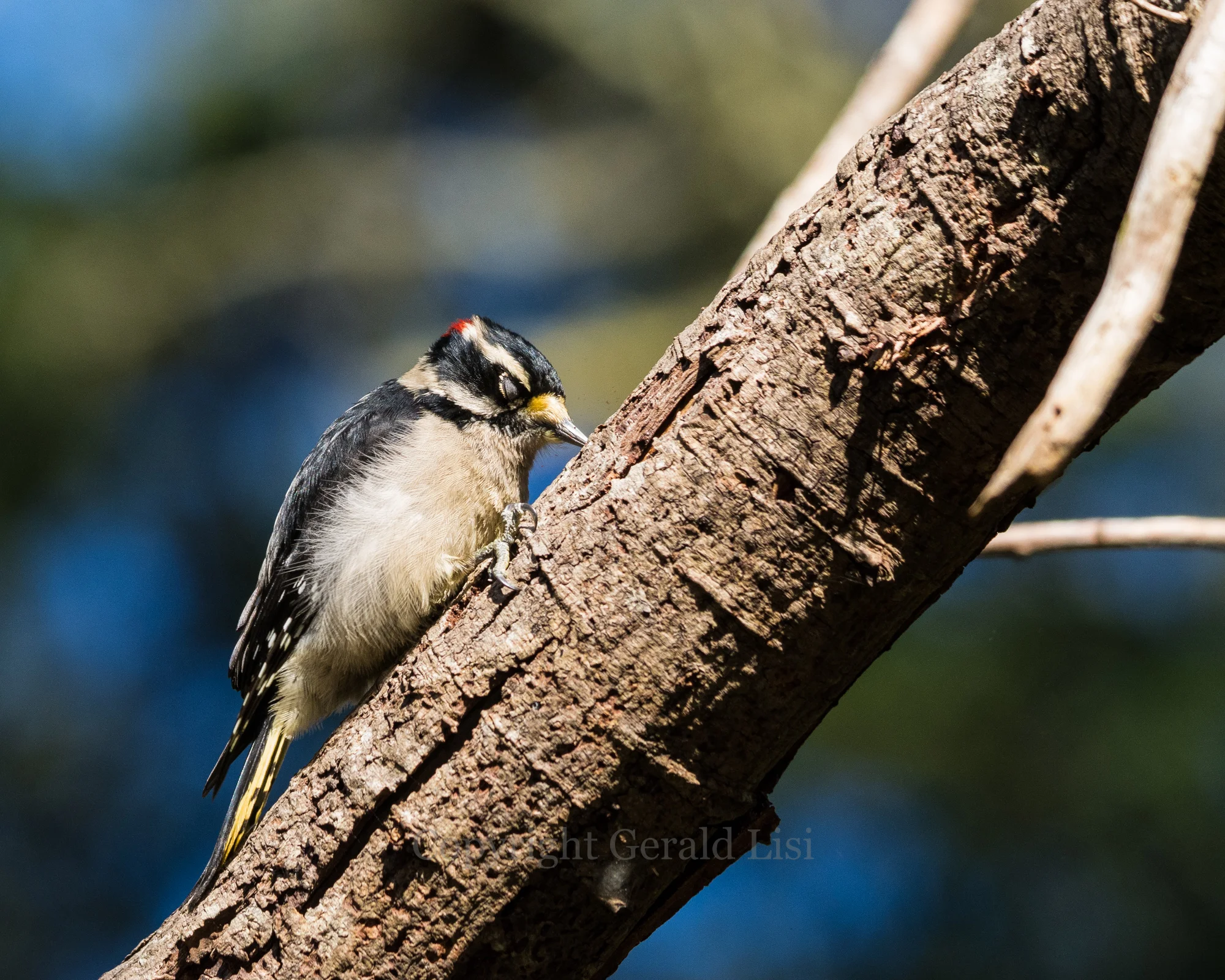
When you take a bite that's so damn tasty you just have to close your eyes and savor it.
Actually this is the moment right after the bill's impact, and you can barely see the tiniest specks of flying debris above it. Woodpeckers close their eyes when pecking to protect them from chips.
When I ran into the male downy woodpecker it was well into the afternoon and I was slowly moving towards the highway to catch my bus. The encounter was a fitting way to cap off a day of shooting that had started with a female downy woodpecker. It was also a most welcome chance to get a few good shots before wrapping up a day that hadn't been particularly productive.
That's the nature of wildlife photography though. Sometimes you you hit the jackpot, sometimes you get mostly crap, but still end up with a few usable images, and sometimes you end up with nothing. So ending up with more than nothing can reasonably be seen as a success. Even ending up with nothing isn't so bad, as long as you're not on assignment. A day spent in wild places is a day well spent.

As always I kept my camera out until the last minute, and on my way to bus stop I enjoyed the company of several chestnut-backed chickadees, Poecile rufescens. While I didn't have the benefit of good lighting I couldn't resist photographing this little charmer when he briefly perched nearby. Although my subject is poorly lit I like the atmosphere of this image. There are many ways of creating a good photograph. The one thing they all have in common is making the best of the circumstances.
Thanks for reading my blog. I really do appreciate it. Please use the links at at the top of this page to see more of my work, on social media and on my website. You can follow the "portfolio/shop" link to see high-resolution images and order prints. Paper prints start at just $5 for a 5x7. I also offer ready-to-hang wall art, including wrapped canvases and mounted prints, at very reasonably prices. I can assure you that any purchases from my website will help a struggling artist. Thanks again, and I hope you'll check back periodically to see more of my posts.
Winter Camping at Deception Pass, Day Two
During my first afternoon at the park temperatures were in the mid thirties, Fahrenheit. A night-time low of twenty-four was expected. My sleeping bag is rated for twenty-five degrees though, so I figured I would be fine. As it turned out that rating just means that one will not get hypothermia and die at that temperature. The cold woke me twenty times over the course of the night, making me anxious to get up and go long before it was a reasonable option. As soon as the black sky gave way to the faintest blue glow I sat up, still in my sleeping bag, and unzipped my tent door. I placed my tiny camp stove on the frozen ground and put on a little water for instant hot cocoa. The cocoa warmed me enough to get me out of my bag and into my cold boots. Then I stepped out to tend to a more important preparation; coffee.
Coffee was delicious, but it was a race to drink it before the twenty-eight degree air drained its precious heat. The warm liquid in my stomach overcame the night's chill as the caffeine stoked my mind's excitement for the day ahead. After a second cup and some oatmeal I was eager to hit the trail. The sun had risen at this point, but its rays had not yet hit the forest where I was camped. Nearly jogging to warm my extremities I rushed towards the nearest hiking trails, which were at Goose Rock. I chose the perimeter trail, rather than the summit. I wanted to be by the water, but especially wanted to be in the sunshine that now warmed and illuminated the forest edge that trail followed. Ahead of me I heard a flock of American robins gregariously fluting their calls at each other. I suspected that they were having breakfast in the Pacific madrona trees that grow from the rocky shoreline and hillside. This was soon confirmed as I approached several madrona trees whose upper branches were laden with small red fruits and shaking with the comings and goings of hungry robins.

I couldn't get any good shots of the robins in the tree tops, but this male alighted on a shrub near me where I had a clear view of him. At first he was looking away from me, which doesn't make for much of a photo, but when he looked over his shoulder at me I got this rather comical shot. His apparent plumpness is largely a result of him fluffing out his feathers for insulation from the cold.

This fox sparrow perched briefly about thirty-five feet away from me to assess the scene. While they are common around Puget Sound during the winter I never see fox sparrows in Seattle. Those large feet and long claws are used for scratching in the duff for seeds and invertebrates. Like many of their relatives fox sparrows use a technique of jumping up while kicking backwards with both feet. The prevalence of this foraging method surely speaks to its effectiveness, but I have to say that it looks kind of silly.

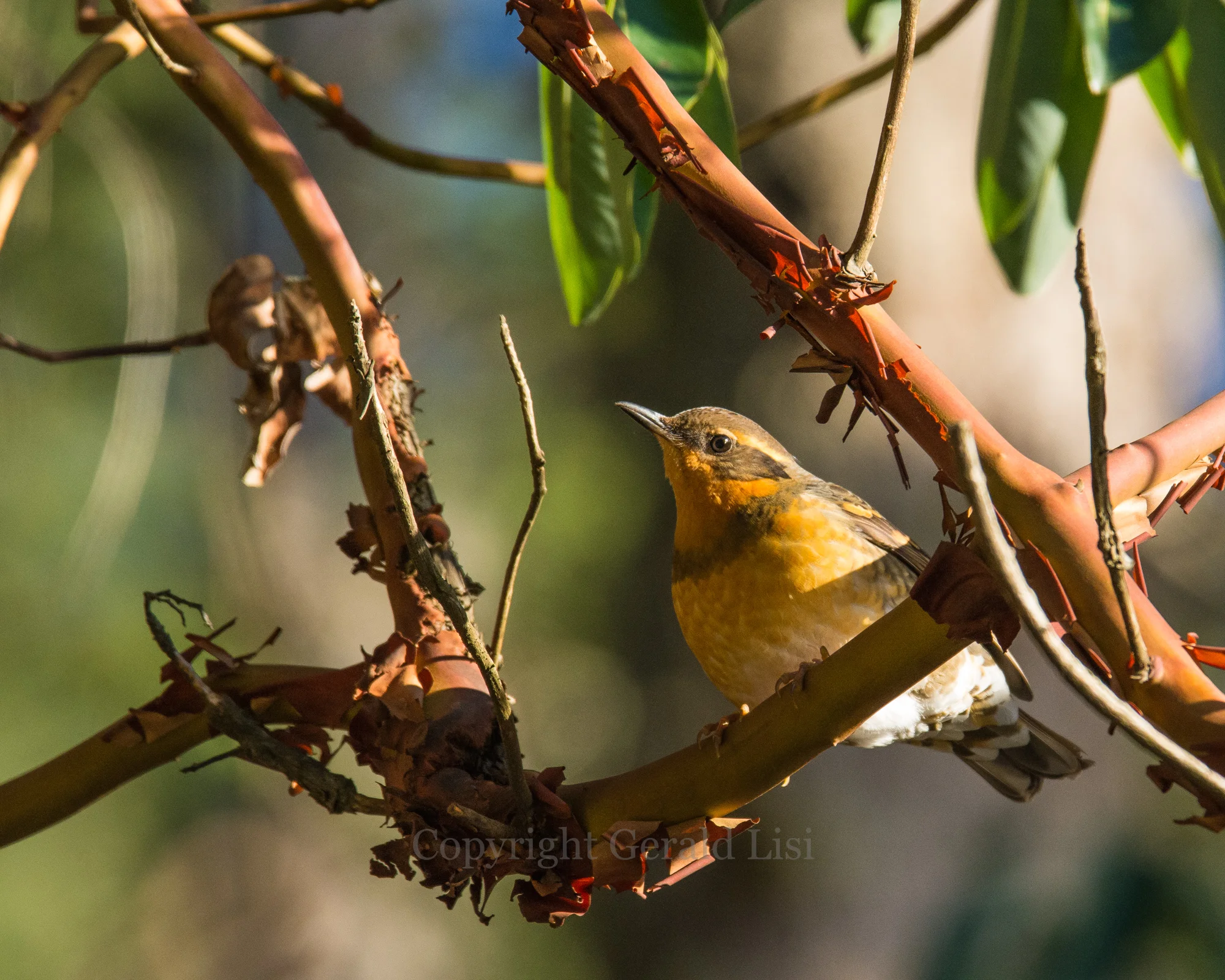
This varied thrush female perched in a lower branch of a madrona after feeding in its canopy. Varied thrushes are close relatives of robins, and have the same fruit-heavy winter diet. But while robins form winter flocks varied thrushes fly solo. At a glance It's easy to miss this species among its cousins, but it's worth scrutinizing your local robin flock to get a look at a varied thrush.

After the trail wound from the east to the north side of Goose Rock I found myself in the shade. This dimmed the prospects for bird photography in that area, but I was afforded this sweet view of Mt Baker.
From Goose Rock I crossed the bridge over the pass. While it wasn't particularly busy at the time, traffic and sight seers broke the peaceful mood of my morning up until that point. After crossing the 1,487 foot bridge I scanned the west side of the road for a trail head. Spotting one a couple hundred feet up the road I jogged back into the forest with relief. A steep, winding trail led me down to Lottie Bay. Along with the small peninsula that separates it from Bowman Bay, this has always been a favorite part of the park for me. The trail ran through mature Douglas fir, Sitka spruce and western red cedar. Emerging from their shadows I found the smooth pebble beach of Lottie Bay enjoying the full sun of its southern exposure. Without even a slight breeze the air here was probably twenty degrees warmer than in the shade of the forest. Just moments after I stepped into the sunshine a pair of great blue herons flew over the bay. One carried on towards the pass while the other broke off sharply and alighted in a tall Sitka spruce by the beach. It was maybe forty feet up, but standing where I could see it from a good angle put me at least seventy-five feet away. A bit of along shot, but fortunately it's a big bird and I had a clear view of its perch.

A great blue heron soaks up the mid-day sun, surrounded by the recently opened cones of the Sitka spruce in which it's perched.

This killdeer blends in well with the beach pebbles. The double breast band of this species distinguishes it from other similar looking plovers.

Shortly after entering the woods of the peninsula by the bay I spotted this Douglas squirrel, who retrieved an unidentified food cache from the duff and ate it on the spot.

After photographing the Douglas squirrel, and some failed shots of a golden-crowned kinglet, I found lighthouse point sunny but uneventful. I watched a belted kingfisher and a pelagic cormorant from there for a bit but both were too far off for good photos. So I walked on around the other side of the peninsula. There I changed lenses to get this shot of a little fjord off of Bowman Bay.

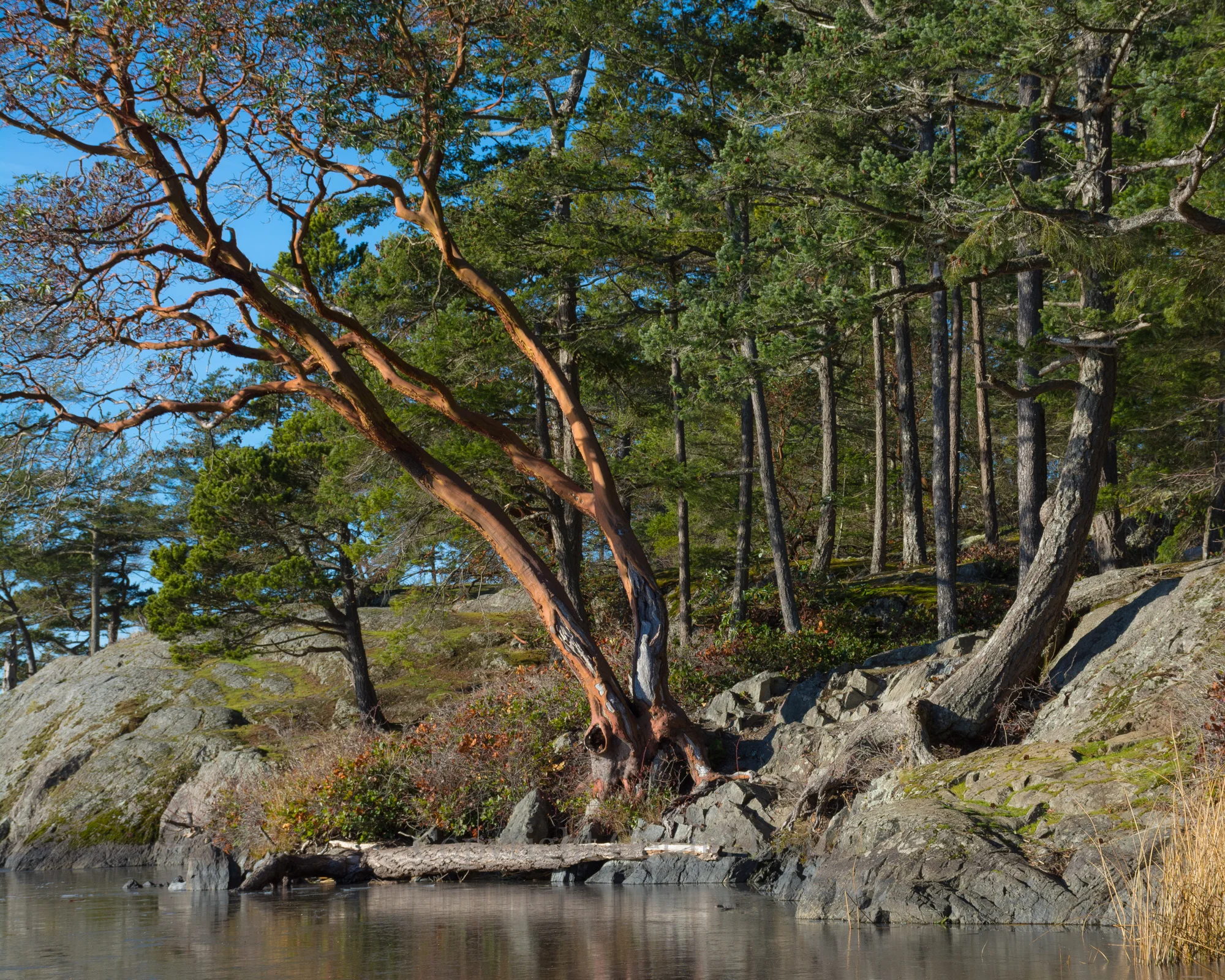
Having changed lenses I decided to do some close-up botanical shots. Ever since I first saw a Pacific madrona tree I have though the colors and smooth texture of their bark were exquisite. Since taking up photography I have repeatedly attempted to capture that beauty, and until this trip I failed consistently. In this close-up I finally have a madrona photo for my portfolio. I want to have a large canvas of this image made for the next time I show my work.

When I saw this eagle soaring towards me I changed lenses and settings as quickly as I could, just managing to get this shot before it passed out of range. This is a second year bird. It takes bald eagles three years to develop the familiar and iconic appearance of adult birds.

Back into the forest, and back to my wide angle lens, for this one. The two trees in the center of the frame are a Douglas fir on the left and a western red cedar to its right. Also present in this forest are the other conifers that characterize low-elevation forests in western Washington; western hemlock, grand fir, Sitka spruce, shore pine and Pacific yew. I'm thinking that this image is another candidate for printing.

Back out on Lottie Bay the sinking sun was casting a warm, soft light on this thick growth of moss and lichen that adorned an old driftwood trunk. I played around with some wide angle shots that included trees and sky in the background, but ended up liking the simplicity of this close-up better. I've always loved moss and lichen. The Pacific Northwest abounds with both, and back in my point-and-shoot days I took countless crappy photos of them.

The textures and colors of lichen-crusted wood fill out this this composition since it's subject, this dark-eyed junco, was so far away from me. But he and his rustic throne were nicely lit by the fading sunlight, and both were brought into relief by the dark forest background.
This was my last shot of the day. I needed to get back to camp and get plenty of firewood before it got dark. After the long, cold previous night in my sleeping bag I intended on spending more of this one up by the fire. I had a pretty good day of shooting, but was glad that there was another one ahead of me. That last day will be the subject of my next post.
Thanks for reading my blog! I hope you enjoyed it. Please use the links at the top of this page to check out my portfolio website, and to see my Instagram and Facebook pages.
Winter Camping at Deception Pass, Day One
Winter in western Washington is a tough time for outdoor photography. Rain and drizzle can last for weeks at a time. Even when it's not raining it tends to be overcast, producing low, gloomy light that is less than inspiring. So when I saw that the first week of January would have a spell of clear days I decided to take full advantage of it. I was overdue for a camping trip, so I looked at my options. Seattle is surrounded by some of the best hiking and camping areas in the country, but as I don't have a car right now most of that incredible menu was not available.
Nonetheless, with a little online research I was pleased to discover that I could get to Deception Pass State Park by public transportation. It would take five buses and a ferry, but it was doable and I was excited. Nineteen years ago when I was new to Seattle and Washington Deception Pass was one of my first hiking destinations. The pass itself is a narrow, but navigable, passage between the Pacific Ocean waters of the Strait of Juan De Fuca and Puget Sound. The park includes old-growth forests and rocky shorelines at the northern tip of Whidbey Island and the southern tip of Fidalgo Island.

Pacific Madrona and Conifers by Cranberry Lake
This broad-leaf evergreen tree is a favorite of mine for its smooth, peeling bark. It is also loved by American robins, varied thrushes, northern flickers and other birds for its small red fruits.
I booked a camp site for two nights and set my alarm for two hours before sunrise. I wanted to have a few hours of the short winter day left when I got there. After the five-hour trip I arrived at about noon. I found my camp site in the cold shade of tall conifers and put up my tent as quickly as I could. The daylight was already more than half over. I had seen on the map that Cranberry Lake was nearby. I had never seen that part of the park so I headed that way. Ten minutes later I approached the lake shore through old-growth Douglas firs.
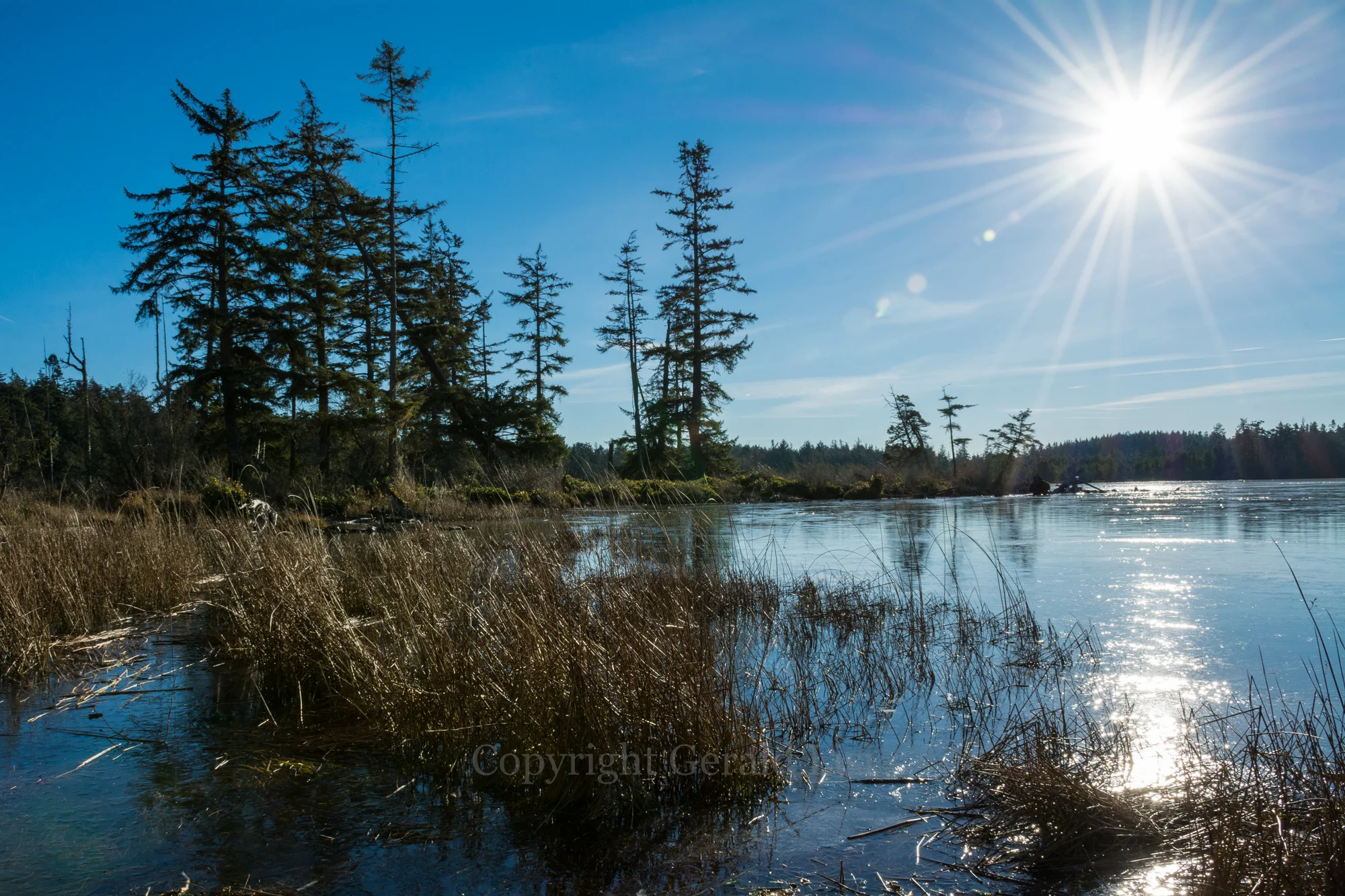
This is a wild lake, although it's just a couple hundred feet from Route 20, which bisects the park. It was so refreshing to see the undeveloped shoreline studded with stunted, wind-gnarled trees. Still, a simple fishing dock in full sunlight was a welcome sight. I sat down on the dock, put my long lens on my camera and surveyed the area for birds. The lake was frozen from the shore to well past the dock. Over a hundred feet away was an unfrozen area where I could see a group of mergansers, hooded and common. I wanted to photograph them, especially the hooded mergansers because I don't have any good pictures of them, but they were too far away.

While waiting in vain for birds to come within photographing range this detail on the lake caught my eye. The low angle of the winter sun brought these dead reeds to life with golden light. And the contrasting colors of the cobalt sky and dark, shaded conifers reflected through the ice brought them into sharp relief.
Clear winter weather here is generally colder than average. Without the usual blanket of low clouds the mild winter conditions in the Puget Sound lowlands sometimes give way to freezing temperatures. This was one of those times. In fact we were a couple days into a record cold spell at this point. Although I was in full sun, sitting still was a chilly affair. At the opposite, northwest, end of the lake I saw two very large, white birds. Even though I couldn't get a very good look at them from that distance they could only be trumpeter swans. Cranberry Lake has good southern exposure, so I decided to explore the sunny northern shore and see if I could get a better look at the swans.
After a short walk on a forest trail I discovered that there is a road off the northern shore. It is a park road though, and on a cold January day there is very little traffic. I walked west along the road, scanning the lake, ground and trees for wildlife. But aside from ducks that were too far away to photograph there wasn't a critter in sight. As I continued towards the area where the trumpeter swans had been I peered at the lake through little alders. I had to do a quick double take to confirm that there was a river otter sunning itself behind the trees.
After doing what I could to get a picture of the otter I continued west. The unfrozen part of the lake where I had spotted the trumpeter swans earlier was empty now. I could see that top of the lake wrapped around a thinly-treed rocky outcropping. A narrow trail meandered a short way through the trees. Following it revealed the shaded, fully-frozen tip of the lake. Out on the ice were the two trumpeter swans. They were maybe two hundred feet away, but approaching very slowly so as to not alarm them I managed to make the distance closer to one hundred feet. That's definitely further than I would prefer, but they're quite large so they actually filled up a decent amount of the frame. If I could just manage to get a sharp image without a tripod at this distance a little cropping could make the photo work.

A river otter catches some rays by Cranberry Lake. Positioning myself so that I could see it's face through the trees was the best I could do under the circumstances. Not much of a shot, but it's better than none at all. It's always a pleasure to see an otter.

"Didn't we fly south to find lakes that AREN'T frozen?" Trumpeter swans on Cranberry Lake.

After photographing the swans I found a sunny spot on the shore to watch for birds. This bald eagle was also scanning the water, but not a fish, duck, gull or coot presented itself to be eaten. Before long we both gave up and moved on.
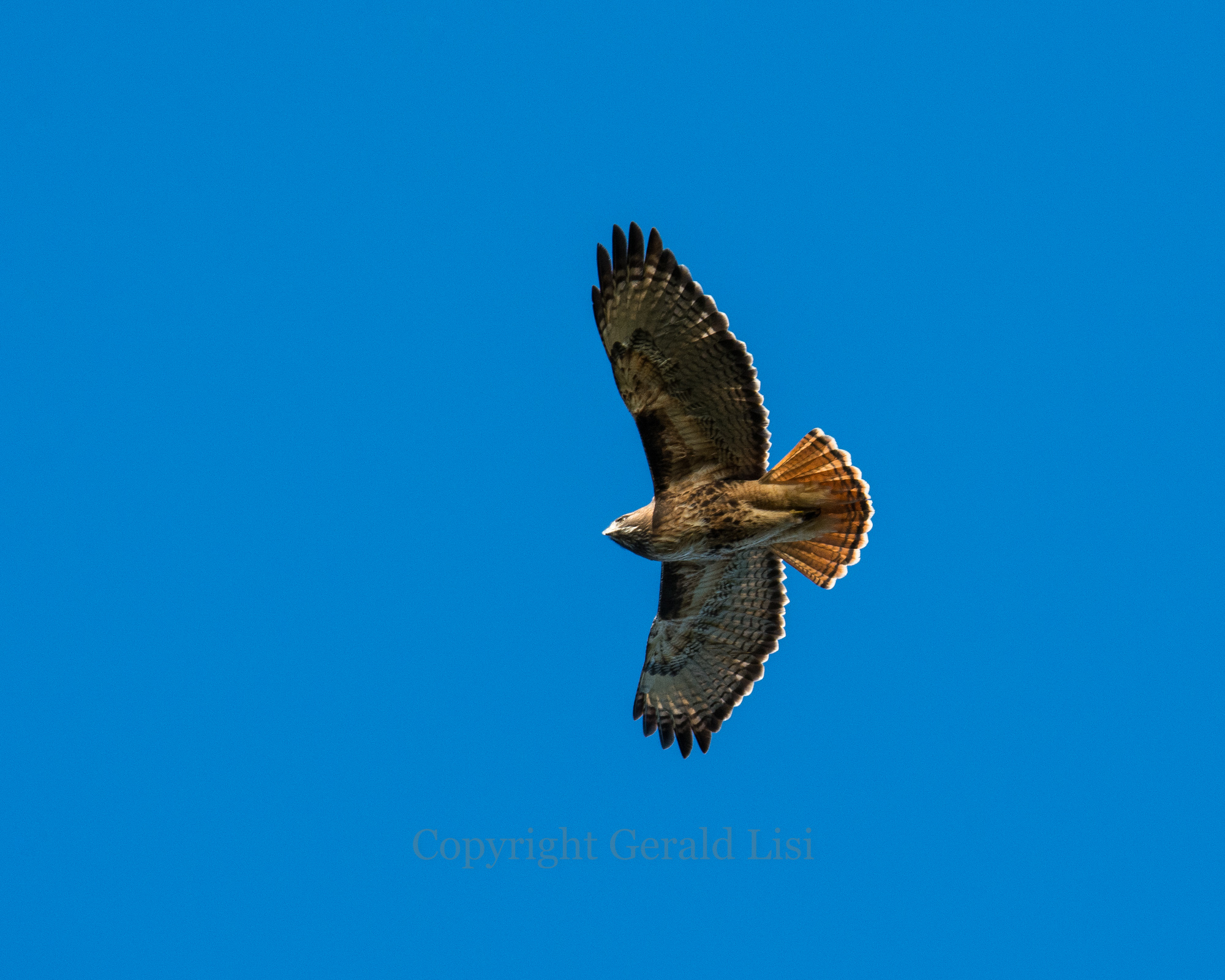
This red-tailed hawk circled over the lakeside forest briefly. They seem small when you've been watching eagles. This picture is nothing special, but I like the way the red tail feathers are illuminated.
Walking towards the marshy northeast edge of the lake I could see mergansers again. They were less than a hundred feet from the shore, but were back-lit by the bright sunshine reflecting off of the lake. This meant that to get a decent exposure of the birds I would have to blow out the highlights in the background. The "high-key" images produced that way can look cool though, so I set my camera accordingly. That eagle must have made it's way towards them too though because suddenly the sound of dozens of duck wings hitting the water shattered the silence. Most of them were flying away but a couple female common mergansers flew roughly towards me. They were on a course to pass me at about fifty feet away. I held down the shutter button as they made their pass and managed a couple shots before they flew out of range.

Common merganser females fly over frozen Cranberry Lake.

After slowly making it to the other side of the marsh I was watching chestnut-backed chickadees up in the trees when more splashing turned my head towards the water. A couple hundred feet out I spotted the commotion. This eagle rose up from the water's surface with empty talons as several ducks scattered across the lake. Having already outed itself the eagle flew to the top of the nearest tall tree, probably hoping that some other ducks would come along before dark and not notice it up there.

With an hour of daylight left I needed to make my way back to camp and build a fire before it got dark. Along the way my old friend the song sparrow perched in the golden light, with salal leaves glowing in the background.
I barely got four hours of shooting in on my first day due to my late arrival. I wasn't sure if I had even gotten any good photographs, but it was a lovely afternoon and I was looking forward to a full day of hiking and shooting. I have to admit that I wasn't looking froward to the 24 degree night in my tent before that, but I was definitely glad to be at Deception Pass.
Thanks for reading. I've got two more posts about this trip on the way, and they'll both include some images I'm excited to share with you. There are links at the top of this page to my portfolio, and to my Facebook and Instagram pages.
"That Dinosaur Bird"
"That dinosaur bird." That's how a friend of mine who didn't know or couldn't remember what great blue herons are called referred to them once. Of course we now know that all birds are descended from dinosaurs, but it's more apparent in some than others. If you've seen a great blue heron fly overhead without being reminded of a pterodactyl then you must not know what a pterodactyl is. If that's the case you should look it up, sometime after reading this blog.

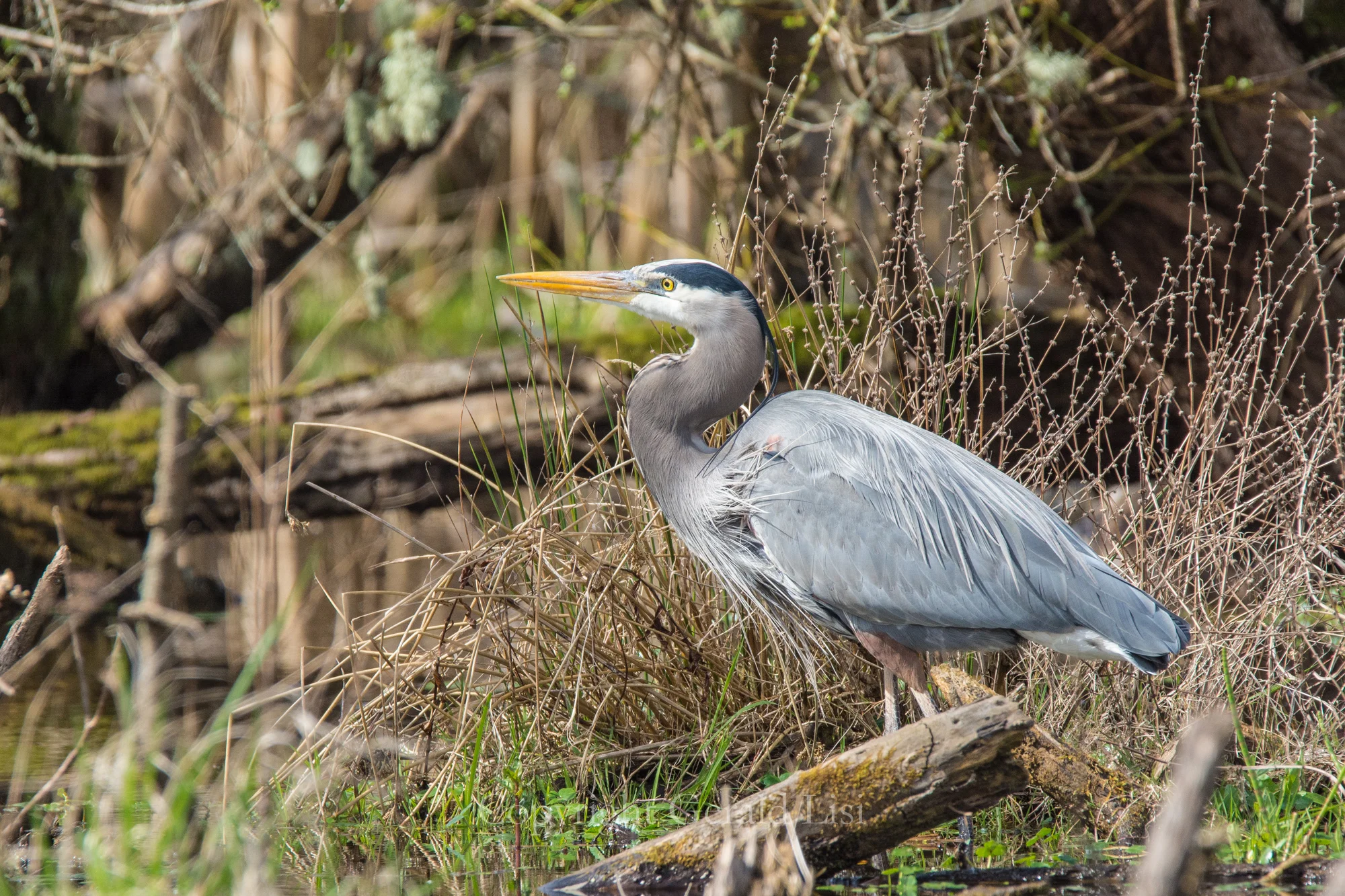
Great Blue Heron, Ardea herodias. The long, sharp bill and even longer neck are essential to this bird's hunting methods.
At four and a half feet tall with a six-foot wing span the great blue heron is the largest member of its family in North America. It can be found, at least seasonally, from the south of Mexico up through the bottom half of Canada. Here in Washington state they are found year round, as is the case in more than half of the contiguous United States. Great blue herons are common in Seattle where I live, so as a naturalist and wildlife photographer I have taken an interest in them. All but one of the pictures in this post were taken around Union Bay, but I have seen great blue herons at various other parts of Lake Washington, around Lake Union and at the edges of Puget Sound.

I watched this heron stalking behind the cattails for a few minutes before its long body rose into clear view while stepping over a dead tree.
Great blue herons are generally seen in shallow water, fresh or salt, where they feed on fish, frogs and anything else within the reach of their long necks and bills. They are capable of standing perfectly still for long periods of time, waiting for prey to swim by. These diligent hunters are also known to take prey on land such as rodents, snakes and small birds. Their catches are swallowed whole as birds have no teeth and herons don't have the hooked bills that raptors use to tear their victims into bite-sized pieces. Later bones and scales, feathers or hair are coughed up.

Waiting for some food to swim by.
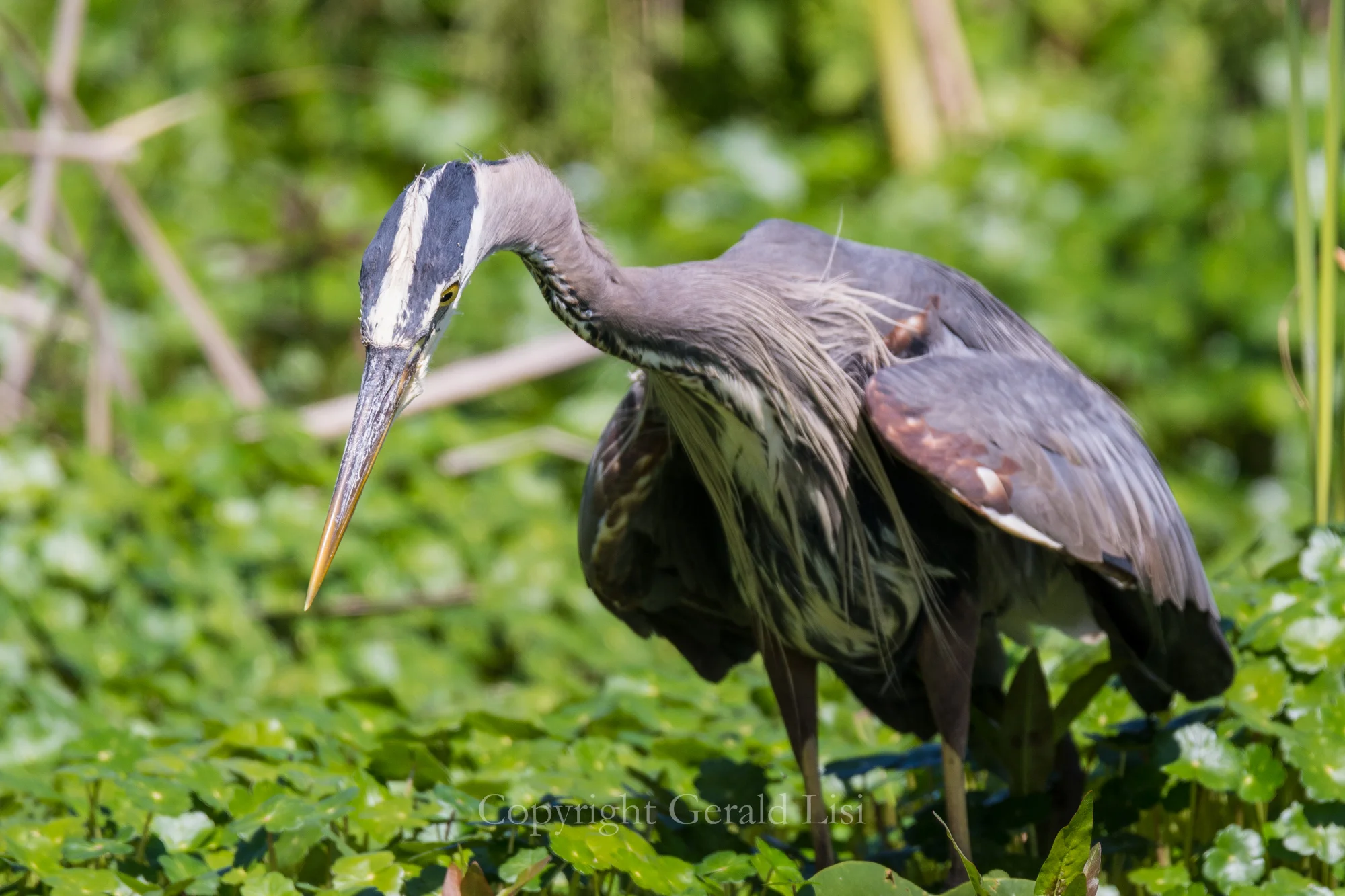
Closing in on a potential victim.

This heron was at least a hundred feet away from me and the light was low for photography. But I was glad that I took pictures anyways when it struck and came up with this big catfish.

This other heron caught an even bigger catfish. It was too big to swallow whole, but the bird managed to behead it with its sharp bill. Then it swallowed the head without much apparent difficulty.

After the head it still had the huge body to eat. It took several minutes, and I thought it might choke, but it finally got it down! I don't think this heron needed to do anymore hunting that day.

The satiated heron found a nice spot to digest and I went on my way. I don't know for sure but I'm guessing it stayed there in a food coma for a long time.
Great blue herons show incredible patience when using their wait-and-ambush fishing method. They're definitely more patient than me. There have been numerous occasions when I watched and waited for a heron to catch something but eventually gave up and left. The birds needed to eat to survive. I wanted pictures of them with fish in their bills, but I didn't need them.
These large, striking birds are popular with wildlife photographers. Their hunting method affords ample opportunities to get shots of them in interesting poses, and their large size makes it relatively easy to fill a large portion of the frame with them without needing to get super close. Many of my subjects are birds that are only four to eight inches long, so even with a 600 millimeter lens I need to be less than twenty-five feet from them to get a good photo. Their size and habits make it relatively easy to photograph great blue herons, but that doesn't mean it's easy to get good photos of them. After amassing a collection of similar images I pretty much stopped photographing them while they were stone still waiting for prey. But I can't resist stopping to watch them. I meter the exposure, adjust my settings and wait for them do something different. Sometimes it's the same old statue routine. So it ends up being some down time by the water, watching an amazing creature in the struggle to survive, which is fine with me. But other times they reward me with cool behaviors and photo opportunities.

Alighting in a willow. Something alarmed this heron and it flew up to this branch for safety. Great blue herons actually spend a lot of time in trees. They roost in them every night and nest in them every spring when it's time to produce the next generation.

"Don't talk to me until I've had my coffee."

Ruffled. Birds fluff up their feathers to increase their insulation value, while they are preening, and to appear larger to rivals. But it wasn't cold when I took this, the heron did not proceed to preen and there were no other herons in sight. So I don't know why this heron ruffled its feathers briefly but it made for a cool photo.

Creeping. By moving along this dead tree branch the heron is avoiding detection by its quarry in the water. While I most often observe these birds using the wait-and-ambush hunting method it's not uncommon to see them actively stalking prey. Oh, and speaking of "dinosaur birds", look at those feet!

The Best Spot on the Pond
This heron was at rest, as is indicated by its neck being curled up, but that didn't mean it couldn't keep an eye on the water for potential snacks.
Thanks for reading my blog. I hope you learned a little bit about great blue herons and that you enjoyed my photos. Please follow the "Portfolio/Shop" link at the top of this page to see more photography and buy inexpensive prints. There are also links to my Facebook and Instagram pages for those of you who are into that sort of thing.
An Exotic Native
One of my top photographic muses is the wood duck. I first saw them here in Seattle, on Union Bay. At that point I was familiar with several species of dabbling ducks that live on that stretch of Lake Washington. There are plenty of mallards of course, but gadwalls, northern shovelers and green-winged teals are regular sights as well, not to mention diving ducks like common and hooded mergansers. But the first time I saw a wood duck swim out from behind the cattails I was stunned. It was so striking, and clearly from a different taxa than all of the other ducks. It looked so exotic to me.

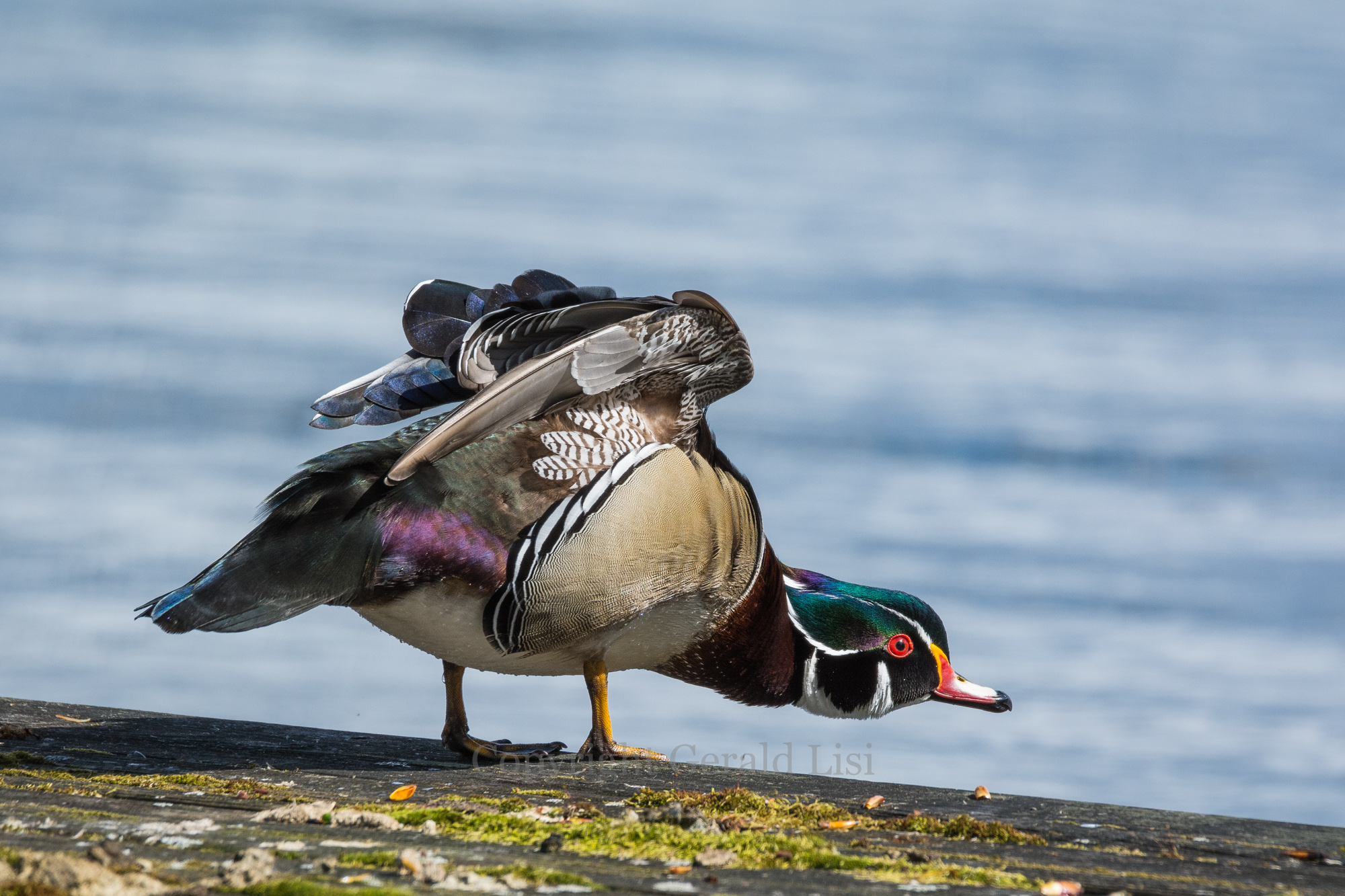
'Wood Drake Yoga'
Indeed, the wood duck is the only member of it's genus, Aix, in North America. It's closest relative is the equally striking mandarin duck of Asia. Meanwhile genus Anas, which includes the ubiquitous mallards, totals eleven North American species. While wood ducks look exotic next to all of those species they are in fact native.

Wood ducks share habitat and feeding habits with mallards, but the fact that they're from a separate evolutionary lineage is easily inferred by their radically different appearance.

A wood duck pair "fords" a fallen tree.
Like their neighbors in genus Anas wood ducks are dabblers. That means use their bills to gather food at or near the surface of the water. Seattle Audubon reports that that food is primarily the seeds of aquatic plants, but also includes insects and other invertebrates as well as plenty of acorns when and where they're available. (http://washington.www.birdweb.org/Birdweb/bird/wood_duck) I have noticed that they also seem fond of the rhizomes of cattails and other aquatic plants.
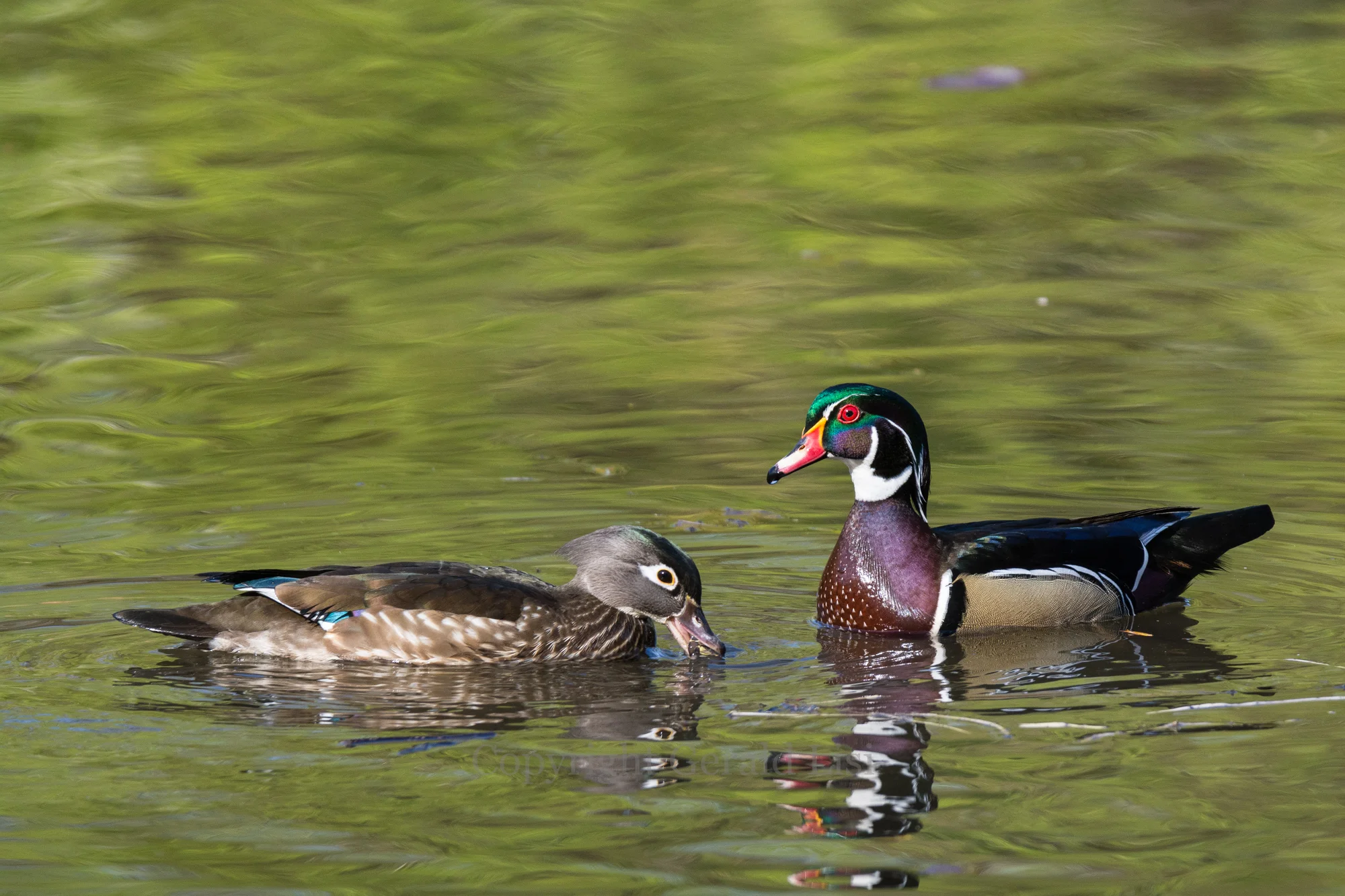
The hen is eating some kind of rhizome. They were swimming along looking for food, her in front, when the drake pulled the rhizome out of the water. He got her attention and when she turned around and approached him he dropped it in the water for her to pick up. What a gent!

The features that make wood drakes so beautiful also make them somewhat difficult to photograph. It's a balance between not underexposing the black feathers and not overexposing the highly reflective white stripes and red eyes and bill.

Wood drake hens are as lovely as the drakes are handsome. While less colorful than their mates they are more colorful than females of any of the Anas species. Unlike those species, who generally nest on the ground, wood duck hens nest in tree cavities. Since they are hidden inside their trees they don't require the camouflage while nesting that ground nesters do.
While the feeding habits of wood ducks are the same as those of mallards the fact that they nest in tree cavities clearly sets them apart. It also limits the areas they can live in. As their name implies, and their nesting habits show, wood ducks require wooded habitat. And not just any woods will do. There must be snags (dead trees) large enough to accommodate a wood duck hen and her eggs. But also, where do these nest cavities come from? Wood duck cannot excavate their own nest sites. Frequently they are the former nest cavities of the very large pileated woodpeckers, who conveniently tend to create new cavities for themselves each year.
This evolutionary relationship between mature forests, plieated woodpeckers and wood ducks goes back many millennia. But in just a few centuries extensive deforestation across North America has severely reduced populations of wood ducks, pileated woodpeckers and so many other species. For this reason it is amazing to me that the city of Seattle is home to wood ducks and the pileated woodpeckers that provide them with nest sites. It goes to show how valuable remnant patches of habitat are, and hints at the future biological promise of secondary forests if we manage them with the needs of wildlife in mind.
Some people must be given credit for helping wood ducks recover from historical population lows that other people caused. Duck-loving conservationists have done this through the simple act of building nest boxes and installing them on trees by ponds and marshes. But it is my great hope that we as a society will move towards protecting the mature forests that remain and facilitating the regeneration of as many of those that have been cleared as possible. This would be for the ultimate good, not just of wood ducks, pileated woodpeckers and myriad other species, but for human beings as well. As the negative effects of climate change accelerate alarmingly around the globe the immense value of carbon sequestration by the world's forests is driven home. Forests also recharge local stores of fresh water, a dangerously dwindling resource in more and more parts of the world.
I deeply hope that everyone that reads this (and more importantly the many, many more that don't) will give the issue of forest protection and restoration serious thought and intention. But I don't want to end this on a heavy note. So let's look at some more pictures of one of the many great reasons to love and protect our forests: Aix sponsa, the wood duck.

'Dazzled Drake'
Yeah, buddy. She's gorgeous. Don't screw it up.

These drakes are competing for the attention of nearby hens.

Two different drakes at a different time and place. One appeared to be mated to a hen he was traveling with. When the other showed up they chased each other around for a while, but the aggression seemed ceremonial and before long the bachelor went on his way.

These two obviously like each other. Once they pair up he won't leave her side until she hits the nest. But alas that is where the romance ends. She's on her own to incubate the eggs and teach the chicks how to be wood ducks after they hatch.
Thanks for reading my blog. Please use the links at the top of the page to check out my portfolio and follow me on Facebook and Instagram.

Go With the Crow
I've been photographing birds in and around Seattle for a few years, and for over a year now they have been my primary subject. So when I decided to start writing a photo blog I knew the first post would be about birds. But which family, genus or species to begin with? While the ducks, woodpeckers and hummingbirds I considered will certainly have their day, or days, here, I decide that for this inaugural post I would go with the crow.
American Crow, Corvus brachyrhnchos
Crows are a species of bird that virtually anyone can identify. They were certainly one of the first birds that I learned as I child in Vermont. Here in Seattle, as in other cities, crows are far more abundant than in any rural or wild area. I have enjoyed regular opportunities to observe these famously intelligent, and notoriously raucous, corvids.
There's a broad spectrum of human feelings towards crows, and I've always been well on the side of those who love them. But in spite of how beautiful and interesting I find them, as a wildlife photographer I have been somewhat guilty of taking crows for granted. It's not that I haven't photographed them at all. In fact two of my portfolio images are crow photographs. But when I go out looking for birds to photograph I'm not looking for crows, because I don't have to look for them to find them.
Many of the birds I photograph offer only fleeting, unpredictable glimpses of their activities. But crows are living out their daily lives in plain sight. This provides regular opportunities to document various aspects of their behavior. Not only that, but I don't even have to leave my neighborhood to do so. After having this realization I got excited about compensating for my previous oversight. After musing on this for a little while I recently decided to get started on my neighborhood crow project.
As the month of October progressed leaves weren't the only thing falling from the trees in my neighborhood. Acorns and walnuts started hitting the ground too, and the local wildlife was immediately all over the bonanza. One day I was home watching crows fly high over the street. They had nuts in their bills which they dropped onto the pavement to crack their shells. It wasn't raining and the light was ok, so decided to try and photograph this behavior. This turned out to be a tricky thing to capture! I haven't managed to get that shot yet, but I did photographing some crows enjoying the fruits of their efforts.
This crow is collecting a walnut that it cracked by dropping it in flight onto the pavement forty feet below.
When I watched this crow fly up from the street with a walnut I hoped to capture it dropping the nut in flight. Instead it alighted by the top of this utility pole and placed the nut into a cavity. At first I though the crow was caching the walnut, but she kept her bill in the cavity and made jabbing motions into it. I realized the nut had already been cracked. She was using the cavity to stabilize the nut while she pecked bites of meat from within the opened shell.
Oops! This crow isn't dropping it's walnut in a clever attempt to break it on the pavement. He flew into this sycamore with the nut to keep it away from other crows, but he almost immediately dropped it. A good deal of work has gone in to getting this nut ready for cracking. The thick, tough outer part of the walnut fruit has to be removed in order to expose the shell encasing the nut within. This guy swooped down with the quickness after he his dropped prize, and was able to retrieve it before any of the other crows around made it their own.
Nut meat isn't the only kind that crows eat. While they can't take much prey, aside from small invertebrates and helpless song bird nestlings, they will gladly eat any animal flesh that's made available in other ways. One recent evening I stepped out to enjoy the last hour of daylight in my neighborhood. Knowing this is a time of high activity for birds I brought my camera with me in case I saw something interesting. In a park only one block from my apartment I came across a crow eating a piece of fresh, red meat in a small cherry tree. There was no carcass in sight, so I had no idea what the crow was eating. But after taking a few shots of the crow feeding I moved on and discovered the source of its meal.
A neighborhood crow uses its bill and feet to tear bites from a piece of unidentified meat.
The meat source revealed: apparently this eastern gray squirrel was ran over by car. A group of crows gathered around and took turns grabbing their share of the valuable protein.
One crow was ineffectively tugging at the dead squirrel's furry hide.
"Step aside, youngster. I'll show you how it's done. Our bills and claws can't cut through that hide, but luckily the car opened the carcass for us."
There was a surprising lack of aggression between the crows at the road kill. I suspect this is at least partially due to these birds being well fed. The city provides a cornucopia for these inquisitive omnivores. But crows aren't always so willing to share, and at times are intolerant of each other. I have observed crows lashing out at each other, but generally this doesn't go beyond a short chase. However I did recently observe a full on fight between two crows, with one being the aggressor and the other the victim.
When this crow alighted here I saw a nice photo opportunity with the fall foliage brightening the scene. The crow was having trouble steadying itself though, and after struggling briefly it swooped down to the ground directly below.
As I followed the bird with my lens I realized it had landed on another crow.
Two other crows stood silently to the side, one with a morsel in its bill, and watched as the bully effectively pinned his victim to the ground.
But the victim was no weakling, and was able to push its attacker off.
The bully flew up a bit, perhaps relenting, perhaps preparing for another attack.
Either way the victim took the opportunity to quickly fly away. Meanwhile that one bystander still had that bite of whatever it was secured in its bill.
Because city crows are highly conspicuous and tolerant of human presence they provide urban naturalists with regular opportunities to observe the daily dramas that make up their struggle to survive. They also afford wildlife photographers like myself ample opportunities to practice our craft right outside our door. I will continue to seek out the more elusive creatures of Seattle's wooded parks, and venture into wilder places when I am able. But if you follow my work this won't be the last you see of my neighborhood crows.