
Blog

Vermont’s Autumn Spectacle
I anticipated Vermont’s famous fall foliage this year with great excitement, not having seen it from beginning to end in twenty-seven years, and my high expectations were fully met. Growing up in Vermont autumn never ceased to amaze me. Sure, some years are more spectacular than others, but to my eyes it was never less than amazing.
Now, as a nature photographer who is increasingly focused on landscapes, this autumn in central Vermont was a fantastic opportunity to practice my craft and build my portfolio. Fortunately I was able to dedicate many hours on many days to these pursuits. Where last month’s post saw me saying “good enough” to many images in order share some of my summer’s birding highlights, this month I am show you examples of what I consider to be some of my best work. Taste is subjective, of course, and I know that some of you enjoy my wildlife photography more than my landscapes. I also know that for some it is the opposite. Regardless of where you fall on that taste spectrum I appreciate your time and attention. I hope that at the least you find beauty in these pictures, and that perhaps you will even glimpse some of the wonder and awe that I felt while making them.

Worcester seen from Blush Hill in Waterbury.

Witch Hazel, Hamamelis virginiana.

Virginia Creeper, Parthenocissus quinquefolia.

Gray Birch, Betula populifolia and Hemp Dogbane, Apocynum cannabinum.

Moscow.

Stowe Pinnacle seen from Moscow.

Hunger Mountain seen from Waterbury.

Spruce Mountain with White Pine and Goldenrod seen from Marshfield.

Sadie Foss Road, Calais.

Sodom Pond, Adamant.

Owl’s Head and Stillwater Marsh, Groton State Forest.

Winooski River and Spruce Mountain, Plainfield.

Winooski River, Duxbury.
Camel’s Hump from Moretown.

Red Maple leaves on rotting Paper Birch.
That’s it for now, folks. I hope you enjoyed this selection of landscape images. If you did then you should also like my all-landscapes 2025 calendar, which is now available, as well as a new selection of greeting cards. You can find them here: https://www.geraldlisi.net/store-1
If you are reading this in an email please consider forwarding it to someone who might enjoy it. If you’re reading it on my website please consider subscribing to get my monthly post in your inbox. Just enter your email address at https://www.geraldlisi.net/ and make sure to respond to the confirmation email. Thanks and take care!

My Birdy Summer
I’m not much of a birder, which is to say that I’m not that good at it. I rarely keep lists while birding, and I don’t use eBird. Also, my birding by ear is very weak, and any good birder knows that recognizing songs and calls is the gateway to most of the avian universe. I could certainly go on about my shortcomings as a birder, but that would be tiresome, so let’s get on with how mediocre I am as a bird photographer.
My bird photography is crap on average, but you don’t see most of it. Judging by the images I choose to share here and on social media it’s pretty good. That’s an average again, taken from a quality range between “good enough” and “actually really good,” which is not to be mistaken for “great.”
In spite of all this self bashing of my credentials as a birder and bird photographer this post will be comprised entirely of bird photograph, (aside from this drivel and the captions of course). Because here’s the thing: I love birds. I meany I REALLY LOVE BIRDS. Ever since I decided to finally dig into my first Sibley Field Guide, perhaps fifteen years ago, I have been tumbling head over heels down a feather-lined tunnel system whose chambers echo with the sounds of countless syrinxes.
Most of this wonderful adventure has occurred so far in western Washington, which is an excellent setting for such a thing. But a change of environments can be quite rewarding for a birder, and when that change involves three thousand miles of distance the differences can be significant. So it was that my return to Vermont this June involved a great deal of excitement about the bird life here. Now, after a summer shared with dozens of bird species, and many hours spent trying to photograph them, I present you with selections from the good-enough, pretty-good, and actually-really-good results.

Ovenbirds create a major component of the soundscape in the Northern Forest in June and July. The swelling staccato of their songs has enchanted me since I first gave it a proper listen several years back. These warblers are outliers in their family. Natural selection in the forest floor habitats they share with thrushes has given them a distinctly thrush-y appearance. An exquisite example of convergent evolution. This Ovenbird has procured a juicy caterpillar, most likely for one of their chicks. The ability of Lepidopteran larvae to turn leaves into protein and fat enables hundreds, if not thousands, of bird species to feed their rapidly-growing young.

The voices of Red-eyed Vireos are the most heard by this bird nerd during the summer in the northern Green Mountains. Their deceptively simple songs come from all directions, at short intervals, all day long. Getting a good look at one on the other hand is no simple matter. Their entire bodies can be hidden behind the leaves of their deciduous canopy habitat. Of course when I did get a clear view of this one it was in the deep shade, where my equipment performs poorly, but Red-eyed Vireos were far to big a part of my birdy summer to be left out of this collection.

Common Yellowthroats are one of the easier warblers to spot since they live their lives at or below eye level in wet meadow and marsh edges. Olive and yellow feathers are common in this large, delightful family of song birds, but an adult male Common Yellowthroat’s black mask with white border above and yellow throat and breast below give a positive ID of this species.

Tufted Titmouse in Eastern Hemlock.
These larger cousins of chickadees have similar habits and charms, and they have crests! They are not so common as Black-capped Chickadees though, and I still get excited every time I see one.

Broad-winged Hawks are very vocal, with a distinct whistling call. Once I learned that call I quickly realized that these forest hawks are all over central Vermont. I was lucky enough to have this juvenile frequent the woods by my home.
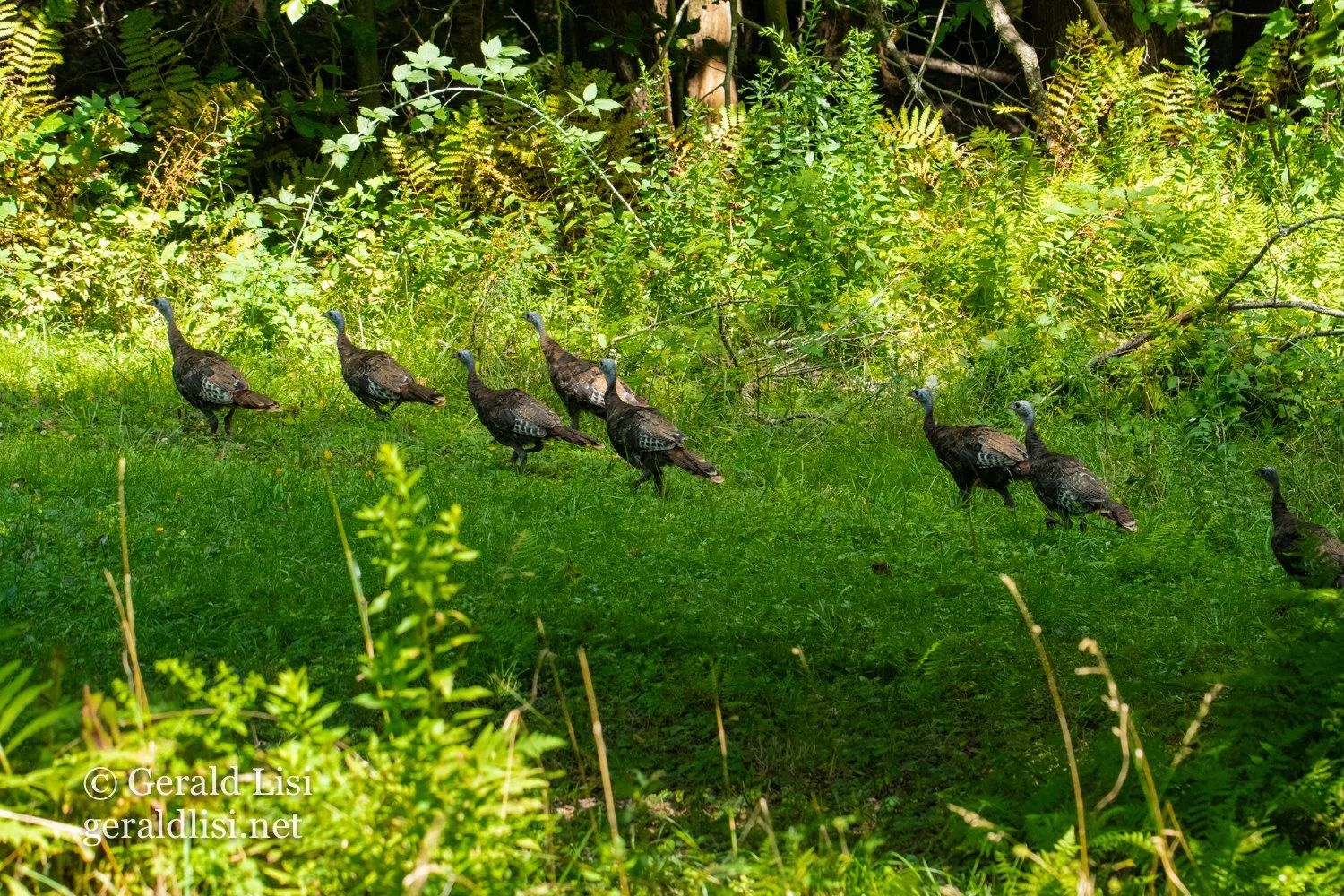
These young Wild Turkeys were just poults when I first saw them. Here I barely managed to catch them fleeing into the forest yet again. Their mom taught them well.

Here's half of the breeding pair of Common Loons that claim a beloved local pond as their nesting territory. A friend of mine took me for a paddle in search of them and their chicks one July morning, and the loons obliged us! I remembered well how beautiful these icons of wild waters are, but was also struck by how big they are.

The loon chicks mostly stuck together, and a parent was always nearby. At this point they were still entierly dependant on thei parents' fishing skills, but learning to catch their own must have come very soon.

Bluejay in White Ash. A childhood favorite of mine, as for many other I'm sure, before I knew about warblers, vireos, wrens, kinglets and so many other kinds of birds. I still love Bluejays of course, and all of the other corvids.

Blackburnian Warbler in Paper Birch.
No close ups of this bird for me. Typical of many Wood Warblers, they sing their songs from high in the trees where even a long lens, spotting scope or a pair of binoculars often won't provide a good look. It's when they're silently foraging on lower branches that those of us who obsess about seeing these birds are most often finally rewarded.

This Northern Parula was one of my lifers (first sighting of a species) of the summer. In typical warbler fashion I heard their songs many times and repeatedly craned my neck for extended periods of time before I actually got a decent view of this guy singing.

Black and White Warblers nave a foraging style like that of the nuthatches, gleaning insects and spiders from bark rather than leaves as they wind their way down trunks and branches.

I was surprised to hear this American Redstart singing in late August, weeks after the songs of most other birds had stopped. Here he listens to another male who is singing nearby. With this year's young now raised this territorial behavior most likely is about control of foraging grounds.
This Black-throated Green Warbler female gifted me many nice glimpses as she hunted in the trees of my backyard. Unlike many warbler species whose females lack the brights colors of males Black-throated Green females have the same basic plumage patterns as males, minus the namesake black throat.

Black-throated Blue Warblers were perhaps the most exciting lifer for me this summer. This male in Plainfield was the second individual I had the pleasure of seeing and photographing.

Moving from one family of small, colorful birds to another, I am happy to leave you with this female Ruby-throated Hummingbird. After repeated unsuccessful stakeouts of this Bee Balm patch my persistence was finally rewarded with the shoot that yielded this shot of her hovering between sips of nectar.
Sixteen pictures of fifteen species of birds is a very small sample of my birdy summer, but I think this is about as long as a post should be. If you’re still with me I thank you for your time and attention. I do hope it was rewarded. May you cross paths with many birds, and allow their feathers, voices and behaviors to draw your attention away from less wonderful things.

A Few Hours in Yellowstone, June 5th
One should spend a few days in Yellowstone National Park, not a few hours. I didn’t have a few days to spare, but I couldn’t just drive right past it. A friend who put me up in Livingston the previous night said that at the least I should see Mammoth Hot Springs, which was a bit over an hour away. I gladly took the advice, and ultimately decided I would drive through the park and out the west entrance rather than backtrack up to I-90. The next morning I found that there was road work on the way to the park, which more than doubled my travel time to the park entrance. By the time I got to Mammoth Hot Springs it was nearly noon, and the harsh midday sun was far from ideal for photography. But, the springs and the landscape around them were incredible, and I did the best I could. There’s a whole lot of Yellowstone between Mammoth Hot Springs and the west entrance of the park, but I’m not trying to cover all of that here. What I am sharing with you now is mostly selections from the springs and some wildlife highlights from my subsequent drive through Yellowstone. Enjoy!

The mountains of northwestern Yellowstone seen from Livingston, Montana the previous evening. The entire drive through Montana was incredible, and I was constantly struggling not to stop on the side of the freeway to take pictures. I was grateful that my friend in Livingston walked me to this incredible view, which will have to stand in for all of the jaw-dropping scenery drove through that day.

On the drive from Livingston to Yellowstone I spotted this beautiful Pronghorn. She was a couple hundred feet away, and the full sun was already high in the sky, but I wasn’t going to waste my first opportunity to photograph this awesome mammal.

The main parking areas at Mammoth Hot Springs were full when I got there, of course. But, I enjoyed some fantastic views on the walk from the next parking area up the road.
This stream fed by the springs ran under the trail.

Steam rises from an unseen pool at the edge of the hot springs.

Shallow pools on the a massive hill built by calcium carbonate deposition from the springs. The white is limestone, while colors in the water are from thermophilic cyanobacteria.

Thermophile mats on limestone terraces.

Juniper by one of the vents.
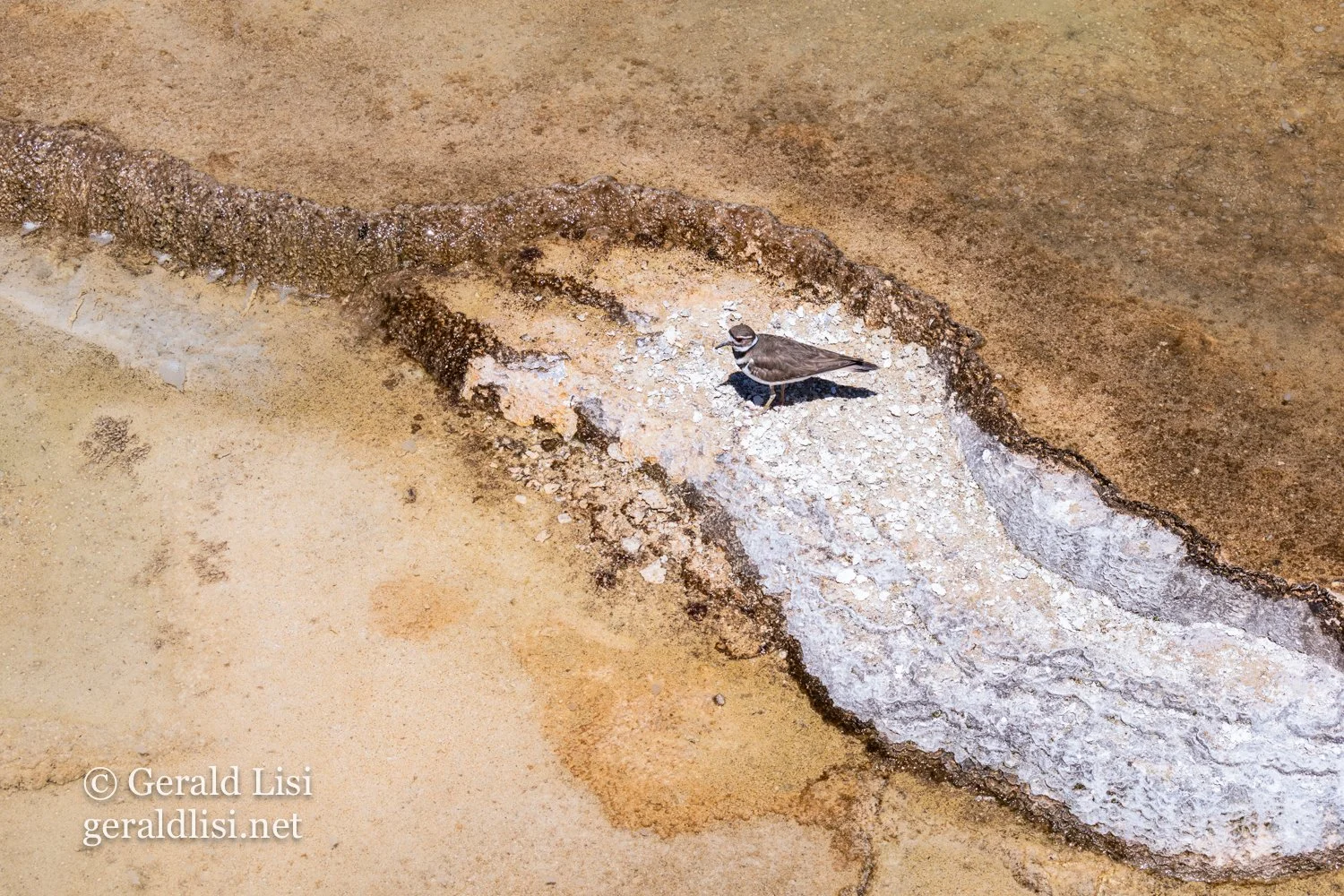
A Killdeer forages in a dry pocket created by a natural mote.

I wasn’t expecting to see Sandhill Cranes. An awesome surprise!

An American Bison licks his nose for the camera. Silliness aside, seeing wild Bison is profoundly moving. May they return to more of their ancestral lands in the centuries to come.

This old Bighorn Sheep ram has true grit. He lingered by the road after the rest of the herd finished their very slow crossing. Cars and RV’s didn’t concern them, and of course the drivers welcomed the chance to see these mountain icons up close. Not the setting I would choose given the option, but still a great pleasure to photograph them.
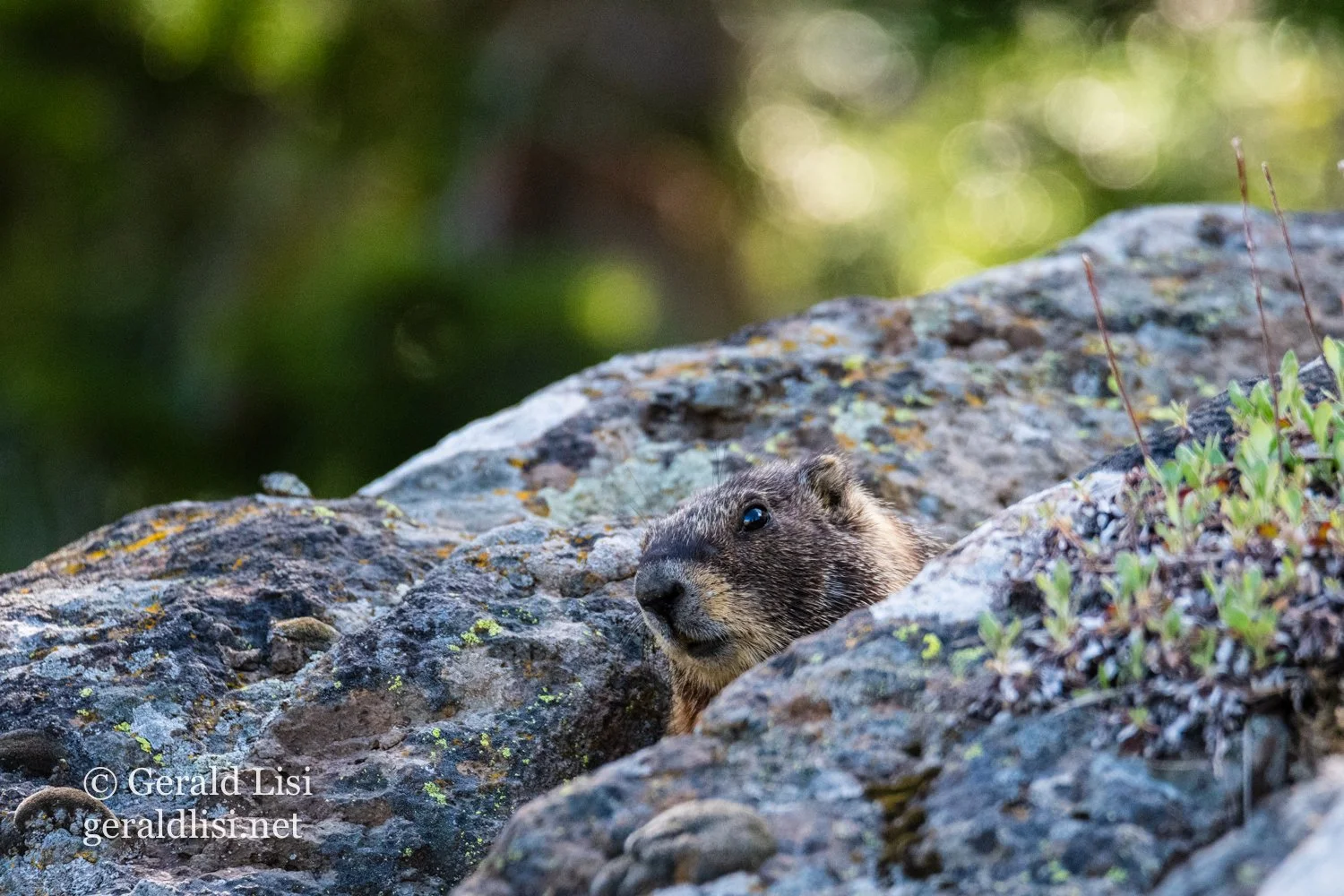
Having driven ahead and found a pull off to better enjoy the Bighorns I was also rewarded with a cautious visit from this Hoary Marmot.

By now it was late afternoon and I had some much better light for photographing the western edge of the park. I believe these mountains are known as Wapiti Ridge
And with that I close this edition. Thank you for the gift of your attention. I hope you feel that it was rewarded. If you are a subscriber please consider forwarding this email to someone who might enjoy it. If you are reading this on my website please consider subscribing at https://www.geraldlisi.net. If you would like to support my work please visit my store at https://www.geraldlisi.net/store-1. If you would like prints of any of the images in this post please email me at woodsling@geraldlisi.net. Or, if you are so inclined you can make a patronage gift on Venmo where I am @Gerald-Lisi or PayPal where I am Gerald Lisi Photography. Thanks again to anyone who is reading this. Please be kind to yourselves, to each other, and to the land you live on.