
Blog

My Birdy Summer
I’m not much of a birder, which is to say that I’m not that good at it. I rarely keep lists while birding, and I don’t use eBird. Also, my birding by ear is very weak, and any good birder knows that recognizing songs and calls is the gateway to most of the avian universe. I could certainly go on about my shortcomings as a birder, but that would be tiresome, so let’s get on with how mediocre I am as a bird photographer.
My bird photography is crap on average, but you don’t see most of it. Judging by the images I choose to share here and on social media it’s pretty good. That’s an average again, taken from a quality range between “good enough” and “actually really good,” which is not to be mistaken for “great.”
In spite of all this self bashing of my credentials as a birder and bird photographer this post will be comprised entirely of bird photograph, (aside from this drivel and the captions of course). Because here’s the thing: I love birds. I meany I REALLY LOVE BIRDS. Ever since I decided to finally dig into my first Sibley Field Guide, perhaps fifteen years ago, I have been tumbling head over heels down a feather-lined tunnel system whose chambers echo with the sounds of countless syrinxes.
Most of this wonderful adventure has occurred so far in western Washington, which is an excellent setting for such a thing. But a change of environments can be quite rewarding for a birder, and when that change involves three thousand miles of distance the differences can be significant. So it was that my return to Vermont this June involved a great deal of excitement about the bird life here. Now, after a summer shared with dozens of bird species, and many hours spent trying to photograph them, I present you with selections from the good-enough, pretty-good, and actually-really-good results.

Ovenbirds create a major component of the soundscape in the Northern Forest in June and July. The swelling staccato of their songs has enchanted me since I first gave it a proper listen several years back. These warblers are outliers in their family. Natural selection in the forest floor habitats they share with thrushes has given them a distinctly thrush-y appearance. An exquisite example of convergent evolution. This Ovenbird has procured a juicy caterpillar, most likely for one of their chicks. The ability of Lepidopteran larvae to turn leaves into protein and fat enables hundreds, if not thousands, of bird species to feed their rapidly-growing young.

The voices of Red-eyed Vireos are the most heard by this bird nerd during the summer in the northern Green Mountains. Their deceptively simple songs come from all directions, at short intervals, all day long. Getting a good look at one on the other hand is no simple matter. Their entire bodies can be hidden behind the leaves of their deciduous canopy habitat. Of course when I did get a clear view of this one it was in the deep shade, where my equipment performs poorly, but Red-eyed Vireos were far to big a part of my birdy summer to be left out of this collection.

Common Yellowthroats are one of the easier warblers to spot since they live their lives at or below eye level in wet meadow and marsh edges. Olive and yellow feathers are common in this large, delightful family of song birds, but an adult male Common Yellowthroat’s black mask with white border above and yellow throat and breast below give a positive ID of this species.

Tufted Titmouse in Eastern Hemlock.
These larger cousins of chickadees have similar habits and charms, and they have crests! They are not so common as Black-capped Chickadees though, and I still get excited every time I see one.

Broad-winged Hawks are very vocal, with a distinct whistling call. Once I learned that call I quickly realized that these forest hawks are all over central Vermont. I was lucky enough to have this juvenile frequent the woods by my home.
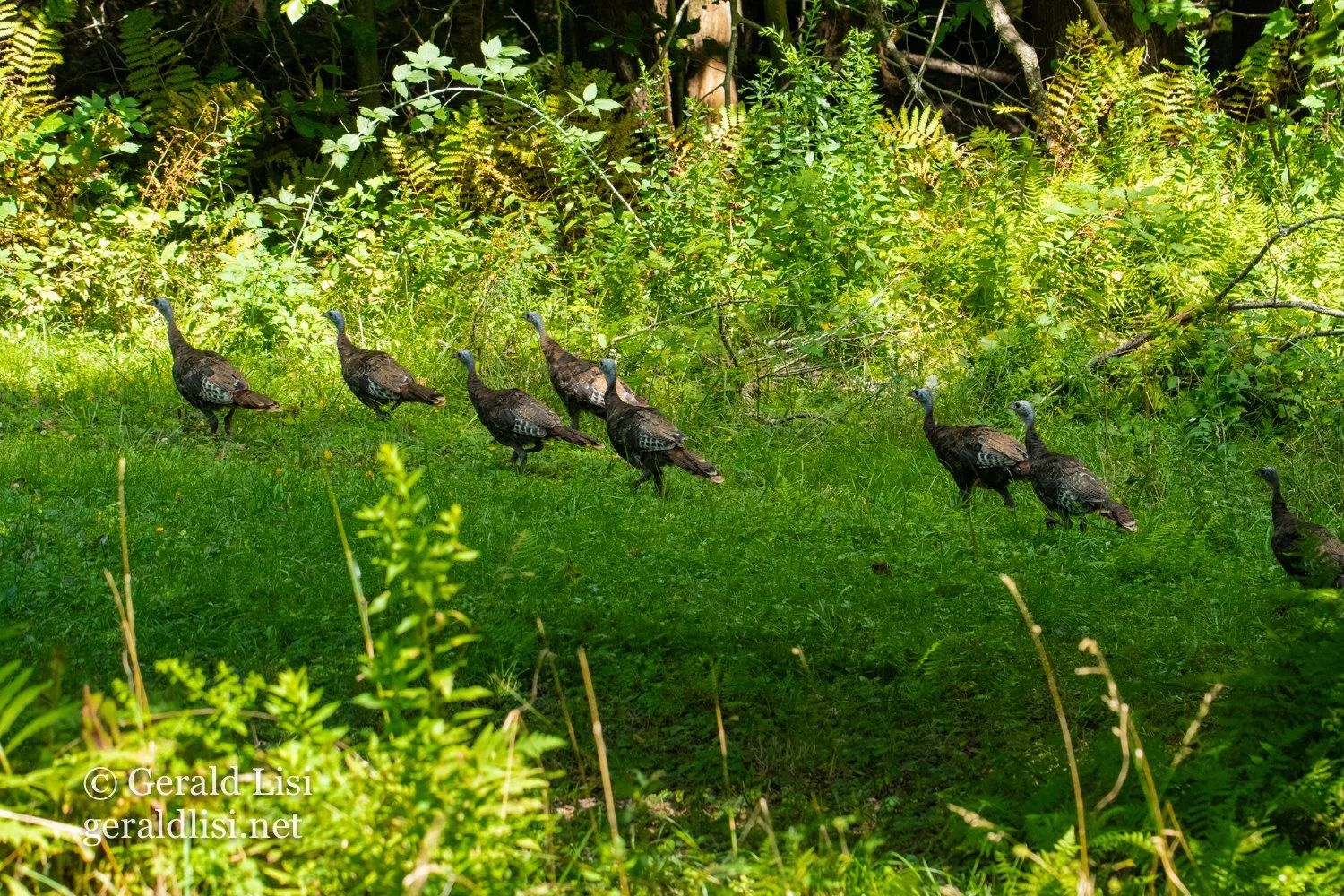
These young Wild Turkeys were just poults when I first saw them. Here I barely managed to catch them fleeing into the forest yet again. Their mom taught them well.

Here's half of the breeding pair of Common Loons that claim a beloved local pond as their nesting territory. A friend of mine took me for a paddle in search of them and their chicks one July morning, and the loons obliged us! I remembered well how beautiful these icons of wild waters are, but was also struck by how big they are.

The loon chicks mostly stuck together, and a parent was always nearby. At this point they were still entierly dependant on thei parents' fishing skills, but learning to catch their own must have come very soon.

Bluejay in White Ash. A childhood favorite of mine, as for many other I'm sure, before I knew about warblers, vireos, wrens, kinglets and so many other kinds of birds. I still love Bluejays of course, and all of the other corvids.

Blackburnian Warbler in Paper Birch.
No close ups of this bird for me. Typical of many Wood Warblers, they sing their songs from high in the trees where even a long lens, spotting scope or a pair of binoculars often won't provide a good look. It's when they're silently foraging on lower branches that those of us who obsess about seeing these birds are most often finally rewarded.

This Northern Parula was one of my lifers (first sighting of a species) of the summer. In typical warbler fashion I heard their songs many times and repeatedly craned my neck for extended periods of time before I actually got a decent view of this guy singing.

Black and White Warblers nave a foraging style like that of the nuthatches, gleaning insects and spiders from bark rather than leaves as they wind their way down trunks and branches.

I was surprised to hear this American Redstart singing in late August, weeks after the songs of most other birds had stopped. Here he listens to another male who is singing nearby. With this year's young now raised this territorial behavior most likely is about control of foraging grounds.
This Black-throated Green Warbler female gifted me many nice glimpses as she hunted in the trees of my backyard. Unlike many warbler species whose females lack the brights colors of males Black-throated Green females have the same basic plumage patterns as males, minus the namesake black throat.

Black-throated Blue Warblers were perhaps the most exciting lifer for me this summer. This male in Plainfield was the second individual I had the pleasure of seeing and photographing.

Moving from one family of small, colorful birds to another, I am happy to leave you with this female Ruby-throated Hummingbird. After repeated unsuccessful stakeouts of this Bee Balm patch my persistence was finally rewarded with the shoot that yielded this shot of her hovering between sips of nectar.
Sixteen pictures of fifteen species of birds is a very small sample of my birdy summer, but I think this is about as long as a post should be. If you’re still with me I thank you for your time and attention. I do hope it was rewarded. May you cross paths with many birds, and allow their feathers, voices and behaviors to draw your attention away from less wonderful things.

Go With the Crow
I've been photographing birds in and around Seattle for a few years, and for over a year now they have been my primary subject. So when I decided to start writing a photo blog I knew the first post would be about birds. But which family, genus or species to begin with? While the ducks, woodpeckers and hummingbirds I considered will certainly have their day, or days, here, I decide that for this inaugural post I would go with the crow.
American Crow, Corvus brachyrhnchos
Crows are a species of bird that virtually anyone can identify. They were certainly one of the first birds that I learned as I child in Vermont. Here in Seattle, as in other cities, crows are far more abundant than in any rural or wild area. I have enjoyed regular opportunities to observe these famously intelligent, and notoriously raucous, corvids.
There's a broad spectrum of human feelings towards crows, and I've always been well on the side of those who love them. But in spite of how beautiful and interesting I find them, as a wildlife photographer I have been somewhat guilty of taking crows for granted. It's not that I haven't photographed them at all. In fact two of my portfolio images are crow photographs. But when I go out looking for birds to photograph I'm not looking for crows, because I don't have to look for them to find them.
Many of the birds I photograph offer only fleeting, unpredictable glimpses of their activities. But crows are living out their daily lives in plain sight. This provides regular opportunities to document various aspects of their behavior. Not only that, but I don't even have to leave my neighborhood to do so. After having this realization I got excited about compensating for my previous oversight. After musing on this for a little while I recently decided to get started on my neighborhood crow project.
As the month of October progressed leaves weren't the only thing falling from the trees in my neighborhood. Acorns and walnuts started hitting the ground too, and the local wildlife was immediately all over the bonanza. One day I was home watching crows fly high over the street. They had nuts in their bills which they dropped onto the pavement to crack their shells. It wasn't raining and the light was ok, so decided to try and photograph this behavior. This turned out to be a tricky thing to capture! I haven't managed to get that shot yet, but I did photographing some crows enjoying the fruits of their efforts.
This crow is collecting a walnut that it cracked by dropping it in flight onto the pavement forty feet below.
When I watched this crow fly up from the street with a walnut I hoped to capture it dropping the nut in flight. Instead it alighted by the top of this utility pole and placed the nut into a cavity. At first I though the crow was caching the walnut, but she kept her bill in the cavity and made jabbing motions into it. I realized the nut had already been cracked. She was using the cavity to stabilize the nut while she pecked bites of meat from within the opened shell.
Oops! This crow isn't dropping it's walnut in a clever attempt to break it on the pavement. He flew into this sycamore with the nut to keep it away from other crows, but he almost immediately dropped it. A good deal of work has gone in to getting this nut ready for cracking. The thick, tough outer part of the walnut fruit has to be removed in order to expose the shell encasing the nut within. This guy swooped down with the quickness after he his dropped prize, and was able to retrieve it before any of the other crows around made it their own.
Nut meat isn't the only kind that crows eat. While they can't take much prey, aside from small invertebrates and helpless song bird nestlings, they will gladly eat any animal flesh that's made available in other ways. One recent evening I stepped out to enjoy the last hour of daylight in my neighborhood. Knowing this is a time of high activity for birds I brought my camera with me in case I saw something interesting. In a park only one block from my apartment I came across a crow eating a piece of fresh, red meat in a small cherry tree. There was no carcass in sight, so I had no idea what the crow was eating. But after taking a few shots of the crow feeding I moved on and discovered the source of its meal.
A neighborhood crow uses its bill and feet to tear bites from a piece of unidentified meat.
The meat source revealed: apparently this eastern gray squirrel was ran over by car. A group of crows gathered around and took turns grabbing their share of the valuable protein.
One crow was ineffectively tugging at the dead squirrel's furry hide.
"Step aside, youngster. I'll show you how it's done. Our bills and claws can't cut through that hide, but luckily the car opened the carcass for us."
There was a surprising lack of aggression between the crows at the road kill. I suspect this is at least partially due to these birds being well fed. The city provides a cornucopia for these inquisitive omnivores. But crows aren't always so willing to share, and at times are intolerant of each other. I have observed crows lashing out at each other, but generally this doesn't go beyond a short chase. However I did recently observe a full on fight between two crows, with one being the aggressor and the other the victim.
When this crow alighted here I saw a nice photo opportunity with the fall foliage brightening the scene. The crow was having trouble steadying itself though, and after struggling briefly it swooped down to the ground directly below.
As I followed the bird with my lens I realized it had landed on another crow.
Two other crows stood silently to the side, one with a morsel in its bill, and watched as the bully effectively pinned his victim to the ground.
But the victim was no weakling, and was able to push its attacker off.
The bully flew up a bit, perhaps relenting, perhaps preparing for another attack.
Either way the victim took the opportunity to quickly fly away. Meanwhile that one bystander still had that bite of whatever it was secured in its bill.
Because city crows are highly conspicuous and tolerant of human presence they provide urban naturalists with regular opportunities to observe the daily dramas that make up their struggle to survive. They also afford wildlife photographers like myself ample opportunities to practice our craft right outside our door. I will continue to seek out the more elusive creatures of Seattle's wooded parks, and venture into wilder places when I am able. But if you follow my work this won't be the last you see of my neighborhood crows.